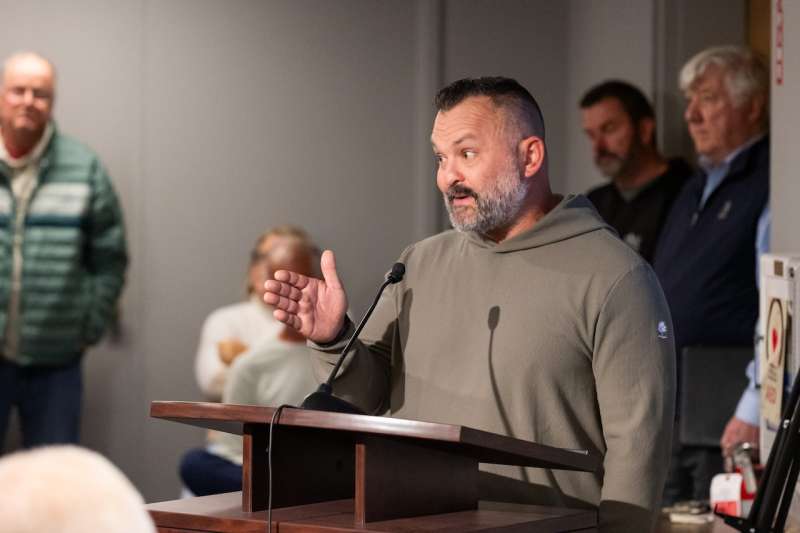
Hampton Beach business owners urged the town Oct. 19 to continue providing commercial trash pickup at no additional cost, arguing Hampton is unlike other communities and the longstanding policy helps keep the beach clean and welcoming.
Several residential property owners — frustrated by rising property taxes they say are pushing longtime residents out of their homes — countered it’s time for businesses to shoulder the expense as a basic “cost of doing business.”
Both groups packed a public hearing on the Select Board’s proposal to begin charging commercial entities for weekly curbside trash collection — and in some cases five and seven days a week. Hampton estimates it spends nearly $1 million a year on trash and recycling pickup, with commercial businesses accounting for roughly 25% of that cost.
The town is considering a fee‑per‑cart model, with the highest rate set at $1.73 per cart. That figure includes disposal costs, the capital cost of one truck, labor, and 25% of maintenance and fuel expenses. The numbers were recently revised after officials discovered an error in the original estimate, which had placed the cost at $3.07 per cart.
Businesses push to keep free commercial trash pickup
Bob Preston, owner of Preston Real Estate, said Hampton Beach businesses already contribute heavily to the town — financially and civically — supporting schools, charities, community programs, and public safety initiatives like the Hampton Police Mounted Patrol Unit.
He said Hampton is unlike other communities because it’s a resort town and any change that risks the beach’s cleanliness could damage Hampton’s reputation.
Al Fleury, who owns Wally’s Pub, The Goat and Bernie’s Beach Bar at the beach, argued now is not the time for the town to “squeeze” beach businesses, noting the 2026 summer season at the beach was not the best.
He said he pays a million dollars in taxes to Hampton, saying the town is the only municipality where his company, which also owns businesses in Portsmouth, Manchester and Newburyport, has seen a decline in growth.
“I chose to start my business, continually invest in my businesses, add businesses, add jobs, and I did that because this is a special place,” he said. “If you take too much of the heart out of this place and start going in on the people who make it special, just be ready. It’s not just a gimme that everything continues the way it was.”
Kevin Brown, whose family has operated the Sea Ketch for 55 years, said businesses have long followed town rules and paid taxes based on the services provided, including trash pickup.
“So the question would be if the service is removed, do we all apply for abatements from the town for services that are now not being served?” Brown said. “That would not be good for anyone.”
Nancy Stiles, a former state senator and key supporter of the $14.5 million Hampton Beach redevelopment completed in 2012 that built the new Seashell Stage, warned charging businesses could create major administrative burdens. She cited tracking trash barrels and billing delinquencies to monitoring compliance — adding it might even require additional staff.
She argued the cost of commercial pickup is relatively small in the context of the town’s budget, but that even a few thousand dollars in new fees could be a make‑or‑break expense for small seasonal businesses that have only 13 weeks to earn their income.
“Salisbury Beach used to be a thriving clean beach with businesses and activities going on all the time,” she said. “There is nothing now. Nothing and that could happen to Hampton if you lost some of your businesses.”
Residents say businesses should pay for trash pickup
Resident Joe Bamforth said claims the beach will become dirty if businesses pay a fee for trash pickup are “a fallacy.”
“The town will continue to pick up all the trash as it does today, including all the commercial, but businesses will pay a fee for that trash pickup,” Bamforth said.
He likened the small per‑cart fee — now estimated at under $2 per pickup — to less than a cup of coffee per day.
“If I was a business owner, I would not be complaining about that because I would say, ‘If you want to go out and try and find a third party to go pick that trash up at that price, good luck,’” he said.
He said taxpayers have subsidized commercial trash for too long.
“It doesn’t happen anywhere else, and it shouldn’t happen here,” he added.
Ed Brackett, of Fellows Avenue, argued the current system is unsustainable, with DPW understaffed and trucks breaking down.
He also noted that residents have been hit hard by property taxes due to the recent revaluation and need relief.
“Hampton residents got beat to death with the property tax two years ago,” he said. “We had people sell their houses and leave because of the property tax. We listened to people crying because they couldn’t afford their property tax. One woman had to put her house up for sale because she couldn’t afford it. Another, at 82 years old, had to go back to work to pay the property tax. Another couple who were retired … they had to go to their children and borrow money to pay for their property tax.”
Caroline Gagne said she is a condo owner who doesn’t receive trash pickup. The town’s current condo policy is to pick up trash from complexes with five units or less.
“My trash is handled and paid for privately,” she said. “I’m not here asking for the town to pick it up. Just asking for fairness. My property taxes still pay for trash pickup for private businesses and the residents.”
She said businesses, including some in Hampton, and in other communities pay for their own trash.
“Many Hampton businesses already do,” she said. “The rest can, too.”
Business owners urge town to tap tourist dollars instead
Tom McGuirk, owner of McGuirk’s Restaurant, suggested the board look at other ways to reduce the town’s trash and recycling pickup costs.
He noted a town trash committee produced strong recommendations in 2019 to reduce both the amount and weight of trash generated, but those ideas were never implemented because COVID hit soon after.
McGuirk urged the town to explore other revenue streams borne by tourists — such as the “pillow tax” which was voted down by the New Hampshire Legislature. The tax would have given communities the local option to charge a maximum of $2 per night, per room on hotel and rental stays.
Shane Pine, owner of the Community Oven, noted Hampton businesses generate $30 million to $50 million in rooms and meals taxes, and Hampton’s share last year was $1.6 million. He suggested the town push the state to get “more from the state and to see small businesses as assets and not a burden.”
Hampton has long argued unsuccessfully the state’s distribution formula for the meals and rooms tax is unfair because it allocates funds based on year-round population rather than the massive seasonal tourist influx.
Former Selectman Rusty Bridle said Hampton has picked up commercial trash for as long as he can remember because “it’s the right thing to do.” He argued any change to the long‑standing policy should go before voters. “If it isn’t the right thing to do, then let the voters have that choice and bring it up at Town Meeting,” he said.
In 2014, voters overwhelmingly rejected a petitioned warrant article to end commercial trash pickup, defeating the proposal 2,517 to 463.
What’s next
Select Board chair Carleigh Beriont said the board plans to take the public comments made at the meeting under advisement and discuss next steps at its next meeting.
This article originally appeared on Portsmouth Herald.
Reporting by Patrick Cronin, Portsmouth Herald / Portsmouth Herald