Turning onto Locke Road from High Street in Hampton, you pass by three older Hampton houses, each with a unique story — a charming Colonial on property that was the beginning of the Redman homesteads, a house that was part of a successful shoe factory, and a sprawling Colonial Revival that started as a modest four-room house.
John Redman arrived in Hampton in 1642 from Dover, New Hampshire. His house and blacksmith shop were located on “Sleepy Town Road,” now known as Locke Road. He was a scrappy guy who got into fights with various citizens— stories of his many altercations can be found in the court records.
Historian Edmund Toppan wrote, “Redman was one of those characters who are a nuisance to every community in which they happened to be placed. An informer, an active man in getting dirty, trivial complaints, prosecuted, he became in his old age not only odious to his fellow townsmen but also much embarrassed by his circumstances…” But when Isabel Towle was jailed on suspicion of witchcraft, John helped to pay her 100-pound bail to get her released, which was quite a sum of money at the time. No matter his disposition, he held many town offices over the years, including that of selectman.
John lived to be 85 years old and had two wives, Margaret and Sabina. He had a son, named John, whom we will call John (2), who married Martha Cass. John (2) served as selectman four times and once as state representative. They had a son, John (3), who had two sons – Joseph and John (4). So, you can see how this can start to get confusing! But there is more to come…
The property that John (1) owned was extensive – the farmland adjoining his home extended down today’s High Street past Redman Ave. Being a blacksmith was a full-time job, so he would need help keeping his farm running smoothly, and luckily, he had enough land to keep multiple generations of Redmans nearby.
In 1758, Joseph (son of John 3) and his family were ground zero in the smallpox epidemic that struck Hampton. Joseph’s servant from Ireland, who brought the epidemic to Hampton, died from the disease, as did Joseph and his wife, Hannah. Dr. Emery, who attended to them, spread smallpox to his own family. Two homes were impounded as “pest houses” to treat the sick. No one was allowed in or out, and provisions for their care were provided by the town. At the end of the outbreak, the selectmen tried to sue Dr. Emery to get back some of the costs in the care of the sick because it involved his family. The town lost.
Homestead 97 Locke Road
The house that John (1) lived in was replaced by the house that is standing today, built on the family’s original land grant. The barn is from the late 1800s and still has the remnants of the hog pen underneath and an outhouse in one corner. This house has beautiful woodwork in the living room, which is thought to be the work of a ship’s master carpenter.
Johns (6, 8, and 9) lived on the homestead as did his grandson, Daniel Redman, years later. (Daniel – finally some imagination!).
101 Locke Road
Joseph, the son of John (6), built a house next to the homestead in 1817.
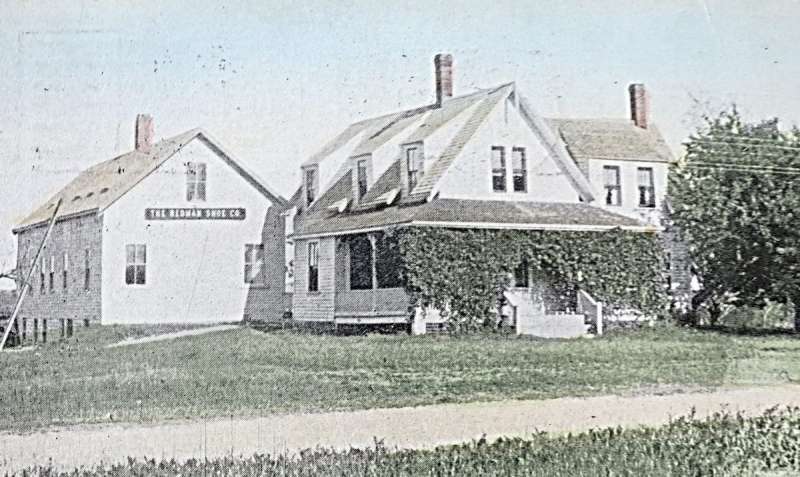
Starting in the fall of 1910 and operating at that location until 1935, Edward E. and William L. Redman built a shoe factory behind their house and started manufacturing ladies’ slippers (white wedding shoes). The 50’ x 20’ factory was two stories tall and employed 50 men and women with a sizeable payroll of $1000/week. Carl Bragg told the story that his mother made donuts early each morning and sent him down on his bike to sell them to the employees for their work break.
107 Locke Road
In 1819, Jonathan Redman married Sarah Lane and settled a few roads north of his father, John (8). The house was finished in 1820. It started as a small two-story house facing south to catch the sun, situated as some of the older homes on Locke Road still are today.
One hundred years later, the house had a new addition doubling the space, and with that, the house was oriented with the facade facing Locke Road. It was quite grand, featuring a central hall that ran from front to back with two beautiful doorways, one on each end, and rooms branching off of the main hall.
Thirty years later, another addition, now a kitchen, was where (through family lore), hired help lived, and that space in turn tied into a shed. This room was never built to be a lived-in structure, as the beams were still covered in tree bark, and it was not insulated. But it was used for many years seasonally as a living space. The building was much older than the house. It is thought to have been moved to the site following the Yankee saying, “Use it up, wear it out, make it do, or do without.”
The “J “s dominated the south end of what was then known as Four Corners – with the extension of High Street in 1857, it is now known as Five Corners today. From 1642 to 1832, there was at least one John Redman in every generation – no middle name used.
Think of the headache that would give today’s homeland security!
This article originally appeared on Portsmouth Herald. Reporting by Betty Moore / Portsmouth Herald