Exeter Hospital patients say they are scrambling for answers about care after recent service cuts and are questioning the benefits of Exeter Health Resources merger with Beth Israel Lahey Health.
Executive Councilor Janet Stevens said the Rockingham County Nursing Home was “panicked” about losing Exeter Hospital’s neurologist amid several cuts to care in September 2024. She said staff feared they would have to transport hundreds of patients to Boston.
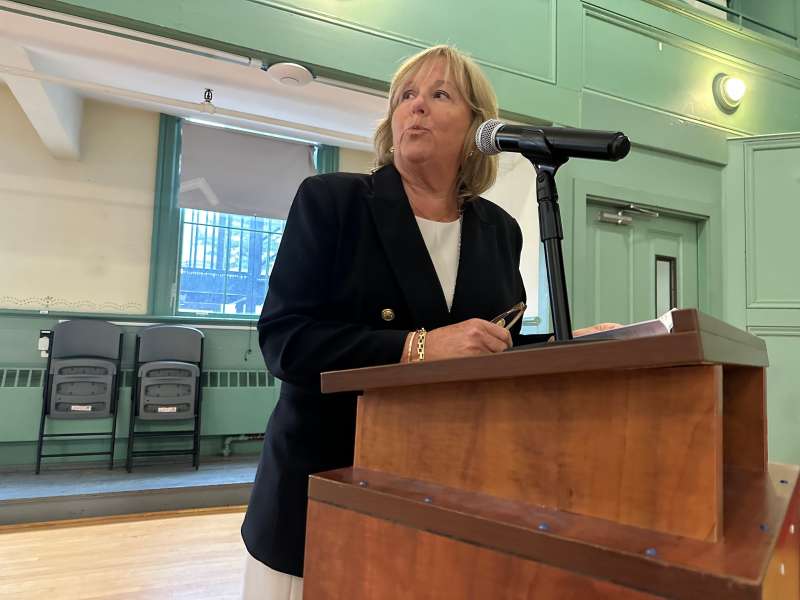
“Not an option,” Stevens said during an April 29 public hearing at Exeter’s historic town hall. She addressed the state’s Health Care Consumer Protection Advisory Commission, led by Attorney General John Formella, which was gathering community feedback on care since the 2023 merger that ended Exeter Hospital’s status as a local hospital.
Residents who attended the hearing described cuts in 2024 to pediatric dental care, neurology, podiatry and the advanced life support paramedic intercept service. The latter was ultimately taken over by the Plaistow Fire Department with the help of a $2 million grant from Exeter Health Resources.
Commission members said they shared many of the concerns raised. Commission member and physician Mitchell Cullen said he was troubled by a report showing a decline in community benefits in 2024 compared to pre‑merger levels. As part of the merger, Beth Israel Lahey Health had pledged to maintain and expand access to clinical services at Exeter Hospital, including a planned $375 million capital investment over 10 years.
“If they’ve got all these millions of dollars that are supposed to be put in, what is the holdup?” Cullen said. “Are you going to be able to implement things for the things that we see the greatest need, as opposed to what was done over the past two years?”
The merger brought Exeter Health Resources — Exeter Hospital, Core Physicians and the Rockingham Visiting Nurse Association & Hospice — into Beth Israel Lahey Health’s network of 13 hospitals in Massachusetts, including Beth Israel Deaconess Medical Center in Boston and Anna Jaques Hospital in Newburyport.
Supporters framed the deal as a way to ensure Exeter Hospital’s long-term sustainability and to control healthcare costs by leveraging the purchasing power of a larger system.
Exeter Health Resources had a difficult financial year in 2022, according to information reviewed by the state Department of Justice during the 2023 approval process.
At a 2023 public hearing, economist and DOJ consultant Tyler Brannen said Beth Israel Lahey Health had the resources to support Exeter Hospital, though his firm, BerryDunn, raised concerns about a potential reduction in services.
Three years later, on April 29, Formella said mergers remain a common strategy for local hospitals struggling financially and often bring changes in what services are offered.
“We’re seeing more and more hospitals consolidate under an umbrella,” Formella said. “That has a lot of consequences for the quality of access and cost.”
Community members air concerns about Exeter Hospital after merger
Residents who spoke said they were struggling to get information about any improvements promised under the merger, even as they raised concerns about cuts to key services. Exeter resident Deb Fournier questioned whether Beth Israel Lahey Health is meeting its timeline for capital improvements, including the addition of 10 new mental health beds.
She also asked whether the hospital could provide the clinical services growth plan required under the merger agreement — a plan due 180 days after the deal closed and expected to outline measurable goals for expanding primary care, behavioral health, substance use treatment, maternal care, and services for low‑income and older residents.
“What are the metrics and the goals in that plan, and how is the hospital doing with respect to growing all those service lines,” Fournier said, “Because they are absolutely necessary.”
Fournier also said she was concerned the merger agreement allows labor and delivery services to be discontinued within 10 years if “volume drops below a level consistent with quality standards.” She said the community deserves to know what that threshold is.
“When does the community get told this is in jeopardy? (That) we’re seeing a trend that’s going in a direction that will make it really hard to keep this service here,” Fournier said.
Stevens, who represents the Seacoast on the Executive Council, said the numbers in the 2024 community benefits report referenced by Cullen were alarming. Medicaid reimbursements dropped by $2.6 million, she said, while net community benefit costs fell from 11.3% to 9.5%. Charity care declined from 1.9% of gross patient service revenue to 0.11%, she said.
“There was decline following the merger,” Stevens said. “They present a clear downward trend in support for the very populations that depend on these safety networks.”
Stevens said she is also concerned the merger’s capital commitment is not on schedule.
“We can do a lot better,” Stevens said. “This raises legitimate concerns about whether these commitments will be fulfilled on schedule and whether the pace of investment reflects the urgency promised to the public.”
Exeter Hospital CEO: ‘We’ve made mistakes. We’re listening.’
Formella told attendees that the state continues to monitor the merger’s requirements and, with his staff present, said Beth Israel Lahey Health is believed to be in compliance. Several speakers also noted they have seen increased support from Exeter Hospital since the merger, including organizations such as St. Vincent de Paul and the suicide‑prevention nonprofit Connor’s Climb.
St. Vincent de Paul Executive Director John Moore said the hospital has committed to supporting the organization for the next three years.
“The support grew significantly since the acquisition,” Moore said. “It’s been very supportive and very helpful.”
Exeter Hospital President Deb Cresta delivered a statement after public comment, assuring residents the hospital is in a stronger position under the merger. She said the system is investing $35 million to unify electronic medical records across its network.
Cresta also said the merger has expanded access to cancer care for Exeter Hospital patients. She noted the system will soon include the region’s only standalone cancer hospital, a collaboration between Beth Israel Deaconess Medical Center and the Dana‑Farber Cancer Institute.
“I firmly believe that our community is better served because Exeter is part of a stronger system,” Cresta said.
She also said communication could have been much better, though. She spoke frankly about not doing as well” shortly after the merger went into effect.
“Maybe abysmal failure would be a better word,” Cresta said. “We learned a lot from that.”
Cresta said the hospital is still run by a local board and that its leadership is guided by a local advisory committee. She said she appreciated the candid feedback from people at the public hearing.
“We’ve made mistakes,” Cresta said. “We’re listening.”
This article originally appeared in Portsmouth Herald. Reporting by Max Sullivan.