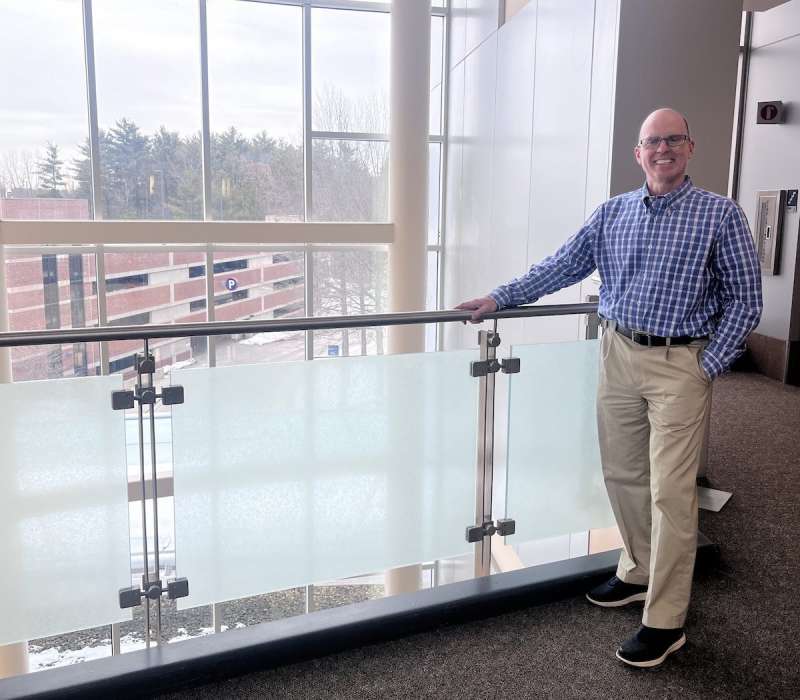
Exeter resident Chad Dixon believes he owes his life to seeking care fast and the expert care he received at Exeter Hospital after suffering what is commonly known as a widowmaker heart attack.
Dixon, 54, is in remarkably good health, according to Dr. Gregory M. Goodkin, medical director for the division of cardiology for Core Physicians at the hospital. His medical emergency was completely unexpected, with no advance signs anything was amiss.
“I cannot say enough about the quality of our cardiac staff here at Exeter Hospital,” Goodkin said. “Still, he was very fortunate that he recognized something was wrong and because of everyone’s quick action, there was an excellent outcome. This was a true definition of emergency.”
Goodkin said Dixon’s experience is not common, nor is it rare. While he praised the excellent care at Exeter Hospital, he said Dixon’s decision to seek medical help quickly was a strong factor in saving his life.
Dixon had no previous signs of heart problems
Dixon, who lives with his wife, Eva, and the couple’s two sons, Ryan, 20, and Adam, 17, took some time before he felt comfortable sharing his story. His heart attack was on March 21, 2025.
“I do not drink, smoke, or do recreational drugs,” Dixon said. “I am not overweight, do not have diabetes, no high blood pressure and no history of heart disease. I exercise. On that day, I woke early, went to the bathroom and then slipped back in bed to relax before starting my day. I started watching the news when I began feeling stiffness in my shoulder and neck. I thought it was a kink, so I jumped in the shower but got out quickly. I told my wife Eva that I just didn’t feel right, then I passed out. My wife said my eyes rolled into the back of my head.”
Dixon said he thinks he woke pretty quickly. When he came to, he said, he saw his wife hovering over him, calling 911.
“I said, ‘We need to go the hospital, this is not right,’” Dixon said. “When I arrived at the emergency room, I was sweating, breathing was becoming difficult and there was pressure in my chest. I was in the right place, because they reacted immediately.”
‘I gasped, then could instantly breathe’
Dixon was taken to the hospital’s cath lab.
“They said, ‘We are going to move fast now,’” Dixon said. “The next thing I remember was hearing the word ‘balloon,’ and I gasped, then could instantly breathe.”
Dixon likened the feeling to pinching a garden hose, cutting off the water. Releasing the pinched area immediately opens the flow, and he said that’s how quickly he recovered.
Goodkin said Dixon suffered injury to his left anterior descending artery, a large blood vessel which provides a high percentage of blood flow to the body. In addition to the balloon placement, two stents were inserted to keep things moving.
“Afterwards, I asked my doctors if there was anything I could have done, but the answer was no,” Dixon said. “They said I had no risk factors, no warning signs. I have met with the hospital’s dietician, and we are taking small steps, but really there is nothing major. I took part in a three-month cardiac rehab care program. I could have died but here I am, completely healthy again.”
Goodkin said he believes somewhere in Dixon’s lineage there is likely a genetic factor he was unaware of. He agrees his patient is fine now, that there was no permanent damage to his heart.
“It can be shocking when you do not know there is a risk factor,” Goodkin said. “His sons are now aware of the risk because of what happened to Chad.”
“I feel great now,” Dixon said. “If you asked me a year ago if I thought I was a candidate for a heart attack, I would have said no. The lesson I learned is that time is the most important factor. If you feel something is not right, listen to your body; go have it checked out. Better to find out it’s nothing, than the alternative, which could cost your life.”
Cardiologist warns no one should ignore symptoms
Goodkin said about 20%-25% of the population could be in the same situation, unaware there is a ticking time bomb in their chest, presenting with no previous symptoms or warning signs.
“So, if you are that healthy, why would you even think – heart attack,” he asked. “Honestly, you would not. I suppose there could be some type of national screening developed for a person of a certain age, but I think that might produce false positives and false negatives, also not helpful.”
People tend to deny, or ignore unusual symptoms. Goodkin advises against it, with the cautionary tale of Dixon, whose outcome would have been much different had he tried to brush aside what he was feeling.
“Be aware this might not be the elephant sitting on your chest that people tend to think of,” Goodkin said. “People chalk their feelings up to indigestion, to exhaustion. They may feel the discomfort in their arms or shoulder was the result of an injury. Waiting even a few hours can be the difference between life and death. Go to the hospital. It’s never wrong to seek advice.”
Exeter Hospital expanding cardiac care space
To address increased patient needs and bring more advanced care to the community, Exeter Hospital, which joined Beth Israel Lahey Health in 2023, is building a second cardiac catheterization lab, renovating its existing catheterization lab, and adding electrophysiology (EP) services.
Sonya Vartabedian, a hospital spokesperson, said the project is intended to address increased patient needs and bring more advanced care to the community.
“The benefits of the expansion will include reduced wait times for procedures, improving patient recovery and outcomes; advanced diagnosis and treatment of heart rhythm disorders, including atrial fibrillation and tachycardia; better prevention of stroke and heart attack enabled by early detection of heart rhythm disorders; and enhanced local access to top cardiologists, raising the standard of care for patients and elevating Exeter’s reputation in the field,” Vartabedian said.
This article originally appeared on Portsmouth Herald. Reporting by Karen Dandurant