“I oppose ANY work requirement for Medicare,” Sununu wrote on X. But the Medicaid policy he says he supports puts 31,000 New Hampshire seniors and disabled residents at risk of losing their coverage.
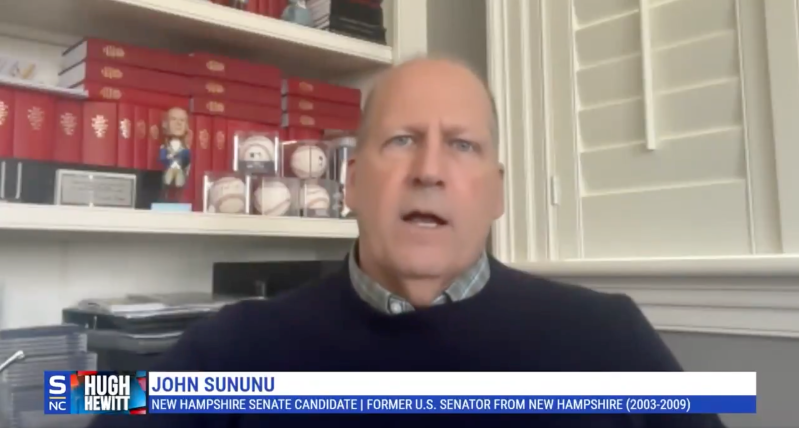
Republican US Senate candidate John E. Sununu told the Hugh Hewitt Show last month that he supports a work requirement for Medicare recipients.
Well after the clip had gone viral, Sununu said he had misspoken—and meant Medicaid.
“I certainly support a work requirement for able bodied Medicare recipients.” Sununu said in the interview. Medicare, the federal health insurance program for Americans 65 and older and certain people with disabilities, does not have a work requirement, and able-bodied recipients qualify by age, not employment status.
On May 1, Sununu posted his own response on X: “It’s just like the left to take a simple slip of the tongue and turn it into an outright lie. I oppose ANY work requirement for Medicare – always have and always will. I was clearly speaking about MEDICAID work requirements. It’s a common sense policy that everyone should support, even Chris Pappas.”
Sununu added in his post, “This is what politicians do when they are on the wrong side of an issue – misconstrue their opponent’s obvious meaning. Even worse, Pappas is using this fabrication to scare seniors. SHAMEFUL.”
The embarrassing episode and walk-back has put Sununu’s record on both programs in the spotlight. It has also raised further questions: Even if Sununu meant Medicaid, his record on both programs has been a long-standing line of attack from Democrats—and it’s a record he has compounded by his remarks on the campaign trail.
In October 2025, Sununu posted his campaign announcement video to X and said he was running for Senate because “somebody has to protect Medicare.”
But the reality is, while he was in office, John Sununu voted to cut Medicare 13 times. And a key Trump bill and GOP win that Sununu supported is still on track to raise Medicare costs for the seniors who can least afford it.
Five months later, at a Cheshire County Republican Committee event on March 4, 2026, Sununu praised the One Big Beautiful Bill Act—the sweeping tax and spending law President Donald Trump signed last year—for its cuts to Medicare.
“We also pared back Medicare and Medicaid spending in the Big Bill that passed,” Sununu said in footage obtained by the Granite Post.
More than 31,000 Granite Staters—most of them low-income seniors—are on both Medicare and Medicaid. Medicare is their health insurance. Medicaid pays the bills Medicare leaves behind, such as the monthly Medicare premium, the copays at the doctor, and the nursing home stays.
Without Medicaid, those costs come out of their own pockets. The One Big Beautiful Bill Act takes away the Medicaid help that makes Medicare affordable.
The Congressional Budget Office estimates that 1.3 million low-income seniors and disabled Americans who are dual-eligible individuals will lose their Medicaid coverage of Medicare coverage under the law—not because they stop qualifying, but because the law delays rules that makes it easier for low-income Medicare beneficiaries to enroll in the Medicare Savings Program and streamlines the enrollment process and makes the paperwork harder to keep up with. A couple earning $21,000 per year who couldn’t access the Medicare Savings Program would face up to $8,340 in additional costs in a worse-case scenario of impact, according to the Center for American Progress.
The law Sununu praised initially triggered a much larger Medicare cut than the one currently in effect before Congress passed legislation to waive the PAYGO scorecard. Because the One Big Beautiful Bill Act added roughly $3.4 trillion to the federal deficit, it automatically triggered the Statutory Pay-As-You-Go Act, a 2010 law that requires across-the-board spending cuts when Congress passes legislation that grows the deficit. Medicare cuts would have had a limit of4%, starting in fiscal year 2026. about $45 billion that year and totaling around $500 billion through 2034, according to the House Budget Committee’s analysis of the CBO scoring.
The law also cuts about $900 billion in federal Medicaid funding over a decade, leaving states to absorb the shortfall. When states cut Medicaid, the first things to go are usually the services Medicare doesn’t cover anyway—home health aides, dental care, rides to medical appointments.
The stakes for seniors aren’t just financial. A New England Journal of Medicine study published in May 2025 looked at what happened when low-income seniors lost the prescription drug subsidy: They filled fewer prescriptions, and their death rate rose 4% over the next 11 months—an estimated 3,000 more deaths.
Between 2005 and 2007, Sununu voted four times against allowing Medicare to negotiate lower prescription drug prices for seniors, including the April 18, 2007 Senate vote on S.A. 525 to the Medicare Prescription Drug Price Negotiation Act, which drew front-page coverage at the time in the New York Times.
New Hampshire enacted Medicaid work requirements in 2018 that took effect in 2019, mandating 100 hours of work per month for Granite Advantage recipients. About one month into implementation, only 8,000 of the roughly 25,000 people subject to the requirement had documented their hours and the remaining 17,000 were on track to lose coverage. Then Gov. Chris Sununu (R)—John Sununu’s brother—paused the program. The state had already spent more than $130,000 on outreach.
The One Big Beautiful Bill Act now requires states to implement Medicaid work requirements nationally—80 hours per month—by Jan. 1, 2027.
Sununu also embraced the Medicaid cuts at the Cheshire County event, saying Trump was “paring back” the program. But the One Big Beautiful Bill Act he endorsed includes structural changes that KFF estimates will raise costs for 1.3 million low-income seniors and disabled Americans who rely on Medicaid to cover their Medicare premiums and out-of-pocket costs. In New Hampshire, federal data shows 31,095 Granite Staters are enrolled in both Medicare and Medicaid.
Sununu’s Democratic opponent, US Rep. Chris Pappas, responded to the viral clip on X.
“Is anyone really surprised?” he posted. “My GOP opponent @SununuSenator voted to cut Medicare and was a leading architect of the scheme to privatize Social Security.”