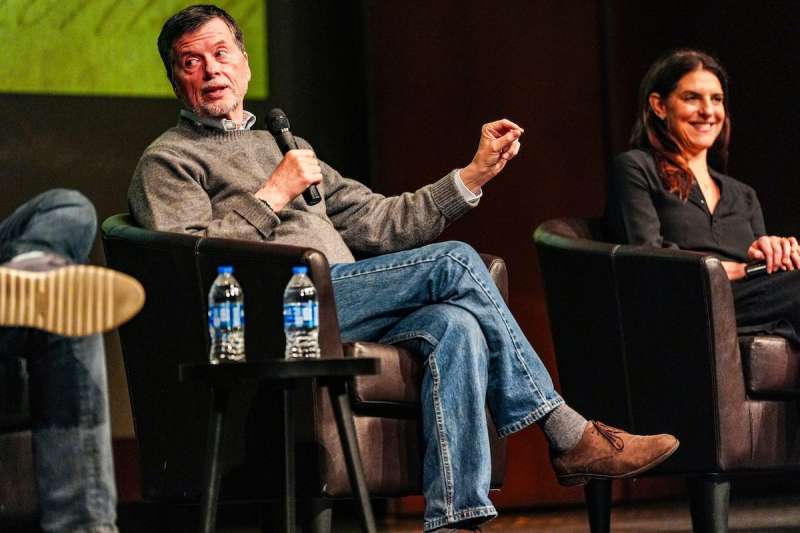
Backstage at a Wayne State University auditorium, Ken Burns opens a can of Vernors and fields a question about Jeff Daniels providing the voice of Thomas Jefferson in “The American Revolution.”
Why did the part go to Daniels, a southeast Michigan icon? “What about me? I grew up in Ann Arbor!” Burns exclaims jokingly during a visit to Detroit to promote the six-part documentary series, which premieres Nov. 16 on Detroit PBS and runs through Nov. 21.
Getting down to business, the filmmaker points out that the actor from Chelsea did voice work for Burns‘ landmark 1990 series “The Civil War” and 2021’s “Hemingway.”
“He is one of the great, great, great actors of our time, and we’ve used him a lot. I consider him a friend. He is a good man,” says Burns, adding that “The American Revolution” has, in his opinion, “the greatest cast list ever assembled for any film ever.”
Men from Michigan speak the truth. Besides Daniels, the voice work is provided by Tom Hanks, Morgan Freeman, Meryl Streep, Josh Brolin, Claire Danes, Paul Giamatti, Samuel L. Jackson, Michael Keaton, Laura Linney, David Oyelowo, and Liev Schreiber, among many others.
Directed by Burns, Sarah Botstein and David Schmidt, “The American Revolution” explore how 13 British colonies won their independence and formed a government of ideas and ideals that has influenced democratic movements around the globe and through the centuries.
A decade in the making, the project is the result of years of filming and a massive research effort to locate as many pamphlets, paintings, etchings, proclamations and letters from the era as possible. Its airing in 2025 is timed to the 250th anniversary of the start of the Revolutionary War.
Interviews with numerous academics and authors help bring the latter part of the 18th century alive throughout the 12-hour run time, as do the roughly 400 first-person accounts (voiced by the stellar cast) from people from all walks of life: soldiers, politicians, Native Americans, free and enslaved Black Americans, women and children, those who support the fight against Britain and those who remain loyal to King George III, along with the many German, French and Spanish figures who played a role in the conflict.
In classic Burns fashion, the combination of narration, visual artifacts, maps, sweeping camera shots and, in this case, some scenes using colonial reenactors, combine for a journey with depth, emotion and an accuracy that strips away the mythology surrounding what truly was a radical, world-shaping event that simultaneously was a revolution, a civil war and a world war.
Like the neon sign that hangs in Burns’ editing room says, “It’s complicated.”
On this particular day, Burns is in Detroit with Botstein and historian Kathleen Duval, a Pulitzer Prize winner in 2025 for her book “Native Nations: A Millennium in North America,” for a PBS Detroit event previewing “The American Revolution.”
It is his latest stop in a lengthy tour that has been eliciting the sort of reactions that Burns and his team hoped to hear. “Everybody is sitting up, going, ‘I did not know that,’” he says. “And that’s the best thing, as a storyteller and a historian, you could ever want, is for someone to say, ‘I had no idea.’”
Burns enthusiastically talks about aspects of docuseries, which is committed to telling the whole complex story of the revolution, the lofty and the brutal sides, in order to clarify a period that has ““been smothered in some mythologies,” some big, some small.
Burns says he and his co-filmmakers have gone to lengths not to rely on familiar tales unless they can be confirmed in a scholarly way. For instance, he points out that Paul Revere’s famous cry, “The British are coming! The British are coming!” was actually: “The regulars are coming out! The regulars are coming out!”
And Nathan Hale’s noble statement, “I only regret that I have but one life to lose for my country,” before his execution by the British? Because the story is not backed up by eyewitness accounts, the documentary describes things differently. “What we say is that a British officer noted that he died with great composure,” says Burns, adding ruefully that he’s “99% doubtful” that today’s kids have even heard of Nathan Hale.
Burns has been stressing in interviews that he sees his role in chronicling history as that of an umpire calling balls and strikes. He isn’t out to condemn the loyalists who sided with Britain or venerate or condemn the founding fathers. His approach, as usual, is to provide perspective and context to a subject that matters greatly to who we were and who we are today as Americans.
“The American Revolution” covers the role of Black Americans who fought for their freedom, some on the side of the revolutionaries, some with the British. It also notes that founders of the United Stakes like George Washington and Jefferson were enslavers themselves.
During a panel discussion with the Motor City audience, Burns noted how historian and law professor Annette Gordon-Reed addresses slavery’s foundational role in Jefferson’s life.
“She comes on camera and says, ‘Well, why would somebody do something if they knew it was wrong?’… That’s a question for all of us. At that moment, she does not let Thomas Jefferson off the hook. She kept him on the hook, but put the rest of us, as well, on the hook. … There is scholarship and there is transcendent scholarship.”
The docuseries also strives to portray the Indigenous community as the global players they were in the 18th century and had been for centuries. “They know how to talk to the French. They know how to talk to the British. They’ve got foreign policy … and they’re different cultures, nations,” says Burns.
One of the most striking elements of “The American Revolution” is its echo of contemporary divisions in the United States. There couldn’t be easier parallels to spot than the No Kings rallies that are being held in opposition to President Donald Trump’s efforts to increase his executive powers and the rifts between family members who have been voting differently in the presidential elections since 2016.
What would the people who participated in the American Revolution think about the United States and its problems today? Says Botstein: “I think they would be amazed at how well we’ve done as a country. … It’s a privilege to exercise your rights as a citizen, and that was something the founders thought about.”
DuVal says she likes to imagine Abigail Adams, the wife of John Adams and an early advocate for the rights of women, time-traveling to the present day. “I think she’d be deeply impressed that we still quote the Declaration of Independence, we still live under the Constitution, that those rights … in ways she glimpsed a little bit more than her husband did, could be expanded to more people than (they) were initially”
According to Burns, John Adams worried whether American would have the virtues required to maintain a democracy. Adams realized that “it was going to require a great deal of education and continual learning in order not to succumb to, as he puts it, ambition and avarice, the greed for profit.”
It was a concern shared by the nation’s founders, who are all understanding that these are things that are going to be required of a responsible citizenship.”
This article originally appeared on Detroit Free Press. Reporting by Julie Hinds.