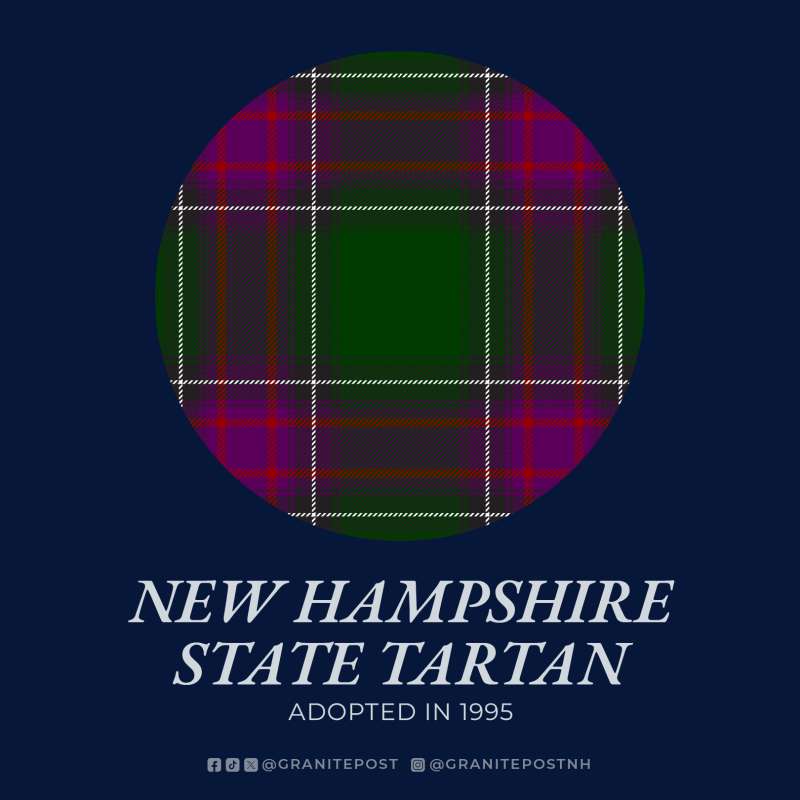
Did you know New Hampshire has its own fabric?
The state tartan (a plaid-like fabric used in Scottish culture) was designed by Ralf L. Hartwell in 1993 to celebrate the 20th anniversary of the NH Highland Games & Festival. Hartwell, who had a hobby of weaving fabric on his loom, created colors that represent aspects unique to the Granite State.
- Purple represents the the state bird and flower (the purple finch and lilac)
- Green represents the forests
- Black represents the granite mountains
- White represents the snow
- Red is for the state’s heroes
What is a tartan?
A tartan is a fabric with a distinctive pattern of horizontal and vertical stripes, often in multiple colors. Each tartan is unique and can be associated with specific clans, families, regions, or institutions.
In Scotland, tartans are used to represent the heritage, allegiance, or affiliation of the person wearing it. Historically, tartans were used for clothing, like kilts, shawls, and other garments. They were also used for decorative purposes such as blankets and upholstery.
The colors and arrangement of stripes in a tartan can convey various meanings, including connections to nature, family crests, or historical events.
The copyright of New Hampshire’s tartan is held by NHSCOT. You can learn more and find where to purchase NH tartan yardage here.