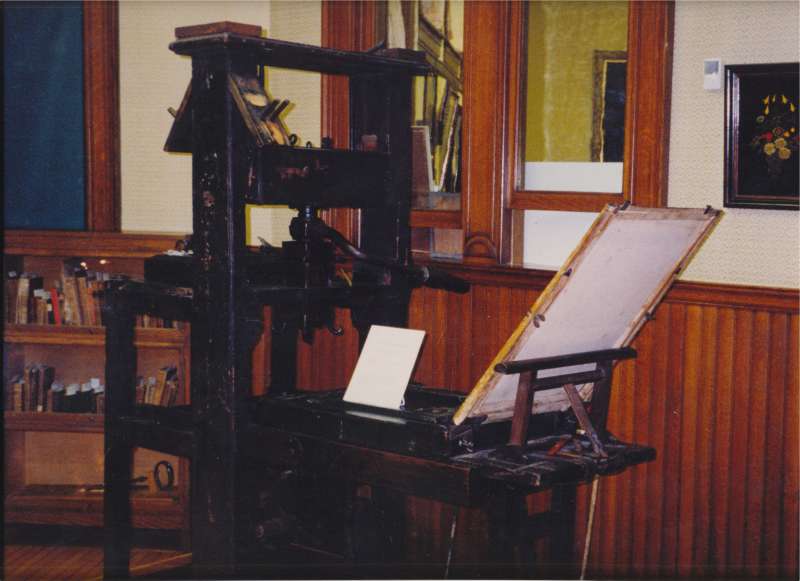
Tucked in the front room of the Exeter Historical Society is an old English press. While it looks unassuming, it produced a piece of paper that likely first spread the word of American independence in New Hampshire — and then survived a journey across the Atlantic Ocean.
On July 3, the National Archives in London announced an incredible discovery: a rare copy of the Declaration of Independence had been found over 3,000 miles from its origin. Michael Scurr, a retired insurance executive and longtime volunteer, discovered the document while sorting through a collection of 18th-century Royal Navy letters.
Barbara Rimkunas, co-executive director of the Exeter Historical Society, said that when the Society heard that this copy of the Declaration had been found in London, they were excited because they had already decided to make the printing press a focal point for Exeter 250. The press is currently enrolled in the New Hampshire Historical Society’s 603 history scavenger hunt.
“New Hampshire was a small place, and it’s a very early copy,” said Rimkunas. “Now, there’s probably plenty of Declaration of Independence copies out of Philadelphia and New York and those locations. So, they’re not as hard to come by. But finding them in these more outskirts… of the U.S. was probably pretty rare.”
How did the Declaration of Independence copy end up in London?
Rimkunas said three months after the signing of the Declaration of Independence, 29-year-old Capt. Eleazar Johnson and his 120-person crew boarded the Dalton, an 18-gun privateering vessel, from Newburyport, Massachusetts.
Privateers were privately owned ships authorized by the Continental Congress to attack British merchant vessels. Carrying a commission signed by John Hancock, the president of the Continental Congress, the Dalton’s goal was to attack British ships, disrupting trade and military supply lines. Ships like these made up most of the United States’ early naval forces.
Sailing 20 miles north of Portsmouth on the Piscataqua River in New Hampshire, the Dalton picked up more crew, and it was likely there that Rimkunas believes they acquired their copy of the Declaration, which was printed in Exeter.
According to Rimkunas, the reason why the Dalton picked up a copy of the Declaration could have been because they needed a copy to prove that the United States was its own country. At the time, information traveled slowly.
How a loyalist ended up printing the Declaration of Independence
While the crew may have been committed to the rebel cause, Rimkunas said the printer of the Declaration of Independence copies in Exeter, Robert Luist Fowle, was ironically uneager about the revolution.
Fowle was a loyalist who initially learned the printing business from his uncle, Daniel Fowle, of Portsmouth, who was on the opposite end of the political spectrum. After parting ways due to their conflicting political beliefs and his uncle’s censure from the colonial government, Robert Fowle took one of the printing presses to Exeter between 1775 and early 1776 to begin his own printing business.
Living in a small town compared to Portsmouth, Robert “took whatever job he could get,” according to Rimkunas. While he was loyal to the Crown, he took jobs grudgingly to earn money. One of them was printing copies of the Declaration of Independence to spread word of independence after the Dunlap Broadside — one of the original copies made in Philadelphia — arrived in Exeter on July 16, 1776, and was read aloud to townspeople.
“He is the one, this loyalist, who has to print the Declaration of Independence…on an English press,” Rimkunas said.
Fowle’s Declaration broadsides, according to Rimkunas, were “all considered ephemera — things that you read and then you don’t save.”
The Dalton’s Declaration seized by the Royal Navy
Rimkunas said one of the “ephemeral” copies was seized by the Royal Navy when Capt. Thomas Fitzherbert of the 64-gun HMS Raisonnable spotted the American privateer in December 1776. After nearly seven hours of pursuit, the Raisonnable captured the Dalton off the shores of Portugal. Before the ship was captured, Johnson had thrown all his papers, logs and crew lists overboard except for three printed documents: his privateering commission, his orders from Congress and the Declaration of Independence.
According to the National Archives, Johnson “boldly declared ‘that he is a subject to the United States of America’” when he was questioned in Plymouth, England. He also confirmed that the Dalton was operating under commission from the Continental Congress. The crew of the Dalton was imprisoned in Plymouth and tried to escape several times unsuccessfully. They were gradually released in 1780.
The Exeter broadside that survived against all odds
Only 11 copies of the Exeter Declarations are known to survive and until now, none had been found outside of the U.S., according to Britain’s National Archives. This copy is also the only copy of the U.S. Declaration known to have been captured in military action.
“These older papers are actually a lot better because they hold together better,” Rimkunas said, citing how old broadsides were usually made out of cotton or linen, with those fibers holding up much more solidly than newspapers published in the last century. “So that might be one of the reasons why it survived, and it’s in relatively good condition. The surprising thing was that it didn’t just get chopped.”
Instead of sending the copy to a wartime court overseeing seizures of enemy ships, as was protocol, Fitzherbert sent the declaration directly to the Admiralty, which oversaw Britain’s Royal Navy. He described it as just “another document.”
Incredibly, it survived in the Royal Navy inventory for 250 years.
Celebrating independence in Exeter, 250 years later
Today, visitors to Exeter can view the printing press that produced a scrap of paper that experienced the adventure of a lifetime. Ahead of Exeter’s American Independence Festival, held annually around July 16 in recognition of when the town received the Dunlap Broadside in 1776 — one of the original copies of the Declaration from Philadelphia — this discovery brings a fresh perspective to the importance of the Declaration and Exeter’s role in the American Revolution.
Joe Pace, executive director of the American Independence Center, said that he is “always delighted” when a new historical document surfaces because it draws people’s attention to America’s founding.
“The more of these things that show up [and] the more excited we get, the more interested we are in exploring our founding and how it relates to the work that we need to do as modern citizens,” Pace said.
Those interested in learning more about Exeter’s role in the American Revolution can visit the American Independence Center during the American Independence Festival on Saturday, July 11, from 10 a.m. to 4 p.m. The center is also open during its regular hours, Thursday through Saturday from 10 a.m. to 4 p.m. The Exeter Historical Society is open to the public on Tuesdays and Thursdays from 2 to 4:30 p.m. and Saturdays from 9:30 a.m. to 12 p.m.
This article originally appeared on Portsmouth Herald. Reporting by Grace Chai.