A developer who withdrew his proposal last month to bring a large data center to Nottingham says he may revive the controversial project, even as town officials move to block such developments.
“If our research shows that it makes sense to do, I would reintroduce it, so that’s still to be determined,” developer Tom Moulton said.
The proposal called for converting an existing 200,000-square-foot warehouse in the Nottingham Business Park, just off Route 4, into a data center.
Moulton pulled the plan on May 27, hours before a packed Planning Board meeting, after fierce public backlash and an online petition opposing the project drew more than 25,000 signatures — a number that has since climbed past 41,700.
Since then, the Nottingham Planning Board drafted a 12-month moratorium on data centers. Voters will consider it at a special town meeting.
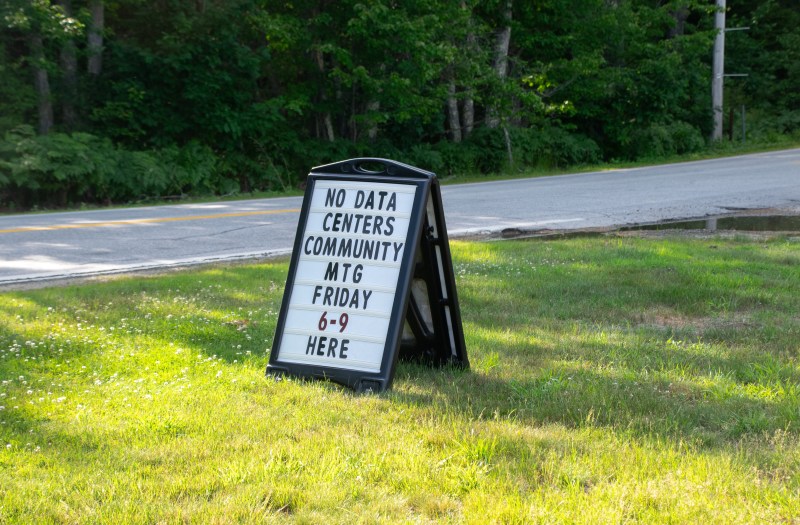
Meanwhile, over 40 people met in Nottingham on June 19 to form a grassroots group focused on opposing hyper-scale data center developments in Nottingham and New Hampshire.
Group forms to fight data centers in NH
Residents who attended the inaugural meeting aimed at fighting data centers came from more than 10 communities, including Nottingham, Durham, Raymond, Newmarket, Epping, Lebanon, Concord, Merrimack, Strafford, Deerfield, Manchester and Berwick, Maine.
Attendees said they were worried about water usage, noise pollution and rising electricity costs. According to the World Resources Institute, data centers require large volumes of water to cool servers and consume significant amounts of power, contributing to greenhouse gas emissions.
Nottingham residents said they were especially concerned about water. Nearly all households in the town of 5,500 rely on private wells — a resource many fear could be compromised by a data center.
“We have only our own water,” said Annette Sell, a Nottingham resident. “It’s in the ground. That’s our own resources. We live off the land.”
Carolyn Morse-Finn, who has lived in Nottingham for 40 years, said she has had to dig her well deeper for water to flow. It is over 350 feet deep.
“I’m very concerned about our water table, because we all draw on the same water,” Morse-Finn said. “So that’s where my biggest concerns with the data center (are), aside from the fact that it’s environmentally not sound.”
Morse-Finn said that the issue of data centers is not a partisan issue. She said to “protect Nottingham and the beauty of Nottingham, we all have to work together and pull together.”
“It’s just big, a big problem — the noise, the environmental impact, the water and the electricity,” Morse-Finn said. “We just have profound concern that our children are gonna be affected. Our environment’s gonna be affected.”
Politicians, environmental advocates speak out against data centers
Several elected officials, including state Sen. Debra Altschiller, D-Stratham, attended the meeting.
Altschiller sponsored Senate Bill 439, which sought to increase oversight of data centers in New Hampshire.
The bill would have limited data centers to commercial and industrial zones, set restrictions on noise levels and required developers to provide written proof from the serving electric utility that the grid had enough capacity to support the facility’s projected energy demand.
The measure was amended to broaden the definition of a data center, permit them in commercial and industrial zones, and place them under existing local regulations rather than requiring additional screening or new design and siting standards. It ultimately died in the House.
Altschiller said data centers pose challenges due to their high electricity use, heavy and continuous water demand for cooling and the lack of a standardized framework for New Hampshire towns to review a use this intensive.
“Nottingham is part of a much bigger story. We are not alone in this. So the question underneath all this is, who pays?” said Altschiller, referencing residents’ concerns about increased electric bills that the data center might bring on.
She said she plans to reintroduce Senate Bill 439 in its original form in the next legislative session.
Catherine Corkery, chapter director for Sierra Club New Hampshire, state Rep. Wendy Thomas (D-Merrimack), state Rep. Tom Cormen (D-Lebanon), gubernatorial candidate Cinde Warmington and U.S. Senate candidate Karishma Manzur were also among the speakers present.
New Hampshire Gov. Kelly Ayotte, who was not there, has opposed data‑center development in the state, citing concerns that the facilities could drive up energy costs.
Developer says ‘misinformation’ led him to withdraw proposal
Moulton, the founder of Sleepnet Corporation and owner of De Niro Construction, said he has no timeline for when he may bring the data center proposal forward again to the town.
The proposal, Moulton said, was met with a lot of “misinformation.”
“Unfortunately, emotions run high and you can’t even have an intelligent conversation unless people just want to sit there and talk about it, and talk about the facts,” he said. “I’m a very responsible individual; I want to do things right. I’m not looking to hurt the environment. But I think you would have to admit that our economy and national security are all run by data.”
Supporters of expanding data centers — including the American Energy Institute — argue that opposition to new facilities puts “ideological agendas over U.S. interests” and slows the growth of an industry they say is essential to AI competitiveness, cloud computing and economic growth.
When asked about why he wanted to build a data center in Nottingham, Moulton responded, “Why not?”
“It’s not really around a residential area; it’s not like in the middle of Boston. I think it’s a good location for our design. It’s zoned commercial,” he said.
Most new data centers in the United States are coming to rural areas, according to a Pew Research study.
Moulton said the project would generate three to four times more in real‑estate tax revenue and provide a significant boost to the town’s finances. He also said it would have minimal impact on water use because the facility would rely on a closed‑loop cooling system that recirculates its water.
“I just wish we could have a conversation,” he said. “People leave an open mind. I think technology is changing. There may have been people who have not done data centers responsibly in the past. I don’t know enough about it, but I would think going forward with technology, we could try to find a pathway that would work for everybody.”
What’s next
Nottingham held a public hearing on July 1 at 7 p.m. at the Nottingham Town Offices about a proposed moratorium on data centers. The board voted unanimously in favor of the 12-month ban.
The proposed moratorium would give the town time to study potential land‑use, environmental, infrastructure and fiscal impacts. It would also allow officials to draft zoning regulations for data centers and gather public feedback on those rules.
The Planning Board also voted to create a subcommittee focused specifically on zoning ordinances and performance standards relevant to data centers.
State Sen. Debra Altschiller, D-Stratham, is the wife of Howard Altschiller, Seacoast Media Group’s executive editor.
This article originally appeared on Portsmouth Herald. Reporting by Grace Chai.