It is summertime! The Explore the Ocean World oceanarium at Hampton Beach opens on Memorial Day weekend every year.
What I failed to notice this year is that it is almost a week earlier than normal. This has sent me into a frenzy trying to get the oceanarium ready for the weekend, cleaning, pumping water, and setting up the tanks. Both my husband and I are frantically trying to collect animals. We have contacted all the fishermen that we know. The weather this spring has not been conducive to fishing, and the lobstermen have put their traps out later than usual. So, we are scrambling to get critters for the tanks.
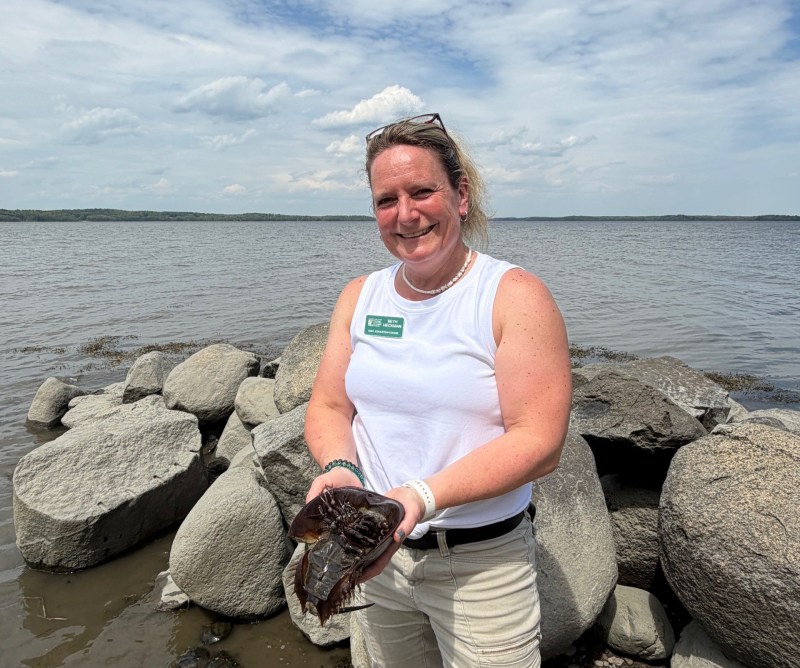
Thanks to Jillian Robillard at Southern Maine Crabs, we have several spiny crabs, and to Greg Marshall of Seabrook, NH, who continues to donate animals from his lobster traps and holds them at the Yankee Coop until I can pick them up. Another thanks goes to Beth Heckman at the Great Bay Discovery Center in Stratham for a couple of feisty horseshoe crabs — but that’s a story for another week.
Monday morning, I awoke at 6 a.m., frantic that I hadn’t filled the tanks with animals. I turned on Facebook, and staring at me was someone holding two orange lobsters. I moaned and resigned myself to the fact that if it had made it onto Facebook, someone else would have probably obtained them.
After I had my cup of tea, I received two text messages from friends about the orange lobsters and realized that I needed to read the article about them. I finished reading and was surprised that the lobsters were in Seabrook. Oh, what the heck, I’ll give them a call. So, at 8:30 a.m., I called the fish department at the Seabrook Market Basket. I explained who I was and that if they loaned the lobsters to me, I would tag them with Fish and Game in the fall and return them to the ocean.
To my amazement, Terry, the manager, said that he thought that was a great idea. I nearly fell off my chair and rushed down to Market Basket with my cart and cooler. I walked through the store with my cart, people giving me the side eye. They were waiting for me at the fish counter, and with not much ado, we took a couple of photos and off I went.
The two lobsters are both female, nice and healthy despite their journey from sea to wholesaler, then to Market Basket. They are acclimating in the Oceanarium and ready for the start of the summer season. We think of this as a little working vacation for them. They’re well‑fed and safe for the summer, then return to the Gulf of Maine for their offshore winter migration.
You may have read the article I wrote last year about the different colorations of lobsters. I will summarize it here. Most lobsters have some blue and some orange in their shell. (The shell is their skin.) Mixed, the orange and blue look brownish with speckling. There are several reasons for other colorations. Some are caused by what the animal is eating. Too much of certain seaweeds can make their shell more orange. Too little of that seaweed can make them very pale or even bluish. Genetic mutations can also play a role: a lobster that hatches without the orange‑producing protein will appear bright blue; no blue DNA can cause a lobster to be completely orange. All of this will occur normally in nature.
Terry asked me a serious question. He wanted to know if orange lobsters were so rare, why had one of the other stores just this month found two more orange lobsters in their delivery, and someone from Reading, Massachusetts, had found another all within a month?
I believe there have been some significant changes in DNA due to experiments done by several institutions in the late 1980s-early 1990s. These institutions had developed some gene mutations that caused the lobster larvae to be completely blue. Unfortunately, there were no rules in place at that time to keep them from releasing these genetically modified animals into the environment. The reason given, at that time, was that they were going to use the color of the lobsters to track their movement. I would guess that they had no more funding for the project and didn’t really know what to do with thousands of blue lobsters. Unfortunately, we now know that releasing genetically modified animals into the environment can cause drastic changes in the population.
We are seeing so many more blue and orange lobsters than would normally be found in the wild. My question is, did the release of all those blue lobsters influence the natural population, and were they changed in other ways we don’t understand yet?
This is a serious ethical question that scientists should always keep at the forefront of experiments. It is a question that needs to be decided by society, not by a single scientist or organization.
Meanwhile, nature has a way to survive despite human interference.
I do have an update on the lobsters that we tagged and released last year. The largest orange lobster was caught in a lobster trap twice this winter and released by two different fishermen. We are still waiting to see if the other released lobsters show up anywhere this summer. And no, the orange lobsters we have this year are not the same ones we released last year!
Ellen Goethel is a marine biologist and the owner of Explore the Ocean World Oceanarium at 367 Ocean Blvd. at Hampton Beach.
This article originally appeared on Portsmouth Herald. Reporting by Ellen Goethel.