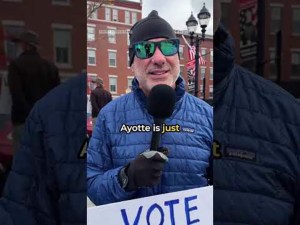
New Hampshire’s new law creates one of the most restrictive voter ID regimes in the country.
Republican Gov. Kelly Ayotte signed House Bill 323 into law late Friday afternoon eliminating student IDs as an accepted form of voter identification and establishing one of the most restrictive voter ID requirements in the nation.
New Hampshire law removes a form of ID that college students across the state have long relied on to exercise their right to vote, creating new barriers to a demographic especially vulnerable to the high-bar of paperwork and government issued ID required to vote in New Hampshire.
Critics swiftly condemned the move as a targeted effort to suppress young voters — a population that skews Democratic — at a time when President Donald Trump has openly stated his desire to ensure “the right people” vote in the 2026 midterm elections.
“Today, Governor Ayotte signed a bill that removes student IDs as an accepted form of voter identification — a quiet but consequential step backward for democracy in New Hampshire,” said Lisa Kovack, Director of the New Hampshire Campaign for Voting Rights. “This bill will only add to that number without making our elections more secure.”
Jesse Fitzelle-Jones, President of the New Hampshire College Democrats, called the bill “profoundly hurtful,” saying it shuts young Granite Staters out of the democratic process.
“Students should be free to engage civically in ways that are meaningful and fair to them,” Fitzelle-Jones said.
Top 2026 candidates also offered sharp reactions to Ayotte’s move, drawing parallels to Trump’s agenda.
“Just 48 hours after Donald Trump’s executive order against absentee voting and voting by mail, Kelly Ayotte signed a new law making it tougher to vote in person here in New Hampshire.” Wrote Stefany Shaheen, candidate for congress in New Hampshire’s first congressional district for 2026 in a post on social media.
Maura Sullivan, another congressional candidate for the first congressional district, said the efforts to curtail student voting were part of a strategic pattern by state Republicans to choose their voters. “First, they went after snowbirds, seniors, and people with disabilities by eliminating affidavits. Now students. Next, it’s married women through the SAVE Act.”
Congressman Chris Pappas, a Democrat running for Senate, called the law “an obvious attempt by Republicans to prevent Granite Staters from holding them accountable at the polls in November.”
“New Hampshire is the gold standard for elections, yet Republicans continue to push legislation to make it harder for Granite Staters to vote,” Pappas said.
The signing caps nearly a decade of efforts by New Hampshire Republicans to erect financial and bureaucratic barriers for young and first-time voters, including threatening extra costs like car registration, imposing new domicile rules, and requiring documentation such as a passport or proof of citizenship.
Student IDs had served as one of several forms of identification used to verify voters who were already registered — voters who, like all New Hampshire residents, must present proof of address and citizenship documentation to register in the first place. Removing them as an option adds a new hurdle without addressing any documented problem: there is no evidence of voter fraud associated with the use of student identification in New Hampshire.
The impact of recent voting restrictions is already measurable, however.
At least 300 Granite Staters have been turned away from the polls since new restrictive voting laws took effect, including during Town Meeting Day last year when hundreds of legitimate voters were denied the ability to cast ballots.
Ayotte did not respond to requests for comment and did not release a statement when she signed the legislation into law justifying why it was necessary.