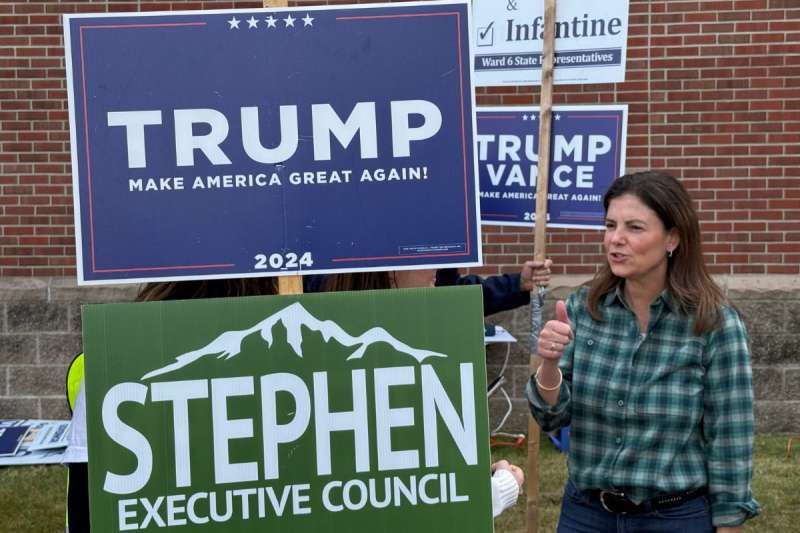
New Hampshire Gov. Kelly Ayotte spent years publicly warning about the devastation that the opioid crisis was causing in New Hampshire, but federal campaign finance records show that her campaign committee and leadership PAC accepted at least $83,049.98 from opioid manufacturers, distributors, their political action committees, employees, and members of the Sackler family tied to Purdue Pharma.
The renewed scrutiny comes as Ayotte’s campaign and New Hampshire Republicans have hinged the entirety of their campaign against Ayotte’s opponent, 2026 Democratic candidate Cinde Warmington, on her 2002 lobbying for Purdue Pharma, during which she argued for easier access to OxyContin for pain-treatment clients.
Purdue Pharma, maker of OxyContin, has become one of the central corporate villains of the opioid epidemic. In 2022, New Hampshire Attorney General John Formella announced a settlement with Purdue and the Sacklers, saying the state had alleged the family directed Purdue’s deceptive opioid marketing strategy while reaping massive profits as addiction cases skyrocketed.
Some of the most striking contributions from members of the Sackler family came as Ayotte was publicly sounding the alarm about overdose deaths. In testimony submitted to the US Senate Judiciary Committee on Jan. 27, 2016, when she called New Hampshire’s overdose toll “staggering,” adding the epidemic was “touching every community in our state” and that too many families had come to her after losing loved ones. A Senate Judiciary Committee livestream captured the hearing.
Yet Federal Election Commission records show that one day earlier, Kelly PAC accepted a $1,041.67 contribution tied to Mortimer Sackler, while a related filing shows the transfer originated through 21st Century Majority Fund. Six days later, Kelly PAC accepted another $2,083.33 tied to Jonathan Sackler, again with a corresponding 21st Century Majority Fund filing.
Additional federal filings cited in the public record identify Mortimer Sackler as a Purdue board member and Purdue executive.
The Sackler-linked donations were only part of a broader pattern. Ayotte’s federal filings include money from a range of companies later swept into opioid litigation, including Allergan, AmerisourceBergen, Cardinal Health, CVS, Endo, Johnson & Johnson, McKesson, Mallinckrodt, Teva, Walgreens, and Walmart. Together, those opioid-linked contributions totaled at least $83,049.98 between 2010 and 2016.
In one especially glaring example, Ayotte introduced legislation aimed at reducing overdose deaths, then took money from an opioid manufacturer the very next day. On March 12, 2015, she joined Sens. Edward Markey (D-Massachusetts) and Tim Kaine (D-Virginia) in introducing the Opioid Overdose Reduction Act, a bill designed to protect first responders, health professionals, and relatives who administer overdose-reversal drugs such as naloxone. The next day, according to a Federal Election Commission filing, Ayotte accepted a $1,000 contribution from Allergan’s PAC.
Allergan would later become part of the national opioid settlement wave. The company agreed to a $2.37 billion settlement, and New Hampshire later joined an Allergan settlement expected to send $12.4 million to the state.
The same pattern appeared again in the closing weeks of Ayotte’s 2016 Senate campaign. On September 20, 2016, the Coalition to Stop Opioid Overdose announced Ayotte was receiving an award for her leadership and commitment to ending the opioid epidemic. Later that same month, Federal Election Commission filings show Ayotte accepted $2,500 from Walmart’s PAC, $1,000 from CVS Health PAC, $833.32 from a Cardinal Health employee, and $150 from a Johnson & Johnson employee.
Those companies would later pay billions to resolve opioid-related claims. NPR reported that Johnson & Johnson and the major distributors McKesson, AmerisourceBergen, and Cardinal Health agreed to roughly $26 billion in settlements. CVS and Walgreens agreed to pay more than $10 billion, while Walmart separately agreed to a $3.1 billion settlement.
Ayotte’s opioid record also reaches back to her time as New Hampshire attorney general.
In 2007, 26 states and Washington, DC, joined a case against Purdue Pharma over OxyContin marketing. New Hampshire did not. A May 8, 2007 settlement announcement from the District of Columbia said the states had reached a $19.5 million settlement with Purdue over allegations the company failed to adequately disclose the drug’s abuse risks and promoted it for off-label uses. New Hampshire was not listed among the participating jurisdictions, though Connecticut, Maine, Massachusetts, and Vermont were.
Ayotte’s decision not to join the case may have cost New Hampshire hundreds of thousands of dollars.
The District said it would receive $949,500 as one of the lead jurisdictions. Maine’s attorney general later announced that state would receive $719,500. Connecticut and Massachusetts were also among the participating states, and records cited in the public material show other states used the settlement money for prevention and public-health efforts.
New Hampshire got nothing because it never joined the case.