New Hampshire’s two US Senators have spent 2026 at the center of the congressional pushback against US Immigration and Customs Enforcement (ICE), helping kill a planned detention warehouse in Merrimack and forcing the agency’s then director to admit that its shooting investigations were biased from the top.
The Trump administration wanted to turn a 43-acre warehouse in Merrimack into an immigrant detention site holding as many as 1,500 people at a time.
Three weeks after documents confirmed the plan, it was dead.
The collapse followed weeks of pressure that New Hampshire’s two Democratic US senators helped organize.
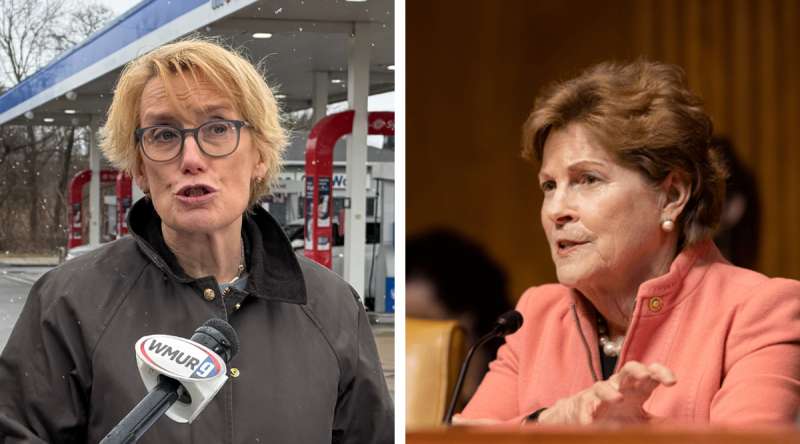
US Sens. Jeanne Shaheen and Maggie Hassan spent early 2026 dragging the Merrimack project into the open, confronting the head of US Immigration and Customs Enforcement (ICE) at a Senate hearing and filing legislation to give communities a veto over new detention sites.
“It’s not acceptable for Americans to be killed in the streets by federal agents,” Shaheen told The Granite Post in an exclusive interview on Thursday.
“We can’t allow that to continue to happen,”she added.
The Monadnock Region saw a wave of ICE activity that began with an enforcement action in Keene on Aug. 10, which Mayor Jay Kahn (D) said “heightened concerns” about residents’ safety.
Advocacy groups confirmed at least five detentions in Keene and West Lebanon that week, including at least three arrests in Keene itself, and nearly 200 people packed a three-hour special Keene City Council session at Keene City Hall on Monday night.
ICE told New Hampshire Public Radio that “ICE Boston routinely conducts operations across New England.” Shaheen said there are still “a number of unanswered questions” about what the agency did in Keene.
The surge is unfolding under a Republican governor who has taken a friendlier line toward the crackdown.
New Hampshire is the only state in New England where local police participate in a partnership program that lets certain local officers carry out federal immigration enforcement, and when ICE planned for a detention facility in Merrimack last winter, Gov. Kelly Ayotte refused for weeks to publicly oppose the facility.
Shaheen has also gone after President Donald Trump’s commerce secretary over remarks insulting Canada, and Hassan has pressed Treasury Secretary Scott Bessent on the rising cost of living, but nothing has drawn more sustained fire from the two than ICE.
The Washington Post first reported in December that ICE intended to convert nearly two dozen warehouses across the country into detention sites, and that the only New England location on the list was in Merrimack.
For weeks, federal officials confirmed nothing, with the US Department of Homeland Security (DHS) blaming “the unprecedented opposition being thrown up by the Left” for its silence.
The stonewalling cracked on Feb. 3, when the American Civil Liberties Union of New Hampshire released state records obtained through a Right-to-Know request showing ICE had been quietly consulting a state agency since mid-January about its intent to purchase and rehabilitate the warehouse at 50 Robert Milligan Parkway.
Shaheen responded the same day that DHS had left the public “completely in the dark” and pledged to “continue forcefully pushing for answers.” The Granite Post subsequently tied the property to the Trammell Crow real estate network connected to Harlan Crow, a donor to Ayotte.
On Feb. 12, Hassan questioned ICE’s then-acting director, Todd Lyons, under oath before the Senate Homeland Security and Governmental Affairs Committee. Lyons confirmed the agency was building the Merrimack facility and claimed DHS had worked with Ayotte on the project, which the governor denied. Hassan noted that ICE had already scrapped an 8,500-bed detention center planned for Byhalia, Mississippi, after Republican Sen. Roger Wicker, who represents the state, objected.
On Feb. 23, Shaheen introduced the Respect for Local Communities Act with Hassan and New Hampshire Democratic US Reps. Chris Pappas and Maggie Goodlander, which would give state and local officials a veto over new ICE facilities and require notice to Congress.
“Our new bill responds directly to the concerns we’ve heard from local officials in towns like Merrimack, New Hampshire and across the country: They were never consulted about ICE’s plans, and they don’t want the chaos of new detention facilities in their communities,” Shaheen said, adding that the administration was spending “$38 billion in taxpayer money to purchase and operate these facilities.”
On Feb. 24, Ayotte announced the Merrimack facility would “not move forward,” after roughly 1,500 Granite Staters rallied against it in Merrimack, Wolfeboro, and Meredith. Shaheen welcomed the cancellation.
The delegation pressed then-DHS Secretary Kristi Noem in March to rule out any future ICE facility in New Hampshire without state and local support.
The agency refused, and it declined to say whether it was scouting other sites.
Hassan raised it again this spring at the confirmation hearing for Noem’s successor, Markwayne Mullin, pressing him to work with local communities before siting any future facility. Mullin dodged the question.
Shaheen, a senior member of the Senate Appropriations Committee, then filed an amendment to Republicans’ budget package in April to write the local-consent requirement into law.
In January, federal agents in Minneapolis shot and killed two US citizens in separate incidents: Renee Good, 37, who was unarmed and shot Jan. 7 as she tried to drive away from agents surrounding her car, and Alex Pretti, a 37-year-old nurse killed later that month. Noem and White House Homeland Security Advisor Stephen Miller publicly branded both of them domestic terrorists while investigations into their deaths were still open.
“We’re here today because Americans are outraged by the deliberate intimidation, trampling of civil rights, and lawlessness from this administration that has left two Americans shot dead – two American citizens shot dead – by masked federal agents,” Hassan said at the hearing.
Under her questioning, Lyons conceded that “any comments that are made publicly, privately, text, email, or Instagram posts, whatever, is going to put a bias” on the probes. Hassan then called for a formal investigation into whether Noem’s comments tainted the investigations or violated DHS policy.
The deaths kept coming.
In July, federal officers killed two more people less than a week apart: Lorenzo Salgado Araujo, 52, in Houston, and Johan Sebastian Durán Guerrero, a 26-year-old Colombian national authorized to work in the United States, during a July 13 traffic stop in Biddeford, Maine. According to the senators, both men were shot while inside vehicles, neither was the target of the operation that killed him, and none of the officers involved wore body cameras.
On July 21, Shaheen and Hassan joined 37 US Senate colleagues in a letter demanding Mullin honor DHS’s earlier commitments to deploy and expand body-worn cameras, strengthen officer identification requirements, and review enforcement protocols. The senators wrote that neither victim could remotely be described as “the worst of the worst.”
In Thursday’s interview, Shaheen made the case for those reforms in her own voice. “We all want a secure border, that’s important for the country,” she said. “But to have an immigration policy that gives free rein to ICE agents, that has no accountability, where they’re not required to wear body cameras and release the video from body cameras to show what’s happened in incidents, is not acceptable, and Congress cannot let that go on.”
Congress handed ICE $75 billion through 2029 in the July 2025 budget law, on top of its regular appropriations. Deaths in ICE custody hit 33 last year, more than the previous four years combined, and the agency logged 26 more through the first seven months of 2026, a pace that would set another record.
The senators told Mullin as part of their July letter, “We remain supportive of removing dangerous convicted criminals from our communities, but this goal can and must be achieved without endangering these very communities in the process.”
In Thursday’s interview, Shaheen said it more plainly.
“We have to make sure that those people who have a right to be here in this country are treated with respect.”