In New Hampshire, a familiar political dynasty is trying to make a comeback. John Sununu, the former Republican senator who lost his seat nearly two decades ago, wants his old job back. And he’s got Trump’s endorsement and tens of millions of dollars in outside spending helping him try to get it.
But there’s a problem with running on a famous last name when voters are demanding change. Especially when that name comes with a political record that voters have already rejected once before.
COURIER’s newsroom in New Hampshire, Granite Post, has been digging into what Sununu’s political comeback really looks like. Their reporting revealed that more than $28 million in taxpayer-backed funding has flowed to his family’s ski resort businesses and the surrounding town since 2010. A separate investigation raised questions about Sununu’s role on the board of an offshore company that stopped filing financial reports with federal regulators, a board position he initially omitted from his Senate candidate financial disclosure.
It’s the kind of scrutiny that makes this race about much more than a familiar last name. It raises questions about the relationship between political power, corporate interests, and the people elected officials are supposed to serve.
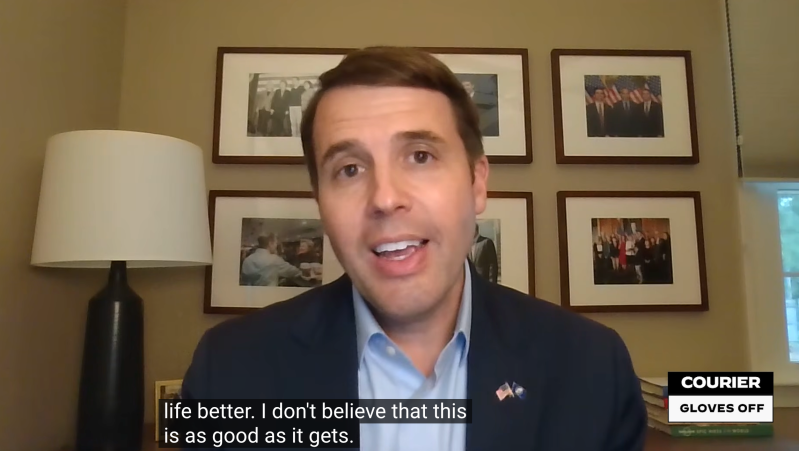
That’s the backdrop for Democratic Congressman Chris Pappas’s campaign to succeed retiring Senator Jeanne Shaheen in one of the country’s most closely watched Senate races. And it’s why I wanted him on Gloves Off.
New Hampshire is famously independent-minded. Pappas reminded me that registered Democrats make up just 26% of the electorate, meaning any Democrat running statewide has to earn support well beyond their own party. And what he’s hearing from Republican voters on the campaign trail might surprise you.
Just a day before our conversation, Pappas told me a Republican approached him at a restaurant and said, “I’m a Republican, but I’m for you, and we have to stand up to Trump and this lawlessness right now.”
At an airport, a Republican veteran told him he was voting for Democrats up and down the ticket. These aren’t the kinds of conversations you’d necessarily expect in a country that feels more polarized by the day. But they’re exactly what Pappas says he’s hearing as voters confront the consequences of Trump’s war, tariffs, health care cuts, and rising prices.
And Pappas believes his opponent represents more of the same.
The Sununu name has been part of New Hampshire politics for generations. John’s father was governor. His brother Chris was governor. And John himself served in the Senate until voters removed him in 2008. Pappas argues that Sununu’s record of supporting the Iraq War, efforts to privatize Social Security, and conservative judicial nominees should matter more than his family’s political legacy.
But it’s what Sununu did after leaving office that Pappas really wants voters to understand.
According to Pappas, Sununu spent the last 18 years working for powerful corporate interests, including the oil, pharmaceutical, and insurance industries, earning as much as $35 million. Pappas sees that as a prime example of the revolving door between Washington and corporate America that voters across the political spectrum have grown to despise.
As he told me: “I represent the Main Street economy in New Hampshire. That’s very different from Wall Street. It’s very different from the big corporations that seem to get all the special treatment out of Washington, D.C.”
And that distinction isn’t just campaign rhetoric for Pappas. Before entering Congress, he worked in his family’s restaurant business, the Puritan Backroom, a Manchester institution that’s been in his family for generations.
When we talked about the growing divide between capitalism and democratic socialism within the Democratic Party, Pappas brought the conversation back to something more fundamental: an economy increasingly shaped by powerful corporations and wealthy interests while ordinary Americans struggle to get ahead.
He wants to ban congressional stock trading, take on monopolies, reform campaign finance, impose term limits on Congress and the Supreme Court, and challenge the unchecked power he says Trump has accumulated.
But when I asked what he’d be most excited to tackle in the Senate, he didn’t hesitate: “Housing.” New Hampshire’s median home price is approaching $600,000, and Pappas says the state’s rental vacancy rate is around half a percent. Young people can’t afford their first homes. Workers can’t afford to live near their jobs. And seniors in manufactured housing communities are facing rising costs as private equity firms purchase their properties. Pappas says Washington needs to help communities build more housing while confronting the corporate practices that are driving up prices.
We also talked about the Trump administration’s immigration enforcement operations and Pappas’s proposal to redirect $75 billion away from ICE. He told me about a community in Merrimack, New Hampshire, where residents across the political spectrum opposed a proposed ICE detention facility. Local officials, law enforcement, and community members pushed back, and the plans were eventually scrapped.
For Pappas, the lesson is that people still have the power to challenge what their government is doing, even when Washington refuses to listen.
And then, of course, we had to talk about John Sununu’s campaign ads. My producer showed me one that might be among the strangest political ads I’ve seen this cycle, featuring Sununu repeatedly getting bleeped out. Naturally, I had to play it for Pappas and ask what he thought.
His response? “I don’t think he’s actually been in the same room as another human being in any of the ads he’s actually put on the air.” Ouch.
But beyond the jokes and the political theater, this race raises a serious question about what Americans want from their government. Are voters willing to send familiar political figures back to Washington, or are they looking for leaders who will challenge the system itself?
Pappas is making his case that the choice isn’t simply between two parties. It’s between a Washington that works for the people with the most power and one that actually responds to the people it’s supposed to represent.
And in New Hampshire, where voters have never been particularly interested in being told what to think, that’s a conversation worth having.
Watch my full conversation with Chris Pappas, including his reaction to Sununu’s bizarre campaign ad, and tell me what you think New Hampshire voters are looking for this November.
For more reporting on New Hampshire, subscribe to Granite Post’s newsletter here.