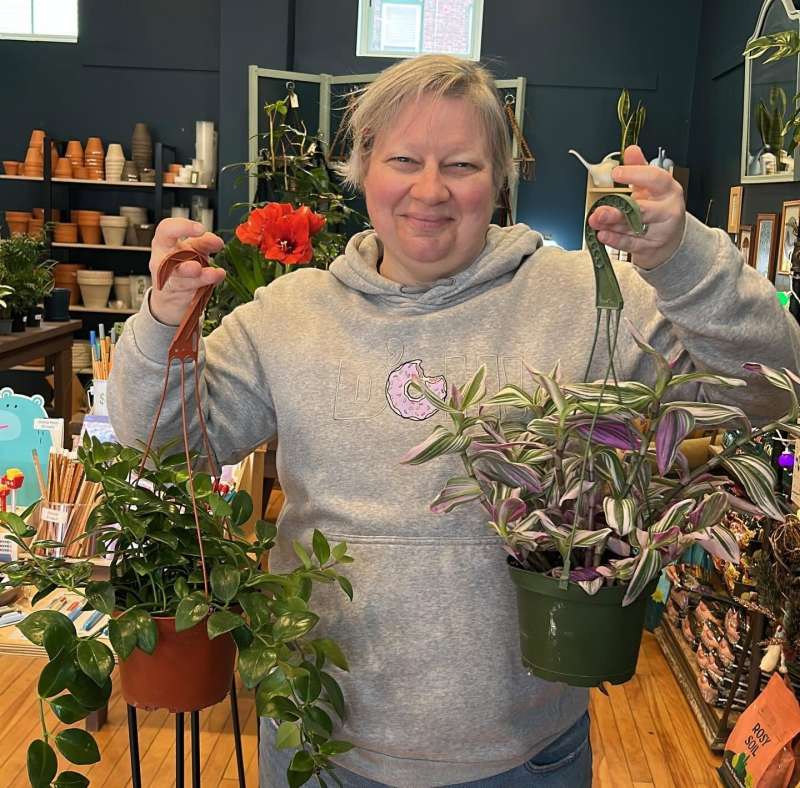
Alyssa McClary wants people to come into Penumbra and experience some things often taken for granted: fresh air and peace.
“We try to have a nice, calm, thoughtful oasis that you can just kind of pop into,” she said. “You can take some deep breaths. You can breathe our beautiful air from all of the plants, and then just kind of be like, ‘Great, I feel so much better now.’”
McClary co-owns Penumbra, a plant and gift shop on North Main Street in Concord, with her wife, Alison Murphy. The pair have been together about 15 years. For the first few, they weren’t open about their relationship. McClary wasn’t out to her family, and they weren’t sure being out would be safe for business. When they opened Penumbra, they made a different choice.
A giant Pride flag hangs in the window, and the shelves are stocked with work by queer artists.
“I hope, as a queer person, if I see a Pride flag in the window or a Black Lives Matter sign, I go, okay, I know what I’m walking into. That’s a safe space for me,” McClary said. “So really, our goal is to be a safe space.”
Being open about who they are wasn’t the only risk the couple took. They opened the doors to Penumbra in March 2020, and a week later, the pandemic shut them down.
A rough start
Murphy had planned to open the store with a business partner, but the partner backed out early that year to care for sick parents. Murphy decided to run it herself. Around the same time, the hospital where McClary had worked as a nurse for 18 years furloughed her. She offered to help.
“She said to me, ‘Well, what do you know about plants?’ And I said nothing, but I can keep a human alive,” McClary said. “Like, how hard can a plant be?”
With people stuck at home, plant sales took off. For three months, the couple delivered plants across the state. McClary built a website so customers could see what was in stock. The shop reopened to the public that June.
Penumbra was too new for most pandemic relief loans, McClary said. “That first year, because we were brand new, we didn’t qualify for anything.”
Help came from closer to home. A mentor from the New Hampshire Small Business Development Center helped the couple find low-interest, long-term financing. Their first landlords, who had run the longtime French’s toy shop in Concord, cut their rent in half for a couple of months.
“They really were also committed to making us survive,” McClary said. “We could not have done it without them and their generosity.”
Later, the shop joined Intown Concord, the nonprofit that organizes downtown events, and the Greater Concord Chamber of Commerce. In late 2025, McClary finished Goldman Sachs 10,000 Small Businesses, a free program for growing businesses. She said it felt “like getting an MBA in three months.”
That kind of help has gotten harder to find for many queer business owners. In January 2025, Trump canceled all federal diversity, equity, and inclusion (DEI) programs, and Target announced a retreat from its DEI goals, including programs to fund entrepreneurs of color and increase diversity among its suppliers. Ford, Walmart, John Deere, and Harley-Davidson have also publicly rolled back DEI initiatives.
RELATED: Give an experience, not more stuff: 12 New Hampshire gifts you can’t find on Amazon
Who gets a fair shot
Stories like Penumbra’s show how much rides on access, said Anisha Steephen, a fellow at the Roosevelt Institute and former senior policy advisor for racial equity at the US Treasury.
“This country makes it easy for corporations and people who already have resources to keep succeeding,” Steephen said. “Most working Americans come to business ownership with far less access to wealth, credit, and connections.”
The numbers show that gap. In the Federal Reserve’s 2024 Small Business Credit Survey, 35% of Black-owned employer firms that applied for loans, lines of credit, or merchant cash advances got the full amount they sought, compared with 56% of white-owned firms. A 2024 survey from the National Opinion Research Center (NORC) at the University of Chicago found that 83% of business owners who needed startup money used personal or family savings, assets, or home equity.
Similar barriers affect LGBTQ owners. The Small Business Credit Survey finds that about 6% of small employer businesses are at least partly owned by someone who identifies as LGBTQ. An analysis of the survey’s 2021 data found LGBTQ businesses were just as likely to apply for loans or financing, but less likely to receive it.
“Removing efforts to address those differences leaves the advantages in place,” Steephen said of the DEI rollbacks.
Steephen said opening doors is only part of the job. Owners also need to be able to stay. “Helping people open businesses has to come with attention to whether they can afford to stay, including the cost of rent, insurance, and financing,” they said.
Why your holiday dollars matter
Small businesses are the backbone of New Hampshire’s economy. The state has 145,314 of them, employing 309,420 people, or 50.3% of the state’s workforce, according to the U.S. Small Business Administration’s Office of Advocacy.
Where you shop affects how much money stays in town. On average, 52.9% of each purchase at local independent businesses recirculates locally, compared with less than 13.6% at chain stores, according to studies by the research firm Civic Economics.
For Penumbra, the holidays carry the year. McClary said the shop makes the bulk of its operating costs in November and December.
“When you shop local, you literally are making sure that our family buys groceries that week,” she said.
Steephen said the stakes reach beyond any single shop. “When people can build something in their own community, the benefits extend beyond the business itself,” she said.
McClary sees that every day in Concord.
“You are putting money right into the community. You are investing in the people in that community,” she said. “It gives us the opportunity to sponsor a Little League team or go do a talk at our library for free. We, too, care about our community, and so we’re not out here trying to make a million dollars. We’re trying to keep the lights on.”