Jeanne Shaheen is retiring. Chris Pappas and John E. Sununu are running to replace her. Here is where each of them stands on costs, health care, jobs and immigration.
New Hampshire has an open US Senate seat for the first time since 2010. Jeanne Shaheen is retiring after three terms, and control of the Senate could turn on a handful of races nationally. This is one of them.
A senator votes on federal spending, taxes, healthcare programs, and who gets confirmed to run federal agencies and sit on federal courts. Those decisions reach your monthly insurance premium, your heating bill, and what your town can get federal money for.
Both parties expect this to be the most expensive campaign in New Hampshire history. The record is the $128 million spent in 2016.
The candidates
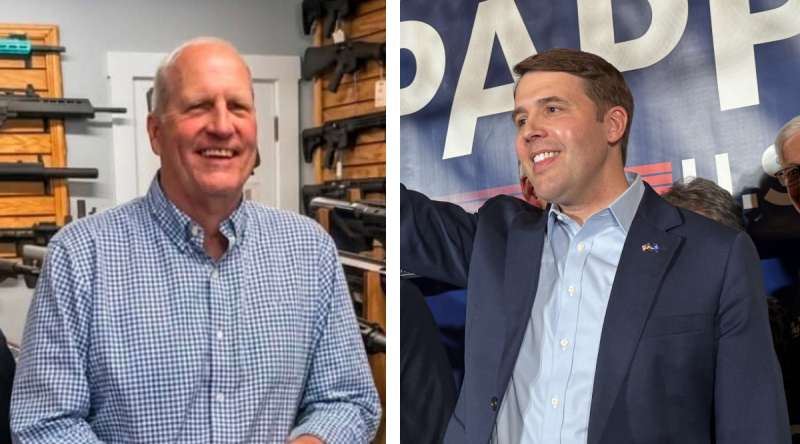
CHRIS PAPPAS, Democrat, has represented the 1st Congressional District in Congress since 2019. Before that, he served in the New Hampshire House, as Hillsborough County treasurer, and on the Executive Council from 2013 to 2019. He is a co-owner of the Puritan Backroom, his family’s Manchester restaurant. He belongs to the bipartisan Problem Solvers Caucus and has generally legislated as a moderate. He won his primary with about 65% against Dr. Karishma Manzur, a democratic socialist running to his left.
JOHN E. SUNUNU, Republican, served in the US House from 1997 to 2003 and in the Senate from 2003 to 2009. He beat Jeanne Shaheen for Senate in 2002 and lost to her in 2008. A mechanical engineer by training, he has spent nearly 18 years in the private sector since he left the Senate. He is the son of former Gov. John H. Sununu and the brother of former Gov. Chris Sununu, both Republicans. He won his primary with about 68% against former Massachusetts senator Scott Brown.
The cost of living
Both are running on the affordability crisis. They disagree completely about the cause.
CHRIS PAPPAS blames what Washington has done in the last two years. He points to tariffs pushing up costs, healthcare cuts, and rising gas prices. Pappas has also made anti-corruption a central theme and launched his campaign saying voters feel the system is rigged after a listening tour through all 10 counties. He also said his opponent would be a rubber stamp for the same policies Pappas criticized the Trump administration for pushing. “John Sununu is going to be another vote for an agenda that’s making lives bad for New Hampshire families,” he said.
JOHN E. SUNUNU blames federal spending and energy policy. He argues wages need to grow faster than prices before families recover ground they lost, and he ties housing costs back to federal trade and energy decisions. He frames his years away from office as the qualification: “I don’t have to worry about re-election.” At his launch he said Congress had become “loud, dysfunctional, even angry” and that he wanted to calm it down.
Health care
CHRIS PAPPAS has focused on three things hitting New Hampshire at once: the end of a Medicare Part D subsidy that lowers what seniors pay for prescription drugs, cuts to the Affordable Care Act tax credits that reduce monthly premiums for people who buy their own insurance, and Medicaid cuts. He calls the combination a health care crisis for the state and has argued Sununu has taken money from the pharmaceutical and insurance industries.
JOHN E. SUNUNU favors more competition and price transparency over expanding federal programs. He has said he would have handled the large federal budget bill differently. His campaign argues the contrast is about effectiveness rather than intentions.
Trump’s tariffs
CHRIS PAPPAS opposes Trump tariffs and has been highly critical of their impact on the state’s trade with Canada, New Hampshire’s largest trading partner.
JOHN E. SUNUNU does not oppose tariffs outright. His position is about how they are applied. He has said that if tariffs are used, “set them at a reasonable rate,” and that businesses need clarity and predictability, with Congress taking a bigger role than it has.
Immigration and ICE
CHRIS PAPPAS wants Immigration and Customs Enforcement (ICE) funded at normal levels and its expansion money moved elsewhere.
He introduced the PUBLIC SAFETY Act, which would redirect roughly $75 billion in ICE expansion funding from the Republican budget law he opposed and send it to local police departments to hire and train 200,000 officers nationwide. The bill would leave ICE’s regular appropriations alone. In announcing it he said the administration is “funneling billions in unnecessary funding to ICE” for operations local police say make the country less safe.
With Shaheen, he introduced the Respect for Local Communities Act, which would require Homeland Security to take public comment and get written approval from state and local officials before building or operating a new ICE processing site or detention center.
He voted against the bill funding the Department of Homeland Security, but said he was not for abolishing ICE. Explaining that vote, he said: “Granite Staters want law and order.” His argument is that ICE should meet the professional standards New Hampshire law enforcement is held to.
JOHN E. SUNUNU supports the enforcement expansion and has attacked Pappas for the funding vote, calling it outrageous that Democrats would block Homeland Security money. He supports a constitutional amendment limiting birthright citizenship. At a primary debate, he argued that people travel here to give birth so their children become citizens, which he says was not what the 14th Amendment intended. The 14th Amendment guarantees all Americans citizenship if they are born within the United States.
Data centers and energy costs
New Hampshire already has some of the highest electricity prices in the country, and data centers are the biggest new pressure on them.
CHRIS PAPPAS ties energy prices to federal policy, arguing tariffs and the administration’s decisions have pushed up what Granite Staters pay for gas and heat. Republicans attack him from the opposite direction, saying he voted for more than $100 billion in energy taxes, a characterization he disputes. He has not put out a position on data centers specifically.
JOHN E. SUNUNU has made energy costs central to his affordability pitch, connecting housing prices back to federal energy and trade policy and calling for more domestic energy investment. He has not put out a position on data centers specifically.
The state-level fight over a moratorium belongs to the governor’s race, where both candidates now support one. Neither Senate candidate has said what the federal government should do to keep data center power demand off ordinary ratepayers’ bills.
Trump
At the first Republican midterm convention ever held, in Dallas on September 9, Trump told the crowd “I’m on the ballot,” and while that is not literally true, his outsize impact on the economy and political climate broadly will have enormous influence this election cycle.
CHRIS PAPPAS wants the race read as a referendum. His argument is that whatever Sununu personally believes, a Republican senator from New Hampshire is a vote for the agenda, and that the agenda is what raised costs here. Sending Sununu to Washington, he has said, would only help Trump get what he wants.
JOHN E. SUNUNU has a complicated history with the president and has not fully resolved it in public. He was a prominent Republican critic: He led John Kasich’s 2016 New Hampshire effort and was a bound Kasich delegate at that year’s convention, backed Nikki Haley in 2024, wrote an opinion piece calling Trump a loser, and criticized Trump’s false claims that the 2020 election was stolen.
Trump endorsed him anyway, calling him an “America First patriot.” Asked directly whether he would be a reliable vote for the administration, Sununu has sidestepped the question and noted that Trump is a lame duck, arguing the race is about what comes after him. New Hampshire Democratic Party chair Ray Buckley calls him Trump’s hand-picked “pro-Trump puppet.”
Trump’s job approval in New Hampshire is 37 percent, with 62 percent disapproving, his weakest showing here since October 2017. Sununu has not said how often he would vote with the administration.
What they’re criticized for
CHRIS PAPPAS is the target of a Republican case built on his voting record. The National Republican Senatorial Committee and Sununu’s campaign argue he supported a gas tax increase, voted to raise the estate tax, backed more than $100 billion in energy taxes, and cosponsored legislation they say would cost the average New Hampshire worker about $1,000 a year. Pappas disputes how those votes are characterized.
JOHN E. SUNUNU faces two lines of attack beyond the Trump question above. Democrats argue he spent nearly two decades working for corporate interests and lost touch with the state. He also declined an invitation to the Granite State Debate during the Republican primary, so voters never saw him and Brown on a debate stage together.
Why the majority matters
Whichever party controls the Senate after November controls what the chamber investigates for the last two years of Trump’s term, including the use of subpoena power. If Democrats take one or both chambers, they are widely expected to open investigations of the administration. That is part of why national money is pouring into a state this size.
Where the race stands
Cook Political Report and Sabato’s Crystal Ball rate this “Lean Democratic”, and Inside Elections calls it “Tilt Democratic.”
A Republican-sponsored poll released in early September showed it essentially tied. As of June, Democrats led by 10 points on the generic congressional ballot according to a Saint Anselm College survey, and nearly two-thirds of Granite Staters said going to war with Iran was the wrong call, according to a University of New Hampshire poll.
How to vote
The general election is Tuesday, Nov. 3, 2026. You can check your registration and find your polling place through the Secretary of State’s office at app.sos.nh.gov.