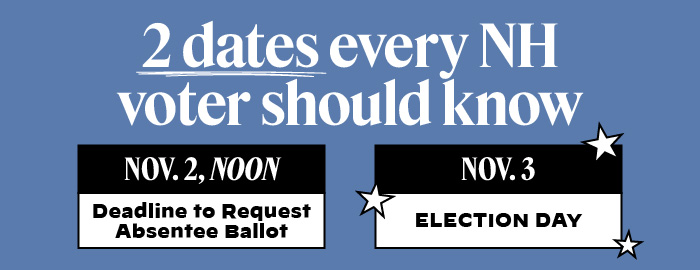
In honor of National Voter Education Week, we’ve shared important voter information all week.
Today, we’re focusing on a New Hampshire ballot measure that would limit school spending.
How does the question appear on the Nov. 3 ballot?
It says: “Shall the Town of (NAME) limit property tax growth for (SCHOOL DISTRICT/SAU) under RSA 32:5-i? If adopted for a two-year period: (1) the local property tax levy may not grow beyond the prior year’s amount, adjusted for inflation and new construction; (2) SAU central office spending may not exceed 6 percent of total school district appropriations; and (3) bonded capital costs are excluded from both limits. These caps apply only to administrative operations of the SAU central office and do not affect classroom instruction, school-based services, or other municipal expenditures. These limits may be overridden as provided in RSA 32:5-i. Adoption requires a three-fifths (3/5) majority vote.”
What exactly am I voting on?
You’re being asked whether to approve two spending limits: one on the amount of property taxes your school district can raise and another on how much its school administrative unit (SAU) can spend on central office administration.
What happens if I vote yes?
A yes vote supports adopting the limits.
Your school district’s property taxes would generally be limited to the previous year’s amount, with increases allowed only for inflation. The SAU’s central office administrative budget would also be capped at 6% of total school district appropriations.
What happens if my school district serves multiple towns?
The votes from all towns in the school district are combined to determine whether the tax cap passes. For example, if a school district serves three towns, voters in all three towns will vote on the question. Even if one town votes against the cap, it could still pass if at least 60% of voters across the entire district vote yes.
When would the caps take effect?
If approved in November 2026, the limits would begin with fiscal year 2028 school budgets and last for two years.
Voters will see the question in November 2028. Caps approved in that election would begin with fiscal year 2030 budgets.
How long would the caps last?
The law is scheduled to expire on Jan. 1, 2032. Any caps adopted under it would cease to have legal effect on that date.
Would this affect school construction projects?
No. Qualifying bonded capital costs, such as principal and interest on bonds issued for school construction or major structural renovations, are excluded from both limits.
If voters approve the caps, can school districts ever exceed them?
Yes. The law allows districts to override the limits through a separate vote.
For districts with annual school meetings, an override generally requires approval from at least 60% of voters casting a vote on the appropriation. Certain local charters may have different supermajority requirements.
➡️ See a sample ballot and read the full law for yourself.