First, a heads up—we’re off on President’s Day, so no newsletter on Monday. Check your inboxes on Tuesday!
Second, HGTV crowned Littleton the most charming small town in New Hampshire—and honestly, it’s hard to argue.
Home to about 5,900 people, Littleton sits right in the White Mountains and has that classic, walk-everywhere kind of vibe. HGTV gave a shoutout to longtime favorites like Chutters (yes, the one with the world’s longest candy counter—112 feet of pure nostalgia), plus Lahout’s, America’s oldest ski shop. Add in historic spots like Thayers Inn, and it’s easy to see why this town keeps winning hearts. Have you been lately? 🏔️🍬
|
📰 What we’re reading, news from around the state
📢 We asked, you answered: Should NH keep its first-in-the-nation primary status?
🔍 Question of the week: Is it really time to move on from the Epstein files?
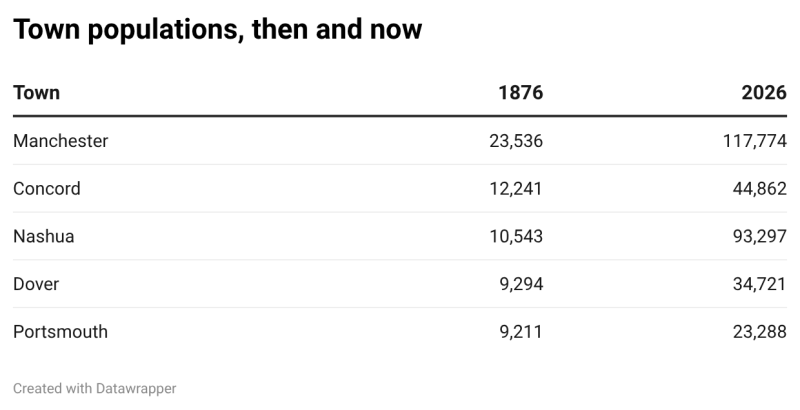
🔥 Then and now: New Hampshire’s largest cities in 1876
|
|
|
P.S. If this made your inbox better, it’ll probably do the same for a friend. Forward away.
|
|
|
👉 FBI invites NH secretary of state on call to discuss ‘preparations’ for midterm elections
“The meeting comes as the Trump administration and New Hampshire are engaged in a legal battle over the state’s voter rolls.” — New Hampshire Bulletin
👉 NH casino industry hits half-billion dollars a year
“New Hampshire’s casino industry saw significant growth last year as larger facilities opened, game rooms expanded, and slot machines were introduced — pushing state revenue from charitable gaming up more than 70%.” — New Hampshire Public Radio
👉 Elementary school students propose official NH state doughnut
“A group of fourth-grade students from Nashua’s Bicentennial Elementary School crafted a bill to designate a state doughnut after a visit to the State House and learning the pumpkin was named the state fruit in 2006 from fourth graders in Harrisville.” — Concord Monitor
👉 Local woman gets probation for cockfighting in NH and NC, feds say
“A New Hampshire woman was sentenced to probation for her role in illegal cockfighting activities in New Hampshire and North Carolina, US Attorney Erin Creegan said.” — Boston 25
👉 Hampton rallies for young mechanic paralyzed in crash: ‘Miracle he survived’
“Paralyzed from the neck down, he returned home to Hampton Beach on Jan. 29 after two and a half months at Spaulding Rehabilitation Center in Charlestown, Massachusetts. His family’s home on Harris Avenue is now being renovated to accommodate his needs and round‑the‑clock care.” — USA Today via Reuters Connect
|
|
|
This week, we asked readers: Should New Hampshire keep its first-in-the-nation primary status?
Here’s what you had to say…
|
“I don’t think states should have any involvement in primaries; they’re private associations so the state has no interest in how they handle internal affairs. But FITN has such a positive economic impact in NH, it has proven to be a good investment.” — Keenan Pawley
“It’s great to see all the candidates coming here, and it’s great for NH’s economy. But is it fair for NH to always have this privilege? I think NH should share this wonderful opportunity with other states. Maybe there could be some kind of a lottery or something to choose the first every year or every couple of years. Let’s spread this treasured first position with other states and not be so selfish and greedy.” — Barb Southard
“Yes, New Hampshire should keep the designation of first in the primaries. Continue that history.” — Mike Schock
“I’m not sure that NH being first in the nation benefits the election process. The focus on face-to-face contact is good, but the media hoopla gets in the way of evaluating a candidate’s integrity. Time will tell.” — JoAnn Carlson
“No, NH should NOT keep its FITN primary status as long as it continues to be a semi-open primary, which greatly restricts voting and is one of the major causes of our dysfunctional government, including the rise of Trump. FITN should go to an open single ballot primary with ranked choice voting (RCV) in the general election. The only state that uses that system is Alaska (Maine uses RCV but doesn’t have an open primary). Other reforms, such as fusion voting and multi-member congressional districts with proportional representation would also be helpful.” — Bill Black
“It’s a great opportunity for NH, personally and financially, for sure. However, some people look to the early primaries to see how people connect to the candidates and their messages, and I’m not sure NH is a good representation for most of the US.” — Lori McGinley
“We have a lot more to be concerned about than this nonsense. In reality, New Hampshire is not a cross section at all of the country on any level of life, culture or business and I believe that the first primary should be in a state with the most diversity, which is what makes this country great.” — Marci Smoger
|
|
|
On Feb. 11, Attorney General Pam Bondi testified on Capitol Hill about the Justice Department’s handling of the Epstein files. Rather than answer many of the questions directly, Bondi deflected and fired personalized criticisms at the Democratic senators questioning her, echoing President Donald Trump’s call on Feb. 3 to “move on” from the matter.
Trump is mentioned more than 38,000 times across documents released by the Justice Department on Jan. 30. Many of the files are heavily redacted—victims’ names are visible, while alleged perpetrators’ identities are blacked out.
So this week’s question is…
|
Is it really time to move on from the Epstein files?
|
|
|
After the 1860 census and Abraham Lincoln’s election, the US erupted into the Civil War as eleven southern states seceded, leading to four years of conflict that claimed 600,000–750,000 lives. With the war’s end and roughly 4 million Black Americans emancipated, many families sought new opportunities, often moving west by covered wagon or stagecoach to start fresh and claim land.
The completion of the first transcontinental railroad on May 10, 1869, transformed travel, allowing passengers to cross the country in just four days and accelerating settlement across the western territories. Irish and Chinese laborers faced grueling conditions to make this possible.
This era of reconstruction and migration shaped urban development, and the 1870 census captures how New Hampshire’s cities looked less than a decade after the war. Stacker used Census data to compile a list of the state’s largest cities at that time.
Here’s a look at New Hampshire’s cities, then and now:
|
⭐ Manchester (Hillsborough County)
Then: Manchester topped the list with a population of 23,536 (ranked No. 56 nationwide).
Now: The city’s estimated population is about 117,774, making it by far the largest in the state.
⭐ Concord (Merrimack County)
Then: Concord had a population of 12,241 (ranked No. 137 nationwide).
Now: Today, its estimated population is around 44,862.
⭐ Nashua (Hillsborough County)
Then: Nashua’s population was 10,543 (ranked No. 168 nationwide).
Now: Nashua’s estimated population is about 93,297, making it the second-largest city in New Hampshire.
⭐ Dover (Strafford County)
Then: Dover had a total population of 9,294 (ranked No. 211 nationwide).
Now: Its estimated population is around 34,721—a significant jump.
⭐ Portsmouth (Rockingham County)
Then: Portsmouth’s population totaled 9,211 (ranked No. 212 nationwide).
Now: The city’s estimated population is about 23,288.
⭐ Keene (Cheshire County)
Then: Keene had a population of 5,971 (ranked No. 384 nationwide).
Now: Keene’s estimated population is approximately 23,166.
⭐ Somersworth (Strafford County)
Then: Somersworth’s population was 4,504 (ranked No. 647 nationwide).
Now: The city’s estimated population is about 12,218.
⭐ Rochester (Strafford County)
Then: Rochester had a total population of 4,103 (ranked No. 764 nationwide).
Now: Rochester’s estimated population is around 33,748.
⭐ Claremont (Sullivan County)
Then: Claremont’s population stood at 4,053 (ranked No. 786 nationwide).
Now: Its latest estimated population is about 13,105.
⭐ Exeter (Rockingham County)
Then: Exeter had a population of 3,437 (ranked No. 1,109 nationwide).
Now: Exeter’s estimated population is just over 16,000.
⭐ Gilford (Belknap County)
Then: Gilford’s total population was 3,361 (ranked No. 1,172 nationwide).
Now: Its estimated population is around 7,900.
⭐ Lebanon (Grafton County)
Then: Lebanon had a total population of 3,094 (ranked No. 1,382 nationwide).
Now: Lebanon’s estimated population is about 15,389.
|
|
|
Enjoying this newsletter?
|
|
|
Do you want to support Granite Post’s mission while showcasing your products or services to an engaged audience of 30,000+ subscribers?
Email advertise@couriernewsroom.com for more information.
|
|
|
You are receiving this email because you opted in via our website.
Our mailing address is:
Granite Post / COURIER
611 Pennsylvania Ave. SE
Washington, DC 20003-4303
Want to change how you receive these emails?
You can update your preferences or from this list.
|
|
|
|