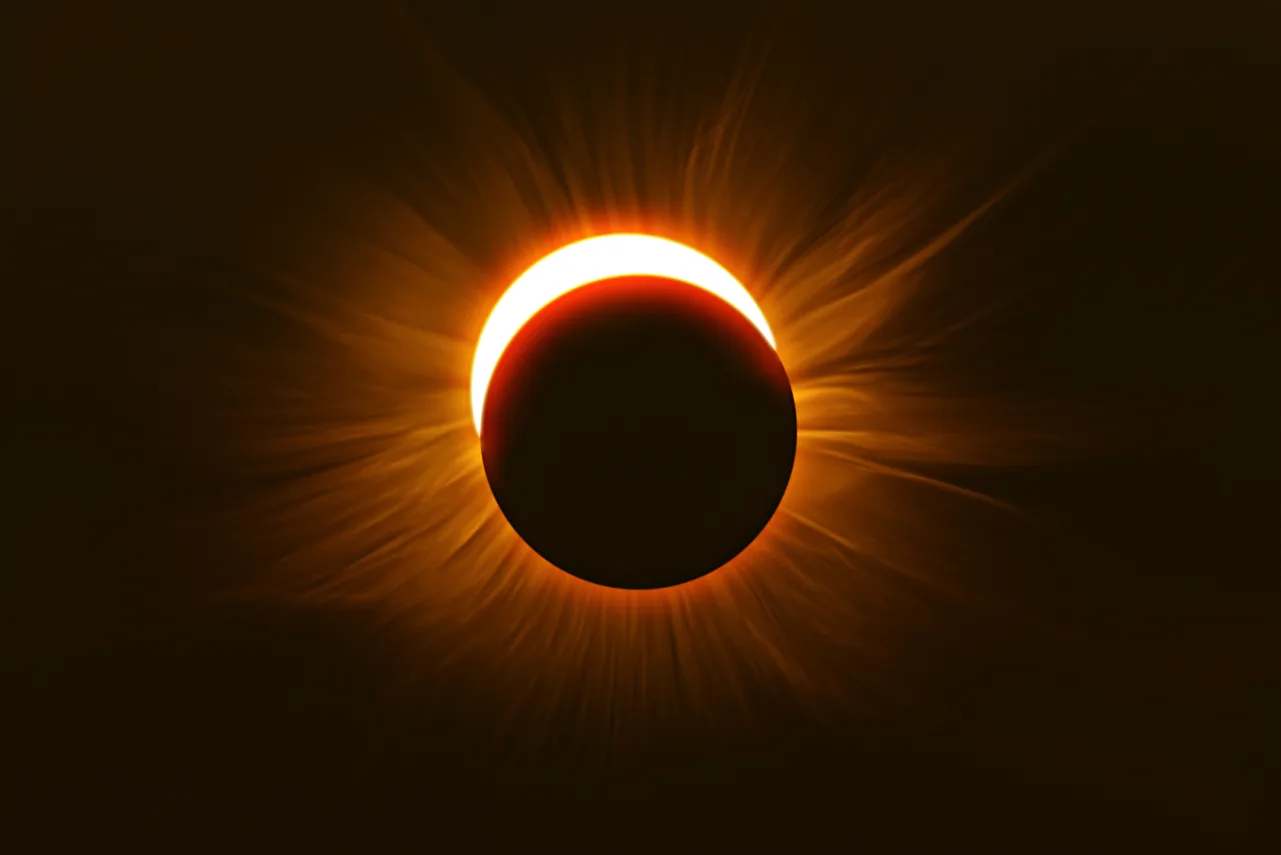
A Solar eclipse was spotted Aug. 21, 2017 at 1:15 p.m. in Wisconsin. By Matt Anderson Photography.
By now, most New Hampshire folks know that in less than a week, we’ll be in the path of totality for the first total eclipse of the sun for the first time in 65 years. On April 8, New Hampshire is expected to welcome tens of thousands of eclipse tourists, many of whom have already booked lodgings, scoped at hiking trails and campsites. It’s a big deal. Not just here, but everywhere in the Northeast where the celestial event will be visible. In addition to packing your special eclipse glasses and pinhole projectors, we’re offering fun eclipse facts to bring along that guarantee the best small talk ever to share with your fellow eclipse viewers.
According to NASA, Granite Staters are among 31 million Americans who live in the path of this year’s solar eclipse, that’s more than twice as many as the 2017 eclipse, and 10 times as much as when the skies darkened in 1979.
It is estimated that one to four million people will travel on April 8 to those states that are on the eclipse’s path of totality. Those tourists will spend approximately $1.6 to $2 billion dollars for the April 8 event. Some of that, of course, will stay right here in the Granite State where it’s estimated over 20,000 visitors will come here to watch the event.
If weather conditions are right, as totality nears things get weird, according to Astronomy Magazine. The sky will look like the onset of night, though not precisely. Areas much lighter than the sky will appear around the horizon. Shadows will look different. Typically if there are breezes they dwindle and birds will stop tweeting and chirping making things very, very quiet. And often the temperature can drop by 10-15 degrees cooler.
Bonnie Tyler’s 1983 hit, “Total Eclipse of the Heart,” was written by the late composer Jim Steinman for an unfinished musical production based on the 1922, classic vampire film, “Nosferatu.” Steinman, best known for writing songs for Meat Loaf, said it was actually a lunar eclipse that inspired him to write the tune. “I thought of it more as a fever song,” he said in a 1983 interview. “Most pop songs are about the lyrical side of love, the pleasant side. I’ve always liked writing about the other side, the darker side. An eclipse seemed like the perfect image to describe when someone is totally overwhelmed by love. It’s like an eclipse. There’s no more light at all.” The video for the hit song was filmed in a gothic-style former asylum in Surrey, England.
We live in New England, where snow falls after Easter and the weather is, well, funky. Right now, things look good for Monday, with mostly sunny skies and temps high in the 40s and 50. But it’s New Hampshire things can change. So what happens if it’s cloudy and/or raining on eclipse day? If it’s cloudy, you’re going to miss the wonder of the moon’s shadow, covering the sun but it will get dark. No matter what, you’ll have to wear safe eclipse glasses to protect your eyes when looking at the eclipse.
According to the National Center for Atmospheric Research, the oldest documented solar eclipse was recorded on a clay tablet found at Ugarit, in modern Syria, with the eclipse taking place on March 5, 1223, B.C.
Before modern science could explain what happens during a total solar eclipse, the remarkable sights were the source of fascination, mystery, and rituals for millennia. Such was the case with many Native American tribes. According to Atlas Obscura, the Cherokee Nation, in current-day Oklahoma, believed the eclipse was a giant frog in the sky attempting to eat the sun. The tradition was for everyone to go outside and make a big noise with drums, whistles, and voices to scare the frog away. In a story told by the Choctaw Nation of Oklahoma, the waning light was blamed on giant, ravenous black squirrels attempting to devour the sun. To chase the squirrels away, everyone would come outside, shoot arrows, throw sticks and make as much noise as possible. As the sun slowly remerged, the crowd yelled, yell “Funi-lusa-osh mahlatah—the black squirrel is frightened.” In an Ojibwe story, the Sun was extinguished during an eclipse, so people shot flaming arrows into the sky until it was relit.
In ancient China, solar eclipses were interpreted as the dragon devouring the sun. The belief was that banging pots and drums during an eclipse would scare away the dragon, allowing the sun to return. In Korea, a pack of dogs is said to be swallowing the sun.
During the Middle Ages in Europe, eclipses were often viewed with fear and superstition. They were sometimes interpreted as divine warnings or punishments, leading to various rituals and prayers to ward off evil influences.
Solar eclipses only happen at a New Moon, when the Moon is between the Sun and Earth according to “Astronomy Magazine.”
According to wunderground.com, There have been 15 total eclipse events to affect at least a portion of the continental US over the past 150 years (since the year 1867). These were in 1869, 1878, 1889, 1900, 1918, 1923, 1925, 1930, 1932, 1945, 1954, 1959, 1963, 1970, and 1979. Of these, only one traversed the entire country coast-to-coast: the event of 1918. On August 31, 1932, The path of totality included only a small portion of the Northeast, including Vermont, New Hampshire, and southern Maine
There have been many works of literature that include a solar eclipse as part of the plot, the best known is Mark Twain’s 1889 novel, “A Connecticut Yankee in King Arthur’s Court.” In it, Hank Morgan, a 19th-century mechanic, is hit on the head and wakes up in the sixth-century court of King Arthur. He stops himself from being executed by remembering a total eclipse would happen on that day in 528 and convinces his would-be executors that he’s a wizard when he tells them he will bring on night in the middle of the day, and destroy the sun if they don’t let him go. Sorry to fact check Twain, but there was no solar eclipse in England in 528.
Author


Spring fever hits New Hampshire: 10 fun events to put on your calendar this weekend
If you’re ready to shake off winter, this weekend is packed with ways to do it. From flipping logs in search of salamanders to spinning carnival...
Your weekly guide to taking action in New Hampshire March 30 to April 5.
You showed up this weekend, Granite Staters—and it mattered. Even in the balmy 30-degree weather, there was no shortage of funny signs, neighbors,...

‘No Kings’ protests planned across New Hampshire. Here’s when and where
Your guide to attending No Kings Day protests, marches, and rallies across New Hampshire on March 28. Looking for a way to take action in your...

Mudfest, backyard chickens, maple weekend, and more. Top events across New Hampshire, March 19–29
A version of this story appeared in Granite Post's newsletter. Subscribe here. From music festivals and comedy shows to hands-on workshops and maple...
Your weekly guide to taking action in New Hampshire March 14-22, 2026
Looking to get involved this week? You can join ICE Out rallies and response trainings, connect with your neighbors, and show up for community...
From art to adventure: NH’s top events coming up
Spring is on the way, and New Hampshire is buzzing with events for every interest—from floral art exhibitions and family game days to half marathons...