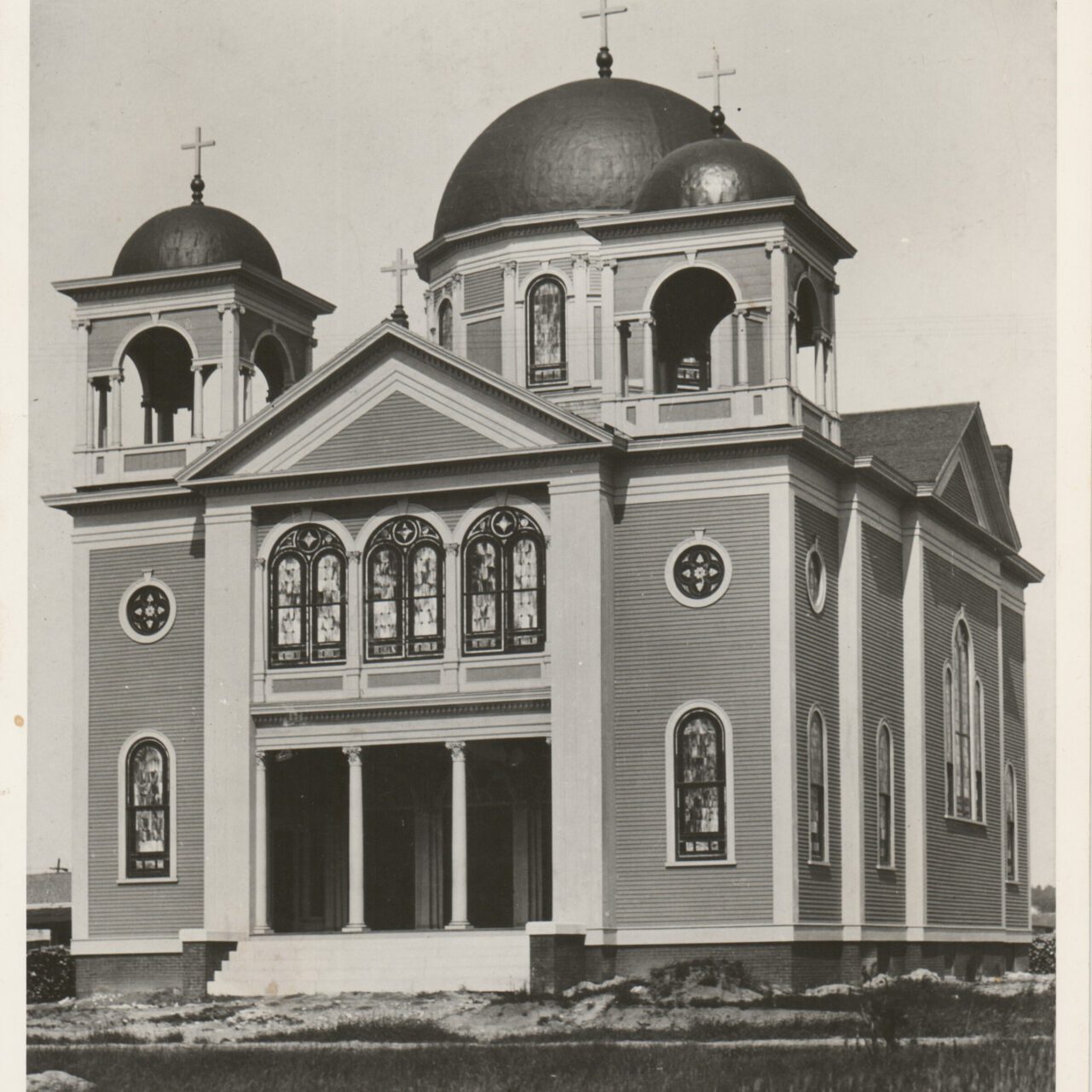
The first St. George Church that was located on 95 Pine St., July 1906. (Courtesy Meletios Pouliopoulos)
For many, Easter celebrations may have concluded last month, but for Orthodox Christians, the “bigger than Christmas” holiday falls this Sunday.
In New Hampshire, one such community ready to usher in Orthodox Easter celebrations is the Greek American diaspora.
“Greek Orthodox Easter is probably the most religious day in the Orthodox calendar,” said Walpole resident George Tsitsonis. “In the United States, Christmas takes its own giant place on top of all holidays, but in Greece it is kind of the opposite.”
Prior to Orthodox Easter Sunday, most Greeks observe a fasting period of 40 days, called Lent. The rationale behind fasting is to cleanse the body to celebrate Christ’s resurrection on the midnight before Easter.
“Right now they’re in Holy Week,” Tsitsnois said of the final week of Lent.
Holy Week is marked with nightly masses—charting out the final week of the life of Jesus Christ—at his church, St. George Greek Orthodox Church in Keene.
“This year, our church numbers are down from what they used to be,” he said. “So unfortunately we did not have a Monday or a Tuesday this year.”
Good Friday is another significant day, he said.
“We actually exit the church and bring out the Epitaphios, the tomb of Christ,” said Tsitsonis, who traces his Greek heritage to his parents who migrated from Greece in the ’70s. “And we walk around the church three times with that, and then bring it back inside to decorate it with flowers.”
Meletios Pouliopoulos, of Stratham, said many Greeks were drawn to economic opportunities offered at the textile mills in Amoskeag in the late 1800s. As their numbers ballooned, churches were established to knit the community together and provide a space for socializing, he said.
Today, there are 11 Greek orthodox churches throughout the state, and growing up, Pouliopoulos attended Saint George’s Greek Orthodox Cathedral in Manchester, the oldest church (it was moved to its current location on Hanover Street in 1970) in the state.
For Pouliopoulos, who is the founder of Greek Cultural Resources, a New Hampshire-based nonprofit that documents, preserves, archives and promotes Greek music and relevant traditions, the community spirit shared by Greek Americans in the region has changed over time.
“There was an intimacy in our homes and in our lives,” he said, referring to his childhood. “It’s funny how we didn’t have as much technology as exists today. Yet we were somehow so much closer.”
While Tsitsonis and Pouliopoulos both recalled spending many days leading up to Easter at their churches, Tsitsonis looked back at his favorite Easter tradition.
“It is a big tradition to participate in the breaking of red eggs. So we hard boil eggs and paint them red to signify the blood of Christ,” he said. “And then it becomes a game … you try to crack the top of my egg with the top of your egg. Whoever’s egg cracks is kind of out.”
Attending midnight mass right before Easter Sunday is Tsitsonis’ fondest memory from childhood, and one that he looks forward to even today.
“I was always really excited to go to that. It was a very cool experience to be in church that late,” he said. “It is sort of a once-a-year phenomenon that you do not get any other time in the year.”
On the other hand, for Pouliopoulos, the Saturday midnight mass evokes something “very powerful.”
“And then Saturday evening as a service of resurrection, which is generally done at midnight all the lights are turned off, and then the priest comes out with the candle symbolizing the light of the resurrection,” he said “We pass that light throughout the church and the whole church is lit up. And then we sing this ‘Christ is Risen’ hymn, and there are passages read from the Bible.
It’s very, very powerful.”
And on Easter Sunday?
“It’s always a big gathering of family and friends,” Tsitsonis said. “I just loved having everyone together. We ate a lot of Greek food.”
Author

Support Our Cause
Thank you for taking the time to read our work. Before you go, we hope you'll consider supporting our values-driven journalism, which has always strived to make clear what's really at stake for New Hampshirites and our future.
Since day one, our goal here at Granite Post has always been to empower people across the state with fact-based news and information. We believe that when people are armed with knowledge about what's happening in their local, state, and federal governments—including who is working on their behalf and who is actively trying to block efforts aimed at improving the daily lives of Granite State families—they will be inspired to become civically engaged.

Can New Hampshire mom win ‘Survivor 50’? Odds say yes as premiere nears
Season 50 of "Survivor" is almost here, and according to early betting odds, a New Hampshire woman has a chance at winning it all. Titled "In the...

We asked, you answered: Is it time to move on from the Epstein files?
A version of this story appeared in Granite Post's newsletter. Subscribe here. On Feb. 11, Attorney General Pam Bondi testified on Capitol Hill...

Hampton rallies for young mechanic paralyzed in crash: ‘Miracle he survived’
Bobby Connell always made time to help out at his old job at Farr’s Famous Chicken, cooking alongside owner Paul Conway even after he’d moved on to...

Six students win New Hampshire’s 2025 ‘I voted’ sticker contest. See the winning designs
New Hampshire officials have announced the six winning designs in the 2025 “I Voted” Sticker Contest, a tradition that invites young Granite Staters...

We asked, you answered: How are health insurance hikes impacting you?
Health insurance prices are going up—a lot. If you buy coverage through Healthcare.gov here in New Hampshire, premiums are expected to rise about...

We asked, you answered: How do you feel about daylight saving time?
Did you know daylight saving time was first widely proposed by George Vernon Hudson in 1895? The goal was to make better use of daylight during the...