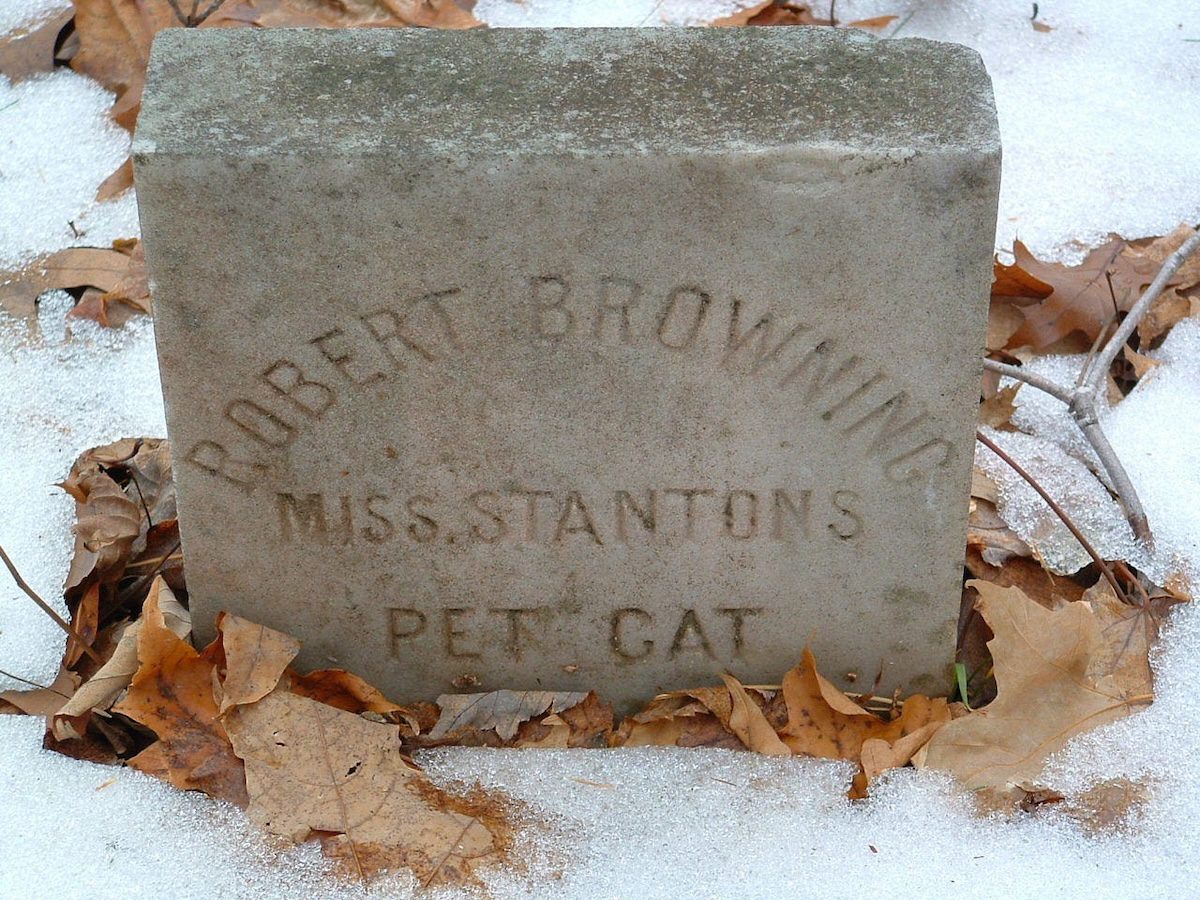
The grave of Robert Browning, the cat owned by Miss Abby Ellen Stanton, stands among the Sanborn family markers in one of Hampton’s oldest private cemeteries. USA Today via Reuters Connect
As you drive around the Seacoast, you have probably seen small cemeteries in some of the oddest places, whether a Starbucks parking lot or an overgrown field.
These are remnants of a time when burial was likely to be at the family farm or homestead rather than in a town center, such as Hampton’s Ring Swamp or High Street Cemeteries. Hampton has seven of these small plots, and one contains two unlikely but obviously well-loved creatures.
Sanborn Cemetery is one of these private cemeteries, located off Exeter Road. Simon Sanborn was the original owner of this land; the cemetery is located at the back of what was once one of his fields. Various members of the Sanborn family rest in this plot, with the earliest internments dating from the early 1800s. But two markers differ from the rest. They are for Robert Browning and Little Lady Pitapat.
Robert Browning, as stated on the gravestone, was Miss Stanton’s cat. It can be assumed that Little Lady Pitapat, who died in 1913, was also hers. Their carved stone markers speak to how highly they were regarded by their owner.
Abby Ellen Stanton was born in Hampton in 1834. Her father was a mason and moved often. She was well educated, and in 1871 would join the staff of the Wheaton Seminary, a women’s academic institution outside Boston. She was a French teacher, having lived for a time in Paris. Miss Stanton’s hiring faced some opposition because some trustees viewed her as “not Christian enough” to set a good example for the students. But the principal and others were able to get her approved. Miss Stanton must have flourished there since, in 1880, she was named principal.
Miss Stanton was popular with the students. She was stern but also fair and had “modern” ideas.
Contemporaries described her as tall and distinguished, wearing stylish clothing and having a keen mind. One student later described her as always looking like a “grand, although gracious lady.” She abolished some of the trivial rules and instituted more self-government among the students, which also added to her popularity. She also increased the size and quality of the faculty and established courses of study not previously available.
Miss Stanton’s time at Wheaton was a challenging one. Wheaton Seminary was founded in 1834 when there were few institutions granting advanced degrees to women. But by the late 1800s, it was facing increasing competition from schools such as Radcliffe, Smith and Mount Holyoke. Miss Stanton realized that the changing environment needed new leadership, and the trustees reluctantly accepted her resignation in 1897.
Miss Stanton would return to Hampton in her retirement and live not far from the Sanborn farm on Exeter Road. She would die in 1924, and her funeral in Exeter had The Reverend Doctor S. V. Cale, president of the newly named Wheaton College, officiating. She is buried with the rest of her family in Manchester.
As for Robert Browning and Little Miss Pitapat? Anyone who has lost a pet can understand Miss Stanton’s grief and her desire to memorialize them. Since the time of the ancient Egyptians, humans have honored their dead pets, and today, pet cemeteries offer a formal way to bury and remember the animals that mean so much in our lives.
This article originally appeared on Portsmouth Herald. Reporting by Mary Ann Nelligan
Author

The world’s deadliest animal is probably outside your New Hampshire home. See what CDC says
The world’s deadliest animal is probably outside your home right now. And no, it’s not a bear, or even a moose – it’s a mosquito. Despite its small...
Oil truck driver saves dog in Rochester fire: ‘What a courageous act’
Matthew Wrisley, an oil truck driver for D.F. Richard Energy, is being credited with saving a family's dog in a fire that destroyed their home Sept....

This is New Hampshire’s most popular cat name
This story appeared in the Granite Post's newsletter. Subscribe here. Ever met a cat named Lily? Turns out, it’s the most popular cat name in New...

The sweet reason why New Hampshire has a new state marsupial
Vivien Deal-Sosa worked alongside her Chesterfield School classmates to petition for the Virginia opossum to become NH’s state marsupial. Here’s how...

If your dog had a job, what would it be? Readers share their pup professions
Ever wonder what your dog would do if they had a 9-to-5? We recently asked readers to imagine their pup in the workforce—and their answers did not...
Your guide to wild turkey hunting season in New Hampshire
What you need to know about spring wild turkey hunting in New Hampshire, from rules and regulations to top locations. It’s spring in New Hampshire....