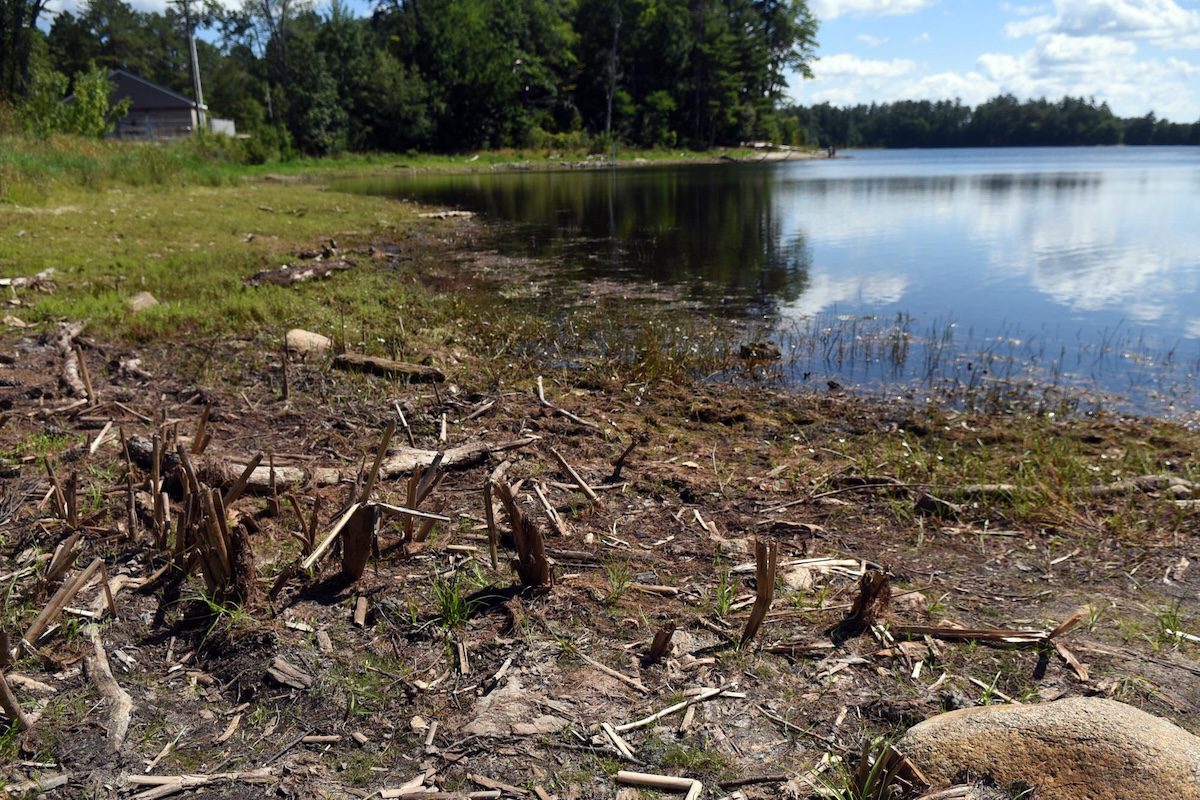
Dover's City Council voted to attempt to remove milfoil from Willand Pond in 2026 without using an herbicide, going against the recommendation of the New Hampshire Department of Environmental Services and the city manager. USA Today Network
New Hampshire Department of Environmental Services officials have stated the agency likely will not issue a permit for mechanical removal of milfoil in Willand Pond, according to Mayor Dennis Shanahan. The City Council approved the non-herbicide method of milfoil removal March 11.
The City Council voted 5-4 to remove the invasive milfoil from Willand Pond without using the herbicide ProcellaCOR, instead hiring a contractor to utilize both diver-assisted suction harvesting (DASH) and eco harvesting, which is a mechanical process NHDES is saying it won’t certify.
The contract with C&D Underwater Maintenance would be for $149,000, including $84,000 for DASH services and $65,000 for the eco harvesting.
The council’s decision to choose the “least toxic” option goes against the recommendation of NHDES, which advised the manual process alone won’t be effective. But that’s not the only problem with Dover’s approved plan, according to NHDES.
Georgia Bunnell, exotic species program coordinator for NHDES, said at the March 11 council meeting C&D Underwater Maintenance is not New Hampshire weed control certified, and it cannot do DASH in the state at this time. She said it’s a required certification and a short course, and added the contractor is willing to do it.
The same is not true for the eco harvesting part of the process, which NH DES does not permit at all, according to Bunnell.
Why NHDES won’t certify eco harvesting
Bunnell during the March 11 council meeting said the eco harvester is “not an approved NHDES control method, it has not been used in New Hampshire ever. We’ve actually found in other states it’s becoming a new management technique that it actually chops up some of the plants and fragments it more, which ends up spreading it.”
Shanahan said a letter was sent to the city, “saying that the mechanical removal is not something that the DES has any interest in permitting due to some concerns they have.”
Shanahan said he believes there were some “technical reasons” DES is concerned about, that “the process would release some milfoil into the pond that might cause it to spread, that they really didn’t have strong confidence in that process to be able to control the spread of milfoil as it’s being removed.”
Dover likely to go with DASH process only in 2026
The mayor said city staff has gone back and talked with the vendor “and told them that we’ll most likely be asking them to do just the DASH.”
The milfoil infestation is 28-plus acres, according to city documents.
City Manager Michael Joyal, who had recommended the herbicide method, said C&D Underwater Maintenance has stated its work won’t be as effective with DASH only, and no eco harvesting.
“The contractor has since indicated it is therefore unlikely they will achieve the 75 to 80% removal they proposed by only using DASH,” Joyal said in an email March 23. “They have advised that they expect their personnel to complete the NH DES required certifications this May and then will begin DASH only as weather conditions allow.”
“I certainly am so very hopeful that we can get a significant amount of cleanup done this year with a non-herbicide treatment, and then if we have to come back and do this and finish it up next year and get Willand Pond to where it needs to be, that we’ll be able to accomplish that,” Shanahan said previously.
This article originally appeared on Fosters Daily Democrat. Reporting by Sarah Donovan.
Author

Ayotte calls for higher penalties for refusing breath alcohol test
The price you pay for refusing a Breathalyzer in New Hampshire could double under a bill supported by New Hampshire Gov. Kelly Ayotte. In a press...

NH bill would double charges for those without NH E-ZPass
The New Hampshire state Senate passed a bill to double E-ZPass charges for out-of-state drivers on March 5. That means the state is one step closer...

Music Hall gets $3M donation from Martha Fuller Clark
The Music Hall on March 2 announced the largest gift in its history: a $3 million pledge from Martha Fuller Clark, a former state senator known for...
What to know about New Hampshire’s 2026 Town Meeting Day
New Hampshire’s 2026 Town Meeting Day takes place on March 10. Here’s everything you need to know. New Hampshire’s Town Meeting Day is a tradition...

‘Survivor’ Season 50 starts February 25 with a familiar face from NH
"Survivor" fans, get excited. The reality competition show returns for its 50th season this month, and it's bringing back multiple contestants...
Peanut butter recalled in New Hampshire, 39 other states. What to know
If you have peanut butter in your New Hampshire home, it may be time to check the label. Federal officials say more than 20,000 peanut butter...