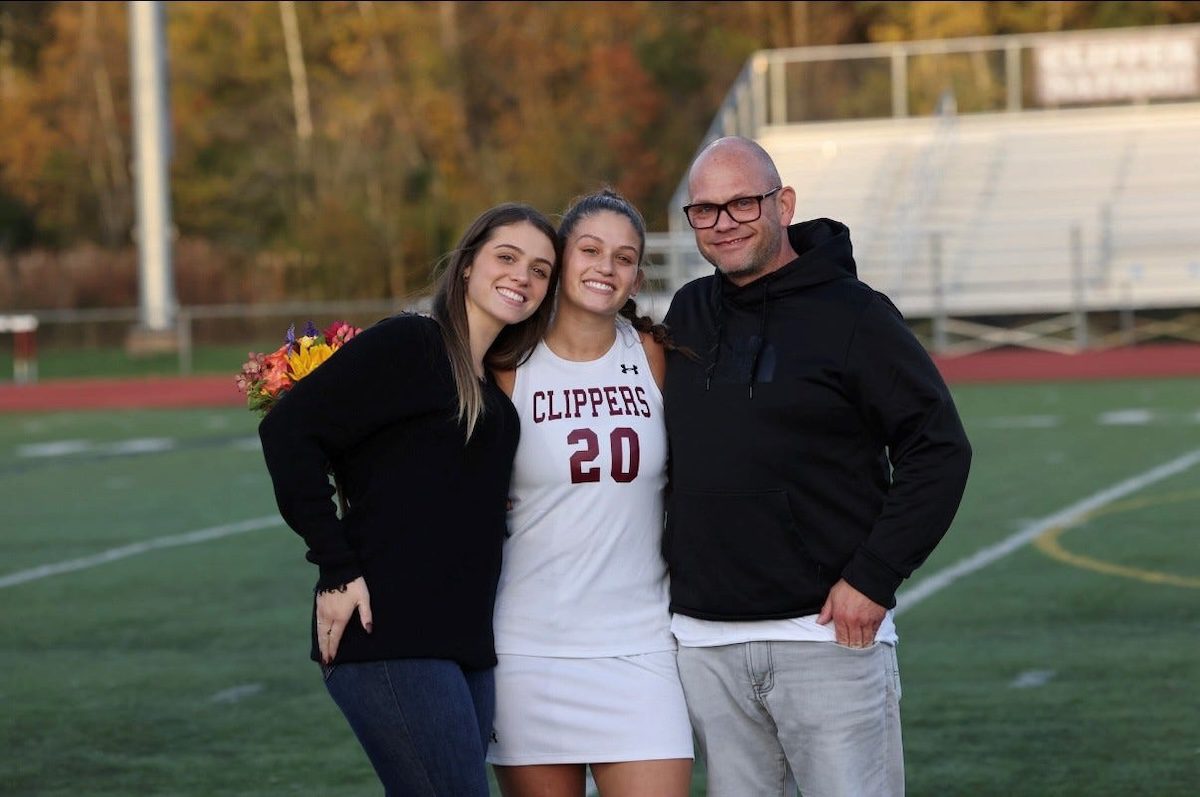
Eric Sirles is grateful for his family, including daughters Olivia and Alexandra, who supported him in his near-death experience with COVID-19. USA TODAY NETWORK
Eric Sirles said when Portsmouth Regional Hospital staff saved his life, he decided to pay it forward by becoming a hospital volunteer.
Sirles, a Portsmouth resident, now 48, came close to losing his life when he battled COVID-19 in 2022, his third bout with the virus.
Amy Lester, director of volunteer services, said she is thrilled to have Sirles volunteering with the No One Dies Alone program. Volunteers sit with and help patients who either have no family to be with them as they face death, or to offer family members respite from their own vigil.
Sirles was so sick in 2022 that when he went to his primary care doctor seeking relief from his symptoms, Dr. Keenan Al-Hojerry of Portsmouth Family Care in Newington called an ambulance. It was the start of a dramatic, successful life-saving effort.
How Eric Sirles went from doctor’s office to coma
“The first time I got COVID, my symptoms were severe headaches, cold symptoms, flu-like,” Sirles said. “The second similar, but this time, I had a heavy depletion of energy. I literally sat on a couch for two to three days. I had a loss of taste and just was not feeling well. I was having trouble breathing. It was a full-body exercise to get a breath out.”
Sirles had flown to Miami to visit his oldest daughter, Olivia, stationed there with the Coast Guard, at the end of April, 2022. He said it was on his return trip home that he began to feel sick and wondered if he was having another bout with COVID.
“When I started having agitated breathing, I suspected Covid,” Sirles said. “By May 6, I was really sick. I did not want to get off the couch. My daughter Alexandra made me an appointment with my primary care doctor, and by then felt like I was dying.”
For Sirles, this is when things got a bit fuzzy. Much of what he recounted came from what people told him.
“I remember going inside the doctor’s office,” he said. “I remember him coming back in and telling me yes, I had COVID, but there was more. He said my heart was operating at about 5% and he said he had called an ambulance. I thought I could drive, but he said no.”
If Sirles had driven himself, he might never have made it.
“I got in the ambulance and was told later my heart went into (atrial flutter),” Sirles said. “The ambulance crew took care of me and my heart until I got to the hospital.”
Upon arrival at PRH, Sirles was placed on ECMO (extracorporeal membrane oxygenation) a lifesaving method that takes over the functions of the heart and lungs temporarily. He was hooked up in Portsmouth and then transferred to Tufts Medical Center.
“Once on it, I experienced kidney failure at some point,” Sirles said. “I had massive strokes, and a heart attack, I am blessed, only by God’s grace that I am able to get to do what I do today.
When Sirles’ daughters, Olivia and Alexandra arrived, strict COVID practices were in place. They needed to wear gowns and mask up to enter his room, and they needed to make a decision.
“I had slipped into a coma,” he said. “I was in a coma for close to two weeks. During that time I was actually very aware, of my dreams, of my daughters and others talking in my room.”
Sirles said his daughters, acting on family conversations about death, asked if he had brain activity. He did, so they chose to continue treatment, to hope for the best.
Al-Hojerry, who is also a hospitalist at PRH, said Sirles had a very aggressive case of COVID.
“When he arrived, COVID was at a peak,” he said. “We were seeing a lot of patients and we put him a room and gave him a mask and gown. He reported fever, coughing, and chest discomfort. I examined him and he looked toxically sick per my clinical intuition; he had that death look, and he definitely needed to be in the hospital. … We called the ambulance. Thank God, my office is only about 5 minutes away (from PRH).”
Al-Hojerry said Sirles was critically ill when he arrived at the hospital.
“They worked on him for a half hour, brought him back and put him on a ventilator. … Even on a ventilator, a COVID patient can’t get the secretions out. The ECMO acts like your lungs, and we were able to save his life, and he graduated from ICU after he fought a hell of a fight.”
Al-Hojerry said even he didn’t realize how severe Sirles’ illness was at first.
“Usually when I send people to the hospital, I go see them and check on them,” he said. “What I heard happened … gave me a goosebump, knowing he was going to drive himself. We have a trust relationship. If he had been driving, who knows? The lord gave him a second chance.”
It was June before Sirles was released from Tufts Medical Center. His decision to volunteer at PRH came from the gratitude he felt for being alive.
“My doctors say I made a remarkable recovery,” Sirles said. “My heart is at 100%. I had to learn to walk, talk, use my hands. Today, I run, work out at the gym. I work in high tech, have for over 25 years. When I woke up I was on dialysis. Not any longer. Physically and mentally, I am doing great.”
Sirles said his ordeal gave him a new outlook on life
“I want to show up, to be of service to others,” he said. “I want to be kind, to be here for life.”
Enter Jack Loring, a hospital volunteer Sirles had befriended.
“He said, ‘I do this thing at the hospital,’ and when I said I wanted to be involved, he suggested No One Dies Alone,” Sirles said. “The first time, I sat with a gentleman. He was fairly responsive so we could interact. He liked heavy metal music, so he told me what he liked and we played music. He could eat whatever, so I asked what he’d like, and when he said he’d like a Kit Kat, I went to the gift shop and brought one back for him. He was happy and I got a lot of joy out of doing this for him.”
Sirles said he has sat with many dying patients now and it still brings him joy, to be able to be there for someone who needs him.
“One big reason I keep doing this is for me, it was a way to face my fear,” he said. “When I hear a certain machine, or other references, the hairs raise on the back of my neck. I was that potential person, so it’s about being there for someone. I had family, my daughters, my former wife. There were people in my circle. When I learned people do die in a hospital bed alone, I was all in. The nurses and staff are wonderful but can’t be with a person around the clock. I can help.”
Lester, director of volunteer services, said the No One Dies Alone (NODA) program was started in 2021.
“The purpose is to be able to provide compassion and support for patients near their end of life,” Lester said. “It helps give a dignified death to people with no family, or family that needs a break from the bedside. There are many patients for many reasons who will pass alone and our community has stepped up. We see snowbirds, and people gone in summer. At any given time, we have 30-35 volunteers, all community members. Many have personal experiences, a dad, a mom, sister, brother, some do not have their own support system.”
This article originally appeared on Portsmouth Herald. Reporting by Karen Dandurant
Author


NH raises red flags on Dover’s Willand Pond milfoil removal plan
New Hampshire Department of Environmental Services officials have stated the agency likely will not issue a permit for mechanical removal of milfoil...
Democrats gain ground in NH, new Saint Anselm poll shows
Democrats are gaining ground ahead of the 2026 midterms, a new poll from Saint Anselm College Survey Center revealed. The poll, released March 23,...

Who are New Hampshire’s billionaires? Forbes releases new list
Forbes has released their annual billionaires list. For their 2026 list of the richest people in the world, the business magazine saw...
Thousands more are moving into New Hampshire from other states than leaving
More people moved into New Hampshire than left from 2024 to 2025, with the state ranking 22nd in the nation for net domestic migration gain,...
Ayotte calls for higher penalties for refusing breath alcohol test
The price you pay for refusing a Breathalyzer in New Hampshire could double under a bill supported by New Hampshire Gov. Kelly Ayotte. In a press...
NH bill would double charges for those without NH E-ZPass
The New Hampshire state Senate passed a bill to double E-ZPass charges for out-of-state drivers on March 5. That means the state is one step closer...