
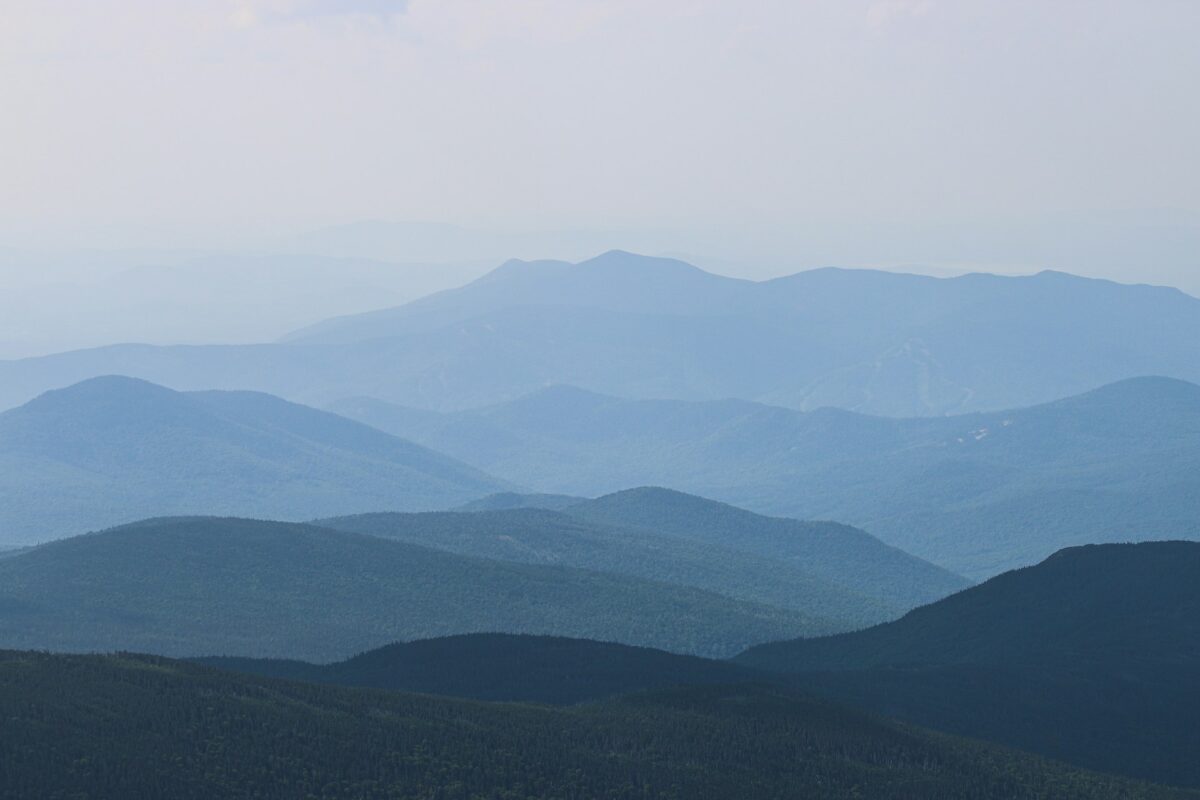
A view of the White Mountains the top of Mt. Monroe in New Hampshire. Brian Yurasits/Unsplash
Certain campers in New Hampshire‘s White Mountains are facing a new food storage requirement amid an increase in bear encounters, according to the U.S. Forest Service.
More than half of the reported bear incidents in the White Mountains in 2025 occurred in the Pemigewasset Wilderness, prompting officials to implement a stricter rule in that area.
Beginning next month, overnight campers will be required to store food and scented items inside an approved bear-resistant canister, officials said. Failure to comply could result in fines or other penalties.
“The Pemi Wilderness is one of the most popular backcountry destinations on the WMNF,” the U.S. Forest Service said in a statement. “As visitation has increased, bears have learned to associate humans with food, leading to more frequent and potentially dangerous encounters.”
Ineffective food storage also poses a significant risk to the black bear population, as it can lead to bear habituation, according to the U.S. Forest Service.
Here’s what to know about the upcoming food storage requirement in the Pemigewasset Wilderness.
Violation of the bear-resistant canister rule can result in a fine
Those who violate the bear-resistant canister requirement in the Pemigewasset Wilderness could face fines of up to $5,000 for individuals and $10,000 for organizations, as well as up to six months in prison, according to the U.S. Forest Service.
Bear canisters required for overnight campers in Pemigewasset Wilderness
Beginning May 1, overnight campers in the Pemigewasset Wilderness will be required to store all food, scented items (soap, toothpaste, deodorant, etc.), and trash in a cylindrical, hard-sided bear-resistant canister, according to the U.S. Forest Service. The canister must be certified by the Interagency Grizzly Bear Committee.
Alternative food storage methods, such as “bear hangs,” will no longer be allowed, as officials have determined them to be less effective.
“Bear incidents in the Pemi Wilderness area have risen sharply in recent years, with most cases involving bears accessing improperly stored food,” the U.S. Forest Service said. “This new requirement is necessary to reduce an increase in human-bear interactions and to improve visitor and wildlife safety.”
The only exceptions to this rule are the bear-resistant food boxes at the Thirteen Falls Tent Site, the U.S. Forest Service said.
Visitors can rent bear-resistant canisters for free
Visitors to the White Mountains National Forest can rent a bear-resistant canister for free at the following locations:
- Lincoln Woods Trailhead Cabin in Lincoln
- Pemigewasset Ranger Station in Campton
- Saco Ranger Station in Conway
- Androscoggin Ranger Station in Gorham
These canisters are also available for sale at most outdoor equipment stores, the U.S. Forest Service said.
Is a bear-resistant canister required in all areas of White Mountain National Forest?
No, bear-resistant canisters are required only in the Pemigewasset Wilderness, according to the U.S. Forest Service. However, food and scented items still need to be stored properly.
Items can be stored inside a closed building, a closed trunk, a hard-sided camper, or a closed passenger compartment of a car with its windows rolled up and doors locked.
They can also be stored in Forest Service-provided food storage boxes and containers, behind electrified fences designed for bears, or suspended 12 feet from the ground using a “bear hang.”
Reporting by Bailey Allen, Portsmouth Herald
Author

The 10 most gorgeous public gardens in New Hampshire
Surround yourself with beautiful blooms, whimsical water features, and well-designed hardscapes at the best public gardens in New Hampshire. New...

Op-ed: With Lyme Disease on the Rise, NH Needs to Protect Their Forests and Biodiversity
Lyme disease is a dangerous yet alarmingly common phenomenon infecting nearly half a million Americans each year. These infections are particularly...

How to track New Hampshire’s fall bird migration
Learn about six websites that make tracking New Hampshire’s fall bird migration easy. Look up! As the days grow short and the weather turns cold...

Explore 6 of New Hampshire’s natural wonders
From the Emerald Pool to Rhododendron State Park, these six natural wonders in New Hampshire inspire awe. There’s no doubt about it. New Hampshire...

How to upcycle your Christmas tree in New Hampshire after the holidays
Our state has over 200 Christmas tree farms and that means a lot of pines left over after the holidays. I can’t be the only one who feels guilty...

It’s deer hunting season in New Hampshire. Here’s what you need to know.
Take a Class. To become a licensed hunter in New Hampshire, you must complete a hunting safety course either online or in person. Classes are open...

