Ayotte sold COGE as DOGE for New Hampshire. Now their first report of recommendations reads like a wish list of longtime GOP policy priorities: cut public schools, slash employee pay, gut public health.
New Hampshire Gov. Kelly Ayotte’s government efficiency commission lays the groundwork to shrink and slash major services across the state.
Gov. Kelly Ayotte’s Commission on Government Efficiency (COGE) claims its goal was “not about austerity; it was about efficiency” and that the report “does not seek to prescribe sweeping cuts or impose mandates.”
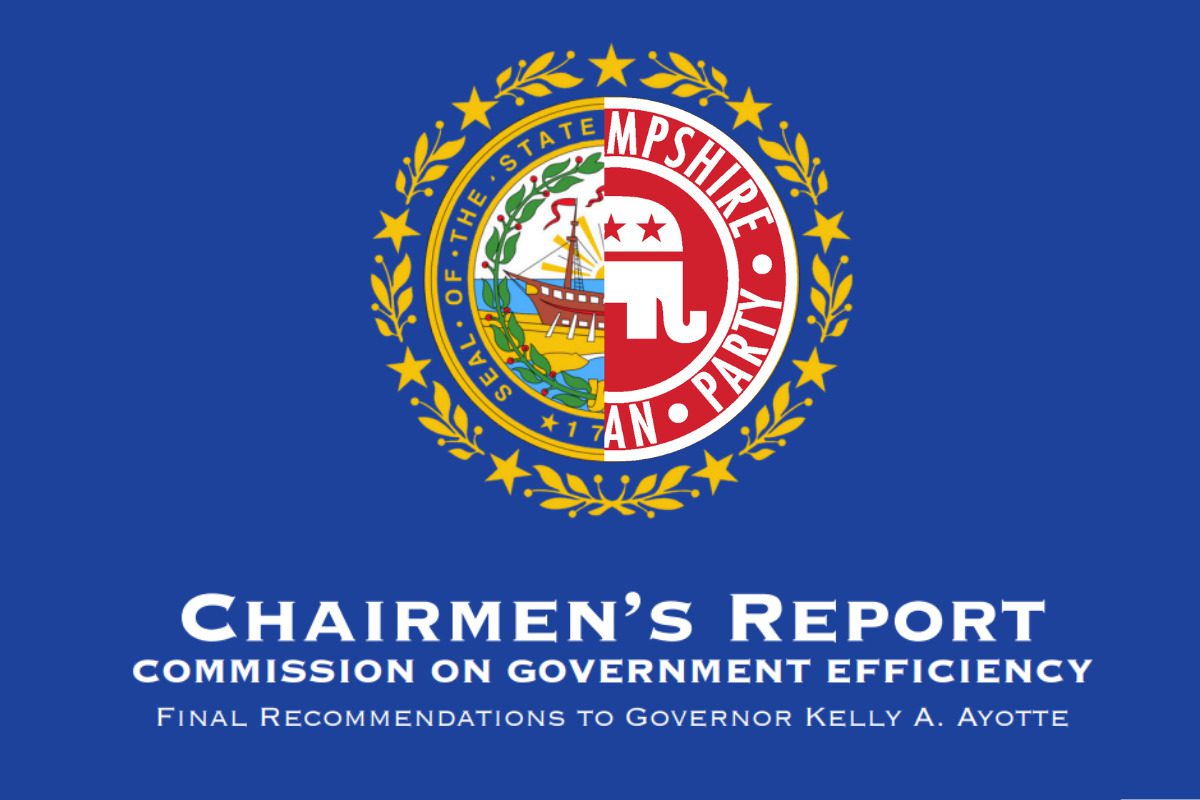
In its first “Chairmen’s Report,” released last Thursday, the 15-member commission urges lawmakers to consider breaking up the New Hampshire Department of Health and Human Services (DHHS), slash funding for school districts, cut public information staff across state government, and stagnate employee pay.
Ayotte created the commission on her first day in office by way of executive order and tapped Benson and Bedford businessman Andy Crews — a top Ayotte donor — to lead it as co-chair. They billed the panel as a way to “streamline government, cut spending, and ensure we’re doing everything we can to create value for taxpayers.”
In her inaugural address, Ayotte explicitly tied her new panel to Trump’s initiative, saying she would create a Commission on Government Efficiency (COGE) that “mirrors” the federal Department of Government Efficiency (DOGE).
But when you read past soothing language about “partnership” and “continuous improvement,” the report looks a lot less like a neutral search for efficiencies and a lot more like a familiar Republican policy agenda: shrink safety nets, squeeze public schools, end transparency, and hold down public-sector wages.
The “efficiency” framing comes afterward, as a justification.
Ayotte’s hand-picked COGE commission, co-chaired by former Republican governor and her mentor to Ayotte Craig Benson — is proposing far-reaching changes to some of New Hampshire’s biggest public systems with recommendations that are — unsurprisingly — pre-existing and long term goals of the Republican party
National outlets have since grouped COGE with a wave of “DOGE-inspired” state efforts to rebrand budget cutting and restructuring under an efficiency label
Led by Elon Musk, DOGE presided over mass layoffs, including more than 200,000 federal employees cut and another 75,000 bought out, along with aggressive efforts to centralize data and gut major federal agencies such as the USAgency for International Development and the Consumer Financial Protection Bureau.
Despite DOGE’s own claims of more than $200 billion in savings, independent analysts and reporters have noted that those figures are impossible to verify because the office operated largely outside standard transparency rules.
The Office of Personnel Management has since confirmed that DOGE was disbanded eight months before its charter was set to expire, and Musk himself has called the project only “somewhat successful” and said he would not do it again.
New Hampshire COGE members have had to go on defense, saying they are “not Elon Musk” and that they won’t “upend” state government the way DOGE did at the federal level.
But the structure and branding of NH COGE — and the substance of its report — make the parallels hard to ignore for state political observers, who have described it as an obvious DOGE knockoff aimed at softening the often contentious politics of harsh cuts and major restructuring of state agencies. The report itself often reads more like a wish list of conservative policy goals in search of an efficiency narrative.
The COGE report’s education section lays out a concrete set of changes that, taken together, track closely with long-standing Republican goals for state public schools.
The report recommends cutting New Hampshire’s 107 School Administrative Units (SAUs) which function as the backbone of the public school system.
The report brands that number “inefficient and unsustainable” and urges lawmakers to take a “serious and deliberate look” at “consolidating” SAUs. On paper, that’s sold as getting rid of duplicative administration and redirecting savings “into the classroom.”
In reality, it means fewer locally-controlled offices and fewer superintendents fighting for their school districts, and a shift of key decision-making away from communities and into larger regional structures that are far easier for state Republicans to steer and influence.
That kind of consolidation slashes the institutional power of public education in New Hampshire, weakening the capacity of individual districts to set their own priorities, defend their budgets, and resist top-down pressure from a Republican governor and Legislature.
COGE’s education recommendations for school administrative units (SAU), commonly referred to as school districts, advance a long-term conservative project: not just cutting costs, but steadily reducing the leverage and reach of the public school system itself.
The report’s most dramatic structural idea targets DHHS, which it labels a “behemoth agency” whose divisions often function like separate departments under one umbrella.
COGE recommends a “careful, data-driven evaluation” of whether DHHS should be broken up into smaller, more focused agencies with their own leadership and missions, arguing that its size “obscures performance, complicates oversight, and slows decision-making.” The goal, commissioners say, is to trim overlapping management and modernize services.
Splitting up DHHS would completely reshape how the state delivers everything from child protection and behavioral health to elder care and Medicaid — and could make it far easier for future administrations to slice off specific programs or whole agencies for cuts or, more likely, privatize , one piece at a time.
The commission report also recommends slashing public information officers (PIOs) at state agencies. For journalists, advocates, and the public, that could mean fewer points of contact and more bottlenecks when trying to get answers from state agencies.
Ultimately, that’s less transparency about how taxpayer money is spent and a far greater ability for government agencies to operate without accountability.
On wages, COGE takes aim at how state agencies fill vacant positions. The report argues that when employees leave, departments often repost the job at the higher salary the departing employee earned after years of experience, which it says can “gradually inflate personnel budgets.”
Many labor advocates are likely to frame that as a form of wage suppression: a policy that pushes salaries backward, deepens pay compression between new and long-time workers, and makes it harder for New Hampshire to compete for talent in a tight labor market — especially in fields like social work, nursing, and IT, where vacancies are already high.
At 77 pages, the report contains many more recommendations, but reading through, it’s hard not to see it was written with an agenda in place, and the suggestions filled in to fit it.
Author
Support Our Cause
Thank you for taking the time to read our work. Before you go, we hope you'll consider supporting our values-driven journalism, which has always strived to make clear what's really at stake for New Hampshirites and our future.
Since day one, our goal here at Granite Post has always been to empower people across the state with fact-based news and information. We believe that when people are armed with knowledge about what's happening in their local, state, and federal governments—including who is working on their behalf and who is actively trying to block efforts aimed at improving the daily lives of Granite State families—they will be inspired to become civically engaged.


Memo: Trump endorsement will haunt Sununu in 2026 Senate race
A memo from the New Hampshire Democratic Party circulating among top donors and strategists argues that President Donald Trump’s endorsement of...

Sununu denies ties despite being named in Epstein files
Sununu says his name being mentioned in the Epstein files is a “fabrication” — critics say that excuse “doesn’t hold water.” A dump of over 3...

Gov. Ayotte takes in maxed out donation from NH gunmaker after granting immunity
After Gov. Kelly Ayotte shielded a top New Hampshire firearms manufacturer from an avalanche of lawsuits, the company donated heavily to her...

Goodlander gets bomb, death threats amid NH GOP smear campaign
New Hampshire Rep. Maggie Goodlander fielded threats of bombing and death as President Donald Trump calls her and fellow lawmakers “traitors” New...

FACT CHECK: Sununu breaks out familiar Social Security playbook while campaigning for Senate
In his 2025 Senate comeback campaign, John Sununu is once again casting himself as a defender of Social Security, despite his history of backing...

John E. Sununu’s changing take on tariffs, as he seeks Trump’s endorsement
Two years ago, John E. Sununu said that President Donald Trump showed bad leadership on trade because of tariffs. Now that Trump is back in office,...