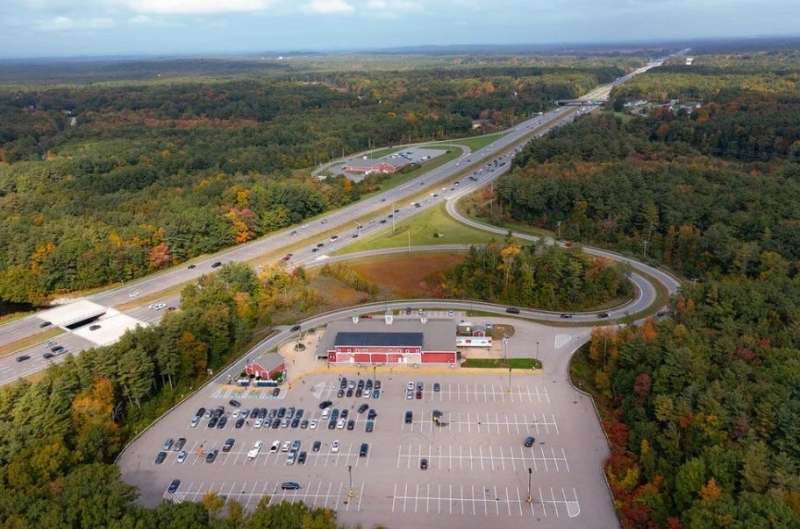
The New Hampshire Liquor Commission secured key approval from a joint legislative committee to move forward with leasing and redeveloping two I‑95 liquor store properties in Hampton, even as a lawsuit from Common Man Roadside seeks to halt the process.
The Long Range Capital Planning and Utilization Committee voted unanimously on Sept. 28 to approve a proposed lease for the sites, though the commission has not yet disclosed the selected bidder. The two finalists for the project to submit bids were Manchester-based developer Dick Anagnost of Anagnost Companies and Common Man Roadside.
Liquor Commission attorney Ari Pollack told lawmakers the commission expects to present the winning bidder to the governor and Executive Council on Dec. 26.
Despite the legal challenge, the bid award remains on schedule, according to commission spokesperson EJ Powers. A judge previously denied Common Man Roadside’s request for an injunction in its lawsuit alleging wrongful disqualification from the bid process. The company has filed a motion for reconsideration, while the state is asking the court to dismiss the case entirely.
“The process is ongoing, per the calendar,” Powers said.
A formal announcement of the selected developer and operator will come only after the Liquor Commission finalizes the terms of the lease, according to a cover letter from Commission Chair Joseph Mollica to the legislative committee.
The redevelopment plan has been years in the making. The state initially pursued a sale of the properties before Gov. Kelly Ayotte reversed course after her 2024 election and directed the commission to seek a lease instead. Mollica said the chosen bidder is expected to open the new locations in 2028 and generate at least $35 million for the state over the 35‑year lease, with proposed amenities including food service, gasoline and a convenience store. The state would continue to own and operate the liquor stores.
“We feel, and hope you do as well, that it’s time for a refresh,” Mollica said.
Commission says lawsuit poses no delay — yet
Liquor Commission representatives shared little with inquisitive members of the legislative joint committee about the candidates in this year’s request for qualifications and proposals process.
“Have we heard from the unsuccessful bidder,” state Rep. Barry Faulkner, D-Cheshire, asked, “And do we anticipate any potential issues with that?”
Matt Broadhead of the state Department of Justice told lawmakers the agency could “say very little at this stage,” though he acknowledged a lawsuit had been filed against the Liquor Commission. He said the legal proceedings to date show the commission did not violate the terms of the bidding process.
The suit filed by Common Man Roadside alleged the commission’s actions threatened “irreparable harm,” but most details are redacted because they involve “confidential business and financial information.” In a Sept. 3 ruling denying injunctive relief, Merrimack Superior Court Judge Martin Honigberg wrote that the redacted record shows Common Man Roadside’s Seacoast Welcome Center LLC failed to meet the financial qualifications required for the lease.
Broadhead described the commission’s review as a “tier approach,” in which bidders either pass or fail an initial financial‑strength test. The commission hired two experts to evaluate the submissions, and only bidders who passed that threshold had their request for qualifications scored, including on projected revenue.
“(The lawsuit) resulted in a court order confirming the Liquor Commission followed its own criteria,” Broadhead said.
Common Man fights on; state moves to end suit
A judge will soon hand down orders in response to a Sept. 10 motion by the Common Man Roadside’s Seacoast Welcome Center LLC to reconsider the rejected injunction, as well as a motion to dismiss by the state.
Much of the motion to reconsider is redacted, but its unredacted portions argue the judge “overlooked or misapprehended” key elements of the claims against the Liquor Commission. It claims the judge failed to address or decide whether the Liquor Commission “acted illegally with respect to jurisdiction, authority or observance of the law.”
“The order leaves Seacoast’s (Welcome Center) most fundamental challenges undecided,” Seacoast Welcome Center attorneys Jeffrey C. Spear and Lisa Snow Wade wrote.
The motion asks that the court grant the preliminary injunctive relief requested, as well as find Seacoast Welcome Center is likely to prevail on the merits of its lawsuit, technically a writ of certiorari. It also alleges the judge had “mistaken views of the statute of separation of powers” when he decided Seacoast Welcome Center was merely a bidder challenging the selection.
“Seacoast is not in that situation,” the attorneys wrote.
The Liquor Commission’s motion to dismiss the suit was heavily redacted, with all but five of its 33 pages blacked out completely. The motion, signed by Attorney General John Formella, argues that the plaintiff fails to make its case on any of its claims.
“The Court should dismiss the Petition in its entirety,” the Liquor Commission’s motion stated.
Liquor Commission hopes redevelopment will boost Hampton outlets
Anagnost said Oct. 1 he could not comment on whether he was the finalist, though he confirmed he was among the candidates in the May bid process. Brad Pernaw, managing partner of Common Man Roadside, did not return a call seeking comment and has said since the lawsuit was filed that he cannot discuss the ongoing legal proceedings.
Mollica told the legislative committee that the base rent for the two properties over the duration of the lease would be at least $35 million. State Sen. Rebecca Perkins Kwoka, D-Portsmouth, a member of the joint committee, asked if the projected revenue was enough. She questioned whether $35 million in Hampton could be considered ”top-performing” as the Liquor Commission said it hoped.
“Could you talk a little bit about how that meets expectations, or whether this is really the right basis upon which to proceed,” Perkins Kwoka said. “It seems, you know, the state might just be leaving a little bit of revenue on the table.”
Broadhead said the actual revenue will be a much higher figure once other rent revenue is factored in, like sales made by tenants.
“We have projections of those in Hampton,” Broadhead said. “We can anticipate there will be substantial revenue.”
Mollica said the Hampton locations were once ranked one and two, as far as sales, in the state for liquor stores. The first one opened on the southbound side in 1981, the northbound side in 1992.
Mollica said the performance dropped over the years to the fifth and sixth rank. He said that has to do with limited sanitary facilities and lack of food and fuel, which are available at the Common Man Roadside locations in Hooksett.
All those features are included in the developer’s proposal, which he hopes will help Hampton’s outlets get back on the map.
“This is the gateway to our beautiful and beloved state,” Mollica said. “We take that charge very seriously.”
This article originally appeared on Portsmouth Herald. Reporting by Max Sullivan.