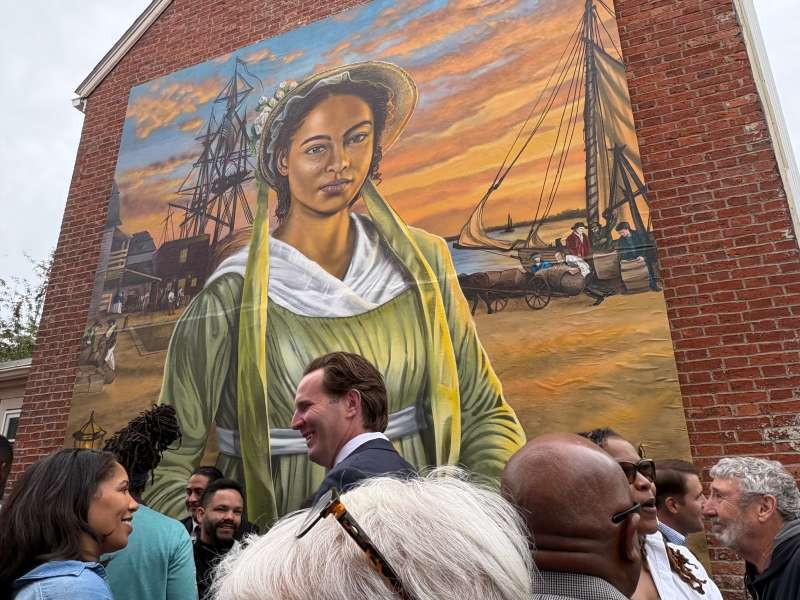
Celebrating the 230th anniversary of her escape from slavery, Ona Judge Staines became a permanent icon of the city’s landscape with a mural dedicated in her honor and to her determination to be free.
On Saturday, May 23, the Black Heritage Trail of New Hampshire unveiled the mural on the side of its office at 222 Court St. The mural was painted by artist Manuel Ramirez of Positive Street Art in Nashua, and depicts the woman who escaped to Portsmouth against the backdrop of the city’s waterfront as it would have looked in 1796 when she arrived.
Ona Judge was a slave born into President George Washington’s household at Mount Vernon in Virginia. After Washington became the nation’s first president, she traveled with the first family to Philadelphia when that city became the nation’s temporary capital city. On May 21, 1796, while the Washingtons were eating dinner, she left the house and soon set sail on a ship that brought her to Portsmouth. In the city and in the neighboring town of Greenland, she married a free Black sailor, Jack Staines, raised children, living the rest of her life as a free person.
“As we unveil this mural, we unveil memory, we unveil history, we unveil the truth. We unveil the courage of a young woman who chose freedom despite all the odds,” said JerriAnne Boggs, executive director of the Black Heritage Trail of New Hampshire, who spoke just before Ramirez and local students lowered a large blue tarp to reveal the mural. “This mural ensures that Ona’s story will no longer remain hidden. Residents, students, visitors from around the world will stand before this wall and encounter a woman whose determination helped redefine the meaning of freedom in America. In fact, she embodies it.”
Spoken word artist Jazzy Mota read her poem, “We Gotta Learn …” to begin the ceremony, which also included remarks by representatives of the city, elected officials and the Black Heritage Trail. Brendan Narcia, a descendent of a Mount Vernon slave, and Michael Coard, founder of the Avenging The Ancestors Coalition, also spoke.
“This mural reflects the heart of the Black Heritage Trail’s mission, but it belongs to Portsmouth, to New Hampshire and to the nation,” said BHTNH Board president Gene Martin. “For far too long, stories like Ona Judge’s were minimized or erased from public memory. Today, we correct that silence. This mural stands as a declaration that Black history is American history, and that the stories of courage, resistance and resilience deserve a visible place in our public spaces.”
Portsmouth Mayor Deaglan McEachern grew up in Portsmouth and went to school here, but he said he never heard of Ona Judge Staines until he went away to college.
“Someone somewhere far away told me of her courage, and about this city’s place in her story. This is why this mural matters,” McEachern said. “This place and this mural make hidden history visible. They tell everyone who passes that Black history is not separate from Portsmouth history or from American history. It is central to both.”
He addressed the students of today. “Look up, learn her name,” McEachern said. “A city is shaped by what it chooses to honor.”
Following the unveiling, a reception was to be held at Strawbery Banke Museum where Dr. Erica Armstrong Dunbar, national recognized historian and author of “Never Caught: The Washingtons’ Relentless Pursuit Of Their Runaway Slave, Ona Judge,” was the keynote speaker.
This article originally appeared on Portsmouth Herald. Reporting by Jane Murphy.