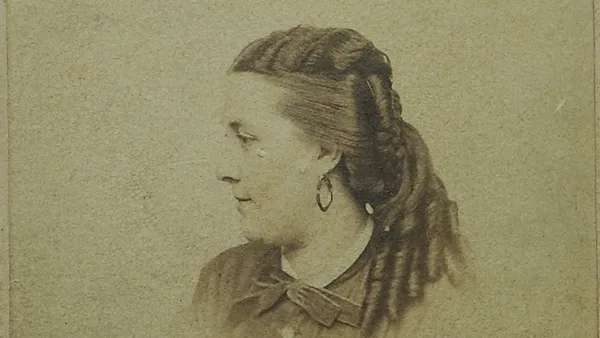
If you’ve been watching the Apple TV+ series “Manhunt,” you probably know a lot about John Wilkes Booth. But you might not know this. When Booth died shortly after assassinating Abraham Lincoln 159 years ago, he carried with him the portrait of New Hampshire heartthrob, Lucy Lambert Hale of Dover. It might be one of the weirdest love stories ever.
Hale was born in Dover in 1842 but lived part-time in Washington, D.C., while her father, John Parker Hale, a staunch abolitionist, was representing New Hampshire in the U.S. Senate for three terms including during the Civil War. She was quite the social butterfly in the nation’s capital. She had courtships with future U.S. Supreme Court Associate Justice Oliver Wendell Holmes Jr. and William Chandler who was to become a U.S. senator from New Hampshire and Secretary of the Navy. She was also said to have received flowers from Robert Todd Lincoln, the president’s oldest son, who studied at Phillips Exeter Academy, according to a 1970 article “They All Loved Lucy,” in “American Heritage” magazine which called Lucy’s personality “a mode that cannot be taught or learned: a subtle brew of flattery, teasing, and cajoling; of rapt attention disturbingly laced with hints of indifference and even, now and then, a touch of cruelty.”
On Valentine’s Day, in 1862, Hale, then 21, received an anonymous missive from one more admirer which read:
“My dear Miss Hale,
Were it not for the License with a time-honored observance of this day allows, I had not written you this poor note … You resemble in a most remarkable degree a lady, very dear to me, now dead and your close resemblance to her surprised me the first time I saw you. This must be my apology for any apparent rudeness noticeable. To see you has indeed afforded me a melancholy pleasure, if you can conceive of such, and should we never meet nor I see you again believe me, I shall always associate you in my memory, with her, who was very beautiful, and whose face, like your own I trust, was a faithful index of gentleness and amiability. With a Thousand kind wishes for your future happiness I am, to you,
A Stranger.”
That stranger turned out to be the actor and Confederate loyalist, John Wilkes Booth who had spotted Lucy at the National Hotel, where they were both staying. Booth, 24, was a well-known actor at the time and to some women, a romantic figure having played Romeo among other Shakespearean leads. The two began a courtship over the next three years and in early 1865, became secretly engaged. At the same time, Booth was plotting to kidnap Lincoln, take him to the South, and hold him hostage in exchange for imprisoned Confederate armies. When that plan failed the assassination plot was put into place, according to the History of American Women. Historians agree that Lucy never knew anything about Booth’s plans. Lucy gave her beau a ticket to Lincoln’s second inauguration in March, according to Terry Alford, author of Fortune’s Fool: The Life of John Wilkes Booth. But in early spring the couple were fighting. Booth was agitated while planning the assassination and jealous, especially of Robert Lincoln.
Lucy’s parents disapproved of their daughter’s engagement with Booth and hoped she’d marry the president’s son. To separate them, Hale asked Lincoln to appoint him ambassador to Spain which he granted. On April 14, 1865, five days after the Civil War ended and the day of the assassination, witnesses at the time, said they saw Booth and Lucy talking in public at the National Hotel while her family was getting ready to move to Spain.
Just hours later, Booth shot Lincoln in the head during a performance “Our American Cousin” at Ford’s Theatre. Almost everyone who had any contact with Booth was questioned after the assassination, but there is no record that Lucy or her family, were ever interviewed. Lucy’s senator father posted a notice in local newspapers, denying that his daughter had any connection with Booth. But the “New York Herald” did print an article that Booth’s fiancée (who was not named) was “plunged in profound grief” and that “with womanly fidelity” was “slow to believe (Booth) guilty of this appalling crime.”
After the assassination Booth, who broke his leg jumping from the presidential box at Ford’s Theatre, met up with an accomplice and was on the lam for 12 days before ending up at a Virginia farm where troops surrounded a barn in which he and his accomplice were hiding. The accomplice surrendered but Booth stayed inside the barn which was set on fire by soldiers who hoped to drive him out. But instead, a soldier fired into the barn and shot Booth in the neck. He died shortly after.
According to the Ford’s Theatre National Historic Site, Booth carried photographs of five women in his pockets when he was shot – four actresses and Lucy Lambert Hale.
Lucy went to Europe with her family after the assassination. She spent five years where she continued to see eligible bachelors including Holmes, John Hay, and U.S. Senator from New Hampshire, William Chandler to whom she was married for 40 years, until she died at age 73 in 1915. She is buried in Pine Hill Cemetery in her hometown of Dover.
The Hale family home is open to the public at the Woodman Museum in Dover.