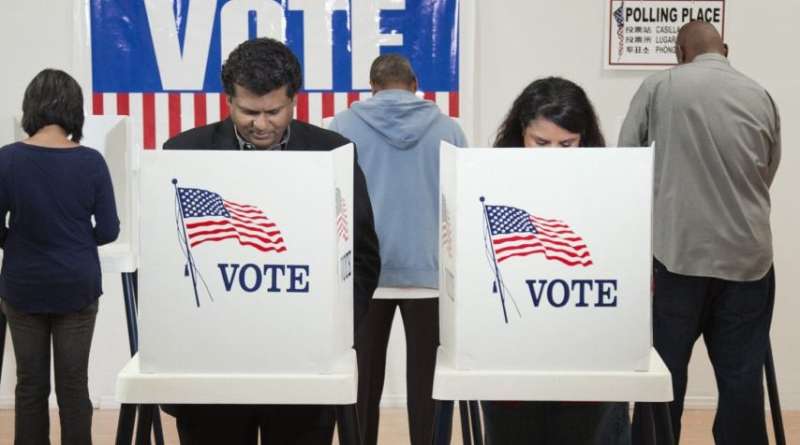
New Hampshire voters will fill hundreds of offices on Nov. 3, from the US Senate down to your local select board. Of those, four New Hampshire races of significant consequence are genuinely up for grabs, and between them, they decide two different things: who controls Congress and who controls Concord.
The two federal races get most of the money and most of the attention. The two state legislative contests get almost none, yet they are the ones that determine how much of New Hampshire towns’ school budgets lands on property taxpayers.
The national climate matters here, too. Trump’s job approval in New Hampshire sat at 37% in late July, his worst showing in the state since 2017, and the party that holds the White House usually loses ground in a midterm.
US Senate
Jeanne Shaheen is retiring after three terms, so this seat is open for the first time since 2008. Open seats are often where control changes hands.
CHRIS PAPPAS, Democrat, has represented the 1st District since 2019 and previously served on the Executive Council.
JOHN E. SUNUNU, Republican, held this seat from 2003 to 2009 before Shaheen beat him. He has been out of office 17 years.
Why it’s competitive: Nobody can agree on who’s ahead. A University of New Hampshire poll in late August had Sununu up two percentage points. A Republican-commissioned poll a week later had him up one, with 23% of voters undecided. On Tuesday, September 15, the Cook Political Report moved the race from Lean Democrat to toss up.
What flips: Control of the US Senate could come down to a handful of seats nationally, and this is one of them. The majority has significant power over what gets investigated in the Senate for the last two years of Trump’s term.
1st Congressional District
Because Pappas is running for Senate, his House seat is open.
ANTHONY DILORENZO, Republican, is a Portsmouth businessman and first-time candidate running on energy costs and federal spending.
STEFANY SHAHEEN, Democrat, served on the Portsmouth City Council and chaired the city’s police commission. She is running on health care, housing and overhauling immigration enforcement.
Why it’s competitive: The district leans Democratic by only about two points, and it has changed hands repeatedly over the past two decades. Both candidates are running for the first time, so there is no incumbency advantage. Cook Political Report rates it “Likely Democratic,” which means favored, not safe.
What flips: House control. Open seats in near-even districts are exactly where majorities are built.
The State Senate
Republicans hold 16 of the 24 seats. Democrats have eight seats and need five more for a majority.
Why it’s competitive: The seat count makes it look lopsided, but the vote count doesn’t. In 2024, Republicans won 51.3% of the statewide vote for state Senate and Democrats won 48.6. That three-point gap produced a two-to-one seat advantage.
Andrew Smith, who directs the University of New Hampshire Survey Center, estimates Democrats would need roughly 53 to 54% of the statewide vote to take either chamber, because of how the districts are drawn. That’s a high bar, but it’s a swing of a few points, not a landslide.
In 2018, the last midterm under a Trump presidency, Democrats picked up four state Senate seats and took the chamber.
What flips: The Legislature writes the state budget, which decides how much of your school costs land on your property tax bill. It sets the rules for the school voucher program. It decides housing and energy policy.
The State House
Republicans hold roughly 217 seats to Democrats’ 177, with two independents.
Why it’s competitive: There are 400 members, the largest state House in the country, so each one represents a small area and a few thousand votes statewide can move dozens of seats. In 2018, 45 incumbents lost in the general election, 39 of them Republicans, and the chamber flipped.
What flips: The same budget, the same property-tax math, and which bills reach the governor’s desk at all.
BUT: Why more votes don’t always mean more seats
In New Hampshire, winning the most votes and winning the most seats are two different things.
Look at the same chamber in two different years. In 2016, Republicans won 50.4% of the statewide vote for state Senate and took 14 of the 24 seats. In 2018, Democrats won 53.9%, nearly four points better, and took exactly the same 14 seats.
In 2024, Republicans won 51.3% of the state Senate vote and came away with 16 seats, two-thirds of the chamber.
This is the result of Republican partisan gerrymandering.
Smith put it bluntly to the New Hampshire Bulletin: the state looks split because the maps are drawn that way, and for a Democrat, “you’ve got to have about 54% of the popular vote” to win.
NHPR examined decades of results using a measure called the efficiency gap, which estimates how many votes each party casts that end up not winning any seat. It found that in 2012 Republicans took a Senate majority despite losing the statewide popular vote outright, and that the maps padded Republican majorities in most years examined.
Check your ballot
Look up your polling place and a sample ballot for your address through the Secretary of State at app.sos.nh.gov. The general election is Tuesday, Nov. 3, 2026.