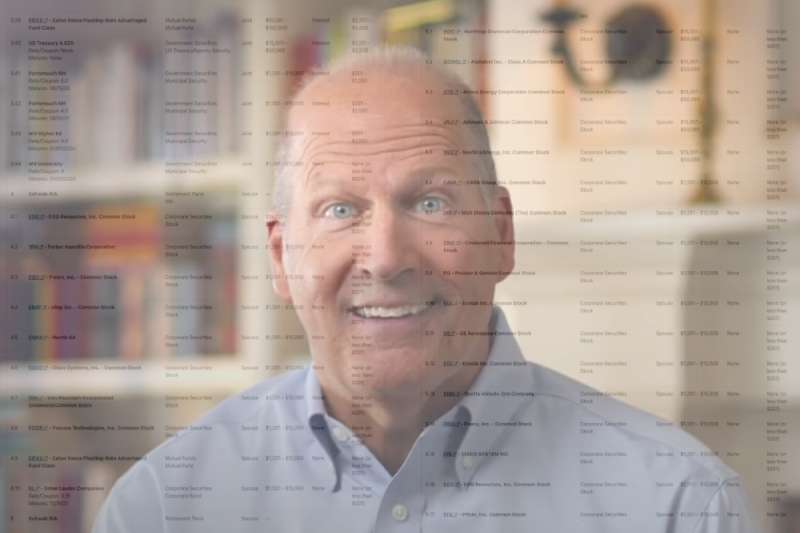
Pharma, big tech, oil, and insurance lobbyists are bankrolling John E. Sununu’s Senate comeback—and his financial disclosure shows he owns stock in nearly all of them
Former US Senator John E. Sununu (R) is mounting a Senate comeback with a stock portfolio worth as much as $2 million spread across pharmaceutical, big tech, oil and gas, and insurance companies—and a campaign fund stocked with checks from lobbyists for those same industries.
Together, those four industries account for between roughly $529,000 and nearly $2 million in personal holdings and more than $239,000 in campaign cash from executives, lobbyists, and industry political action committees.
A review of Sununu’s February 2026 personal financial disclosure alongside his 2025 Federal Election Commission filings shows a pattern across all four sectors: Sununu owns the stock, the industry’s lobbyists write the checks, and his Senate voting record from 2003 through 2008 reads as a sustained defense of those companies’ interests.
The disclosure also shows Sununu is currently earning more than $1.1 million a year in outside income, including $444,354 as a director of medical device manufacturer Boston Scientific Corp. and $220,000 as non-executive chairman of Lloyd’s Americas—the US arm of the global insurance market.
Pharma: $425,000 in stock and $67,000 from lobbyists
Sununu and his wife reported holding between $110,012 and $425,000 in pharmaceutical company stocks and bonds, including positions in Pfizer Inc., Merck & Co., AbbVie Inc., Johnson & Johnson, Bristol Myers Squibb, and AstraZeneca, according to his Senate financial disclosure filed Feb. 13.
He also serves as a director of Boston Scientific Corp., a medical device manufacturer based in Marlborough, Mass., earning $444,354 in 2025 from that role.
His campaign committee took in $67,725.59 from lobbyists tied to the industry through the end of 2025. Of that, $38,500 came from people who were actively lobbying for pharmaceutical clients at the time of their contribution—including representatives of Pharmaceutical Research and Manufacturers of America, Viartis, Merck, Pfizer, Johnson & Johnson, Eli Lilly and Co., and Bristol Myers Squibb. Another $29,226 came from lobbyists with prior pharmaceutical industry work.
The donors include T.J. Petrizzo, who gave $7,000 in November while lobbying for Akebia Therapeutics Inc., and Mathew Lapinski, the CEO of Crossroads Strategies, whose firm lobbies for PhRMA, Vertex Pharmaceuticals, Takeda, Merck, and Bristol Myers Squibb, who gave $2,500 in December.
In the Senate, Sununu voted four separate times against allowing Medicare to negotiate drug prices, including a tie-breaking vote in March 2005. Between 2001 and 2008, he voted seven times against allowing the importation of cheaper prescription drugs from Canada and other countries with FDA-approved manufacturing. He also voted against an amendment that would have required drug companies to charge Americans the same prices they charge Canadian customers, and against measures requiring greater transparency in drug advertising.
Big tech: up to $1 million invested, opposed regulation
Sununu’s tech holdings are his largest sector concentration: Between $265,027 and $1 million across Microsoft, Alphabet, Inc., Apple, Nvidia, Cisco, eBay Inc., PayPal, Equinix Inc., Procore Technologies Inc., and Iron Mountain Inc.—the data center company that markets itself as a key infrastructure provider for AI and cloud computing.
His campaign collected $56,082 from lobbyists with tech industry clients, $41,082 of it from people actively lobbying for companies and membership associations, including Palantir Technologies Inc., the Data Center Coalition, TikTok, Meta, Microsoft, Amazon, Intel Corp., OpenAI, and Anthropic.
Sununu has been explicit on the campaign trail about where he stands on regulating the industry he’s invested in. In a March 1 interview with WMUR, he said federal AI regulation should be “a light touch” and dismissed concerns about disruption, saying AI would be no different from past technological shifts.
Oil, gas, and utilities: $80,000 from an industry his political choices benefited greatly.
Sununu and his wife reported between $122,011 and $430,000 in oil and utility holdings, including Exxon Mobil Corp., Royal Dutch Shell PLC, EOG Resources, Inc., NextEra Energy Inc., Atmos Energy Corp., and Southern Company.
His campaign raised $80,643 from energy executives, their political action committees, and industry lobbyists. The Exxon Mobil PAC contributed $2,500. Joshua Gregg, the chief financial officer of Texas-based Double Eagle Energy Holdings II and the son of a former Republican US senator, Judd Gregg, contributed $7,000 to a joint fundraising committee. Lobbyist contributions included $50,643 from people representing companies and trade associations such as BP, the American Petroleum Institute, Koch Industries, Devon Energy Corp., Duke Energy, Southern Company, and Marubeni.
In Congress, Sununu voted in 2005 against making energy price gouging a federal crime. He voted in 2001 for a bill that the Washington Post reported gave $13 billion in new tax credits and spending to oil companies, and in 2007 against repealing nearly $17 billion in oil industry tax breaks. He voted several times against measures aimed at reducing carbon emissions or expanding clean energy investment. The League of Conservation Voters, an environmental advocacy group, gave him a lifetime score of 35% on his congressional record for his stance on environmental issues.
The insurance sector accounts for between $32,004 and $130,000 of Sununu’s portfolio, including holdings in Progressive Corp., Berkshire Hathaway, and Cincinnati Financial Corp. His campaign took in $34,725 from people connected to the industry, including $24,225 from insurance lobbyists and $2,500 from the Allstate Insurance Company PAC.
Sununu currently chairs the U.S. arm of one of the world’s largest insurance markets. According to his disclosure, he has served as the non-executive chairman of Lloyd’s Americas since January 2023, earning $220,000 from the role in 2025.
In 2008, he co-sponsored the Making Health Care More Affordable Act, legislation that would have allowed insurance companies to sell policies across state lines under the rules of whichever state they chose as their “primary state.”
Critics warned the structure would let insurers headquarter in low-regulation states and exclude coverage for pre-existing conditions. Earlier, in 2003, he had voted against an amendment to prevent the loss of drug coverage for Medicare beneficiaries with cancer.
The pattern, repeated across four industries, is the same one accountability researchers have flagged in past Sununu campaigns—investments, contributions, and votes lining up in the same direction.