
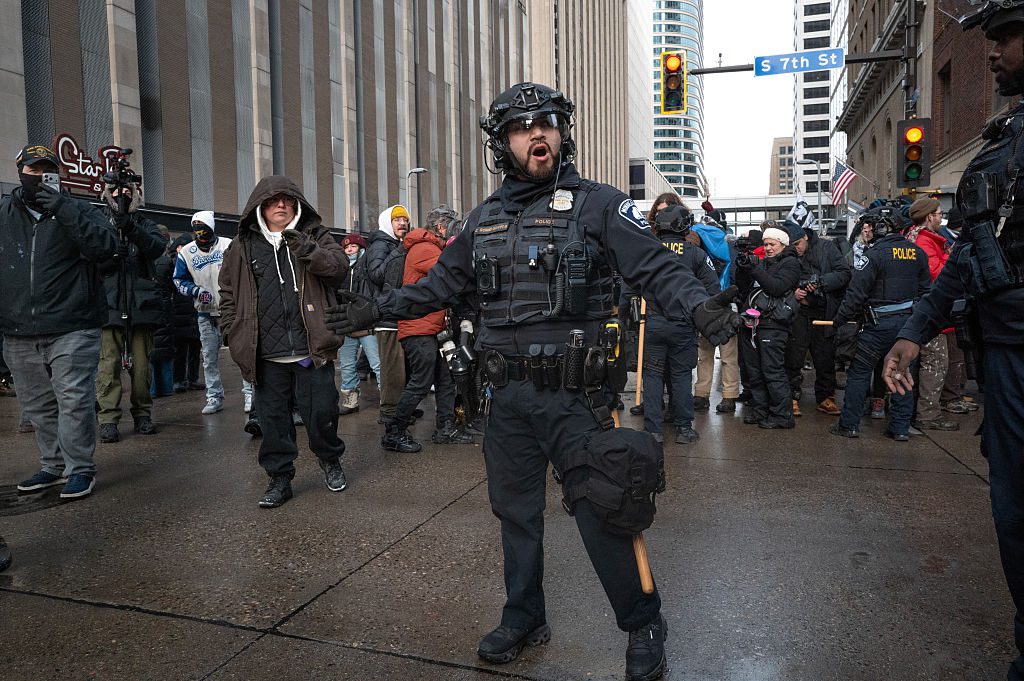
MINNEAPOLIS, MINNESOTA - JANUARY 17: Police confront demonstrators protesting the Trump administration's push to round up and deport undocumented immigrants on January 17, 2026 in Minneapolis, Minnesota. Protest have sparked up around the city after a federal agent fatally shot a woman in her car during an incident in south Minneapolis on January 7. (Photo by Scott Olson/Getty Images)
From routine traffic stops to potential detention, New Hampshire residents could face immigration consequences with little understanding of how local officers are trained.
A routine traffic stop in New Hampshire could now lead to immigration detention, but Granite Staters have no way of knowing what rules local police are trained to follow.
This lack of transparency is at the center of a federal lawsuit filed last Thursday by the American Civil Liberties Union of New Hampshire (ACLU-NH) against US Immigration and Customs Enforcement (ICE), seeking public records detailing how local officers are trained under a federal immigration enforcement program known as 287(g).
The lawsuit, filed in US District Court in New Hampshire, argues that ICE has unlawfully failed to turn over documents requested under the Freedom of Information Act (FOIA), which requires public access to federal government records. According to the press release, in light of the fatal shooting of Renee Nicole Good by an ICE officer in Minneapolis earlier this month, the ACLU-NH believes the “public has a right to know” how local police departments are being trained to participate in the program.
“Across the country we have seen deadly, harmful, and fear-inducing tactics used by federal immigration officers,” said Gilles Bissonnette, legal director of the ACLU-NH. “Now our local police are deputized to do this work despite ICE providing no transparency as to the training it has provided.”
Per the federal website, the 287(g) program is a set of partnerships that authorizes ICE to “delegate state and local law enforcement officers the authority to perform specified immigration officer functions under ICE’s direction and oversight,” such as questioning individuals about their status or issuing detainers.
The program was created in 1996 and operates with four models: The Jail Enforcement Model, Task Force Model, Tribal Task Force Model, and Warrant Service Officer Program. It has faced longstanding criticism over civil rights concerns.
In 2011, a Department of Justice investigation found widespread discrimination against Latino residents by an Arizona sheriff’s office participating in the program, leading to restrictions and suspensions. The Task Force Model, which the ACLU-NH focused on in the suit, allows officers to engage in immigration enforcement during routine policing like traffic stops. The model was discontinued in 2012, but was revived in 2025 under an executive order signed by President Donald Trump.
As of today, New Hampshire is one of 40 states that participates in the program, but it is the only state in New England to do so. Supporters say the program helps federal authorities identify people who may be in the country illegally, but critics argue it blurs the line between local policing and federal immigration enforcement, discourages immigrants from reporting crimes, and increases the risk of racial profiling.

Map source: US Immigration and Customs Enforcement website, Jan. 16, 2025
In the lawsuit, it is said that local officers must complete a 40-hour-long online training course under ICE to be certified. But the ACLU-NH alleges that officers receive no written materials they can keep, that access to training is time-limited, and that the public can not obtain those materials through state public records laws because local agencies do not possess them.
The ACLU-NH’s request focuses on training materials, manuals, lesson plans, guidance, and other documents ICE uses to train at least 138 officers in 13 New Hampshire law enforcement agencies, including the Troy Police Department, the Colebrook Police Department, the Carroll Police Department, the Rockingham County Sheriff’s Office, and the State Police.
“There have already been concerning arrests made under these 287(g) agreements right here in New Hampshire that ruin or change the lives of the people involved,” said Bissonnette. “And yet Granite Staters have few answers as to what the rules are for how local law enforcement are supposed to operate. We need transparency.”
Court filings attached to the lawsuit cite several arrests carried out by the Troy Police Department that support Bissonnette’s claims. In one case, police arrested and detained a 23-year-old Brazilian man in October last year, who had valid work authorization for two more years, as a car passenger in an alleged speeding car. In December, a 26-year-old man from Ecuador was arrested at a traffic stop for alleged speeding by Police Chief David Ellis, and was sent to ICE where he spent 15 days in custody.
Granite Post reached out to the office of Governor Kelly Ayotte for a comment on the lawsuit and to understand if the administration has already reviewed these training materials. They have yet to reply.
WATCH: NH ICE facility gets cold reception in Merrimack, NH
Author


Opinión: el futuro de New Hampshire es de diversidad
El pasado miércoles 18 de septiembre tuve el honor de reunirme con líderes latinos -de todo el país- para visitar la Casa Blanca, con motivo de la...

Opinion: New Hampshire’s future is one of diversity
Last Wednesday, I was honored to join Latino leaders from around the country to visit the White House for their Hispanic Heritage Month celebration....

Ayotte’s lies on immigration prompt fact checks by reporters
Over the weekend, leading Republican candidate for New Hampshire Governor Kelly Ayotte was called out by multiple New England reporters for lying...
‘Political theater’: Sununu’s border deployment plan draws fire
Governor Chris Sununu's request for $850,000 to deploy 15 New Hampshire National Guard troops to the Texas-Mexico border is facing a barrage of...
