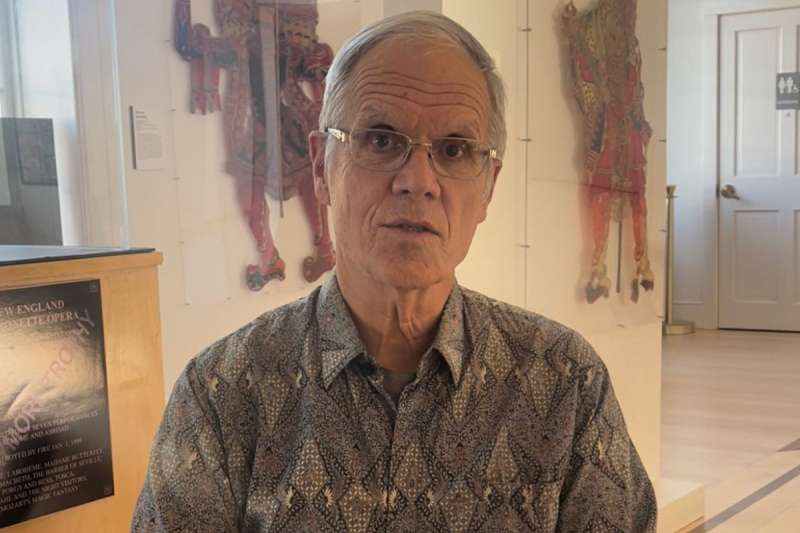
Former public school teacher David Blair, who is the co-founder of Mariposa Museum and World Cultural Center, and his late-wife, Linda Marsella, decided to highlight cultures of the world in their quaint little town of Peterborough—nestled between the hills of the Monadnock Region—for one key reason.
“We knew that many students in other schools don’t travel much. That was particularly true back in the seventies and eighties, but it’s still true of many families,” he said. “We, on the other hand, had the opportunity to travel and to expose our children to cultures all around the world.”
Marsella, a linguist, gave the museum its name, Mariposa, which means butterfly in Spanish.
“Linda spoke Spanish,” Blair said. “Mariposa means butterfly and butterflies are beautiful and they are also symbols of transformation,” he added.
A community-funded effort, Mariposa bought the building it is currently situated in on Main Street and launched its first exhibition on Latin American artifacts in 2007.
The idea behind the exhibit was to tell people in the predominantly white town the stories of different Latin American cultures, and to help visitors remain curious about this “close-by” but different part of the world.
Over time, as more love started pouring in for Mariposa, Blair started expanding the geographical reach of his exhibits.The museum has had exhibits from Morocco, Japan, India, Nepal, Uganda, Ethiopia and many more countries. It also frequently had groups of children tour the museum.
“When I had children come in, I’d ask, ‘So, what do you think this is?’” he said, showing a long staff with a hollow, notched, rotating disc and on the top. “Someone might say it’s a candle holder, or it’s a back scratcher, or one child said you use it to mash cockroaches.”
Blair would then tell them that it’s actually a whisk used in Latin America to froth up your hot chocolate. But the sheer curiosity and vision with which children desired to imagine the richness of the world invigorated him to continue doing the museum’s work.
At some point along its journey, Mariposa hired an education coordinator and started taking their programs and exhibits into schools, while also hosting children at the museum for cultural immersion.
“We did for about 15 years until finally we no longer could afford an education coordinator full time,” Blair shared. “Those who come have really enjoyed our programs and often come back. But over time a combination of factors such as decreasing school budgets, greater emphasis on testing, and therefore less time allowed for field trips.”
But Blair feels in this extreme political environment, it’s important to scale up that work of engaging with young kids all over again.
“We have groups from Boy Scouts, camps, summer camps as well,” said Eugenia Villanueva, the museum’s new part-time education coordinator. “But it’s something that we are trying to restart, and we are trying to get more school groups to come over.”
The most popular program of all time at Mariposa, however, is the five-day event when monks from Tibet come to the museum and create a sand mandala, sell crafts, and offer private blessings for the community. Mariposa has been hosting the monks at regular intervals in Peterborough for the last 20 years.
“This will probably be the monks’ tenth visit to New Hampshire,” Blair shared.
“You can get the ticket for five days or one day,” Villanueva said. “And then at the end they destroy it [the mandala], and everyone goes in procession with them to the river and throws the sand and it ends with a whole ceremony.”
This year’s Tibetan monk visit is scheduled for next week, Nov. 11-15. Check more details here.
On the heels of Donald Trump’s reelection, and the spate of attacks on marginalized communities in the country, Blair highlighted the importance of continuing his work in a small, rural community in New Hampshire.
“Our work is really important today because what we do is help people appreciate the diversity and beauty of different cultures,” he said. “Not to be scared of, but to be curious about and celebrate the ways in which we are different.”