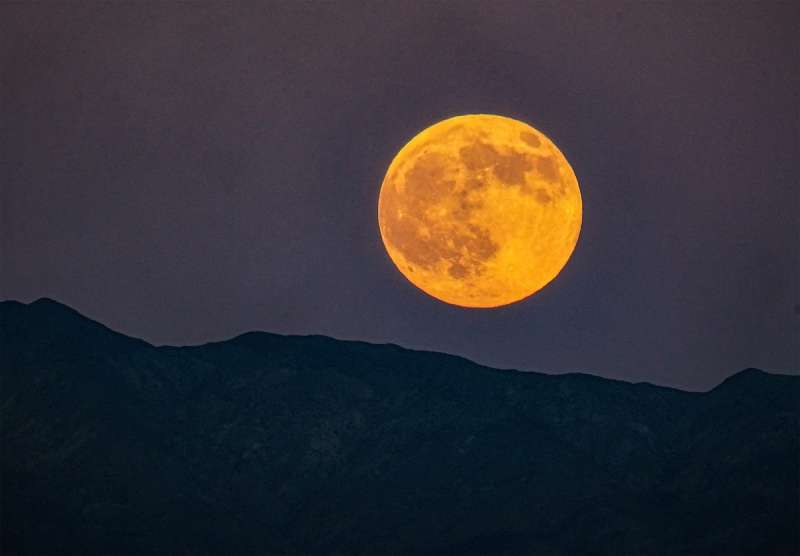
The harvest moon is the full moon closest to the autumnal equinox, and occurs in either September or October depending on the year. It’s one of the most anticipated lunar events of the season, especially as it is known to be quite bright.
Several cultural and religious observances coincide with the harvest moon, including China’s Mid-Autumn Festival, the Modern Pagan and Wiccan festival of Mabon, the Jewish holiday of Sukkot, and the Korean harvest holiday of Chuseok, according to the Farmers’ Almanac.
It’s that time of year when the leaves begin falling and the temperature starts to drop, so grab a jacket before you head out to look at the moon.
Here’s when to view the 2026 harvest moon from New Hampshire.
What is a harvest moon?
A “harvest moon” is the full moon that falls closest to the autumnal equinox.
This moon earned its name because, in the days before electricity, farmers relied on moonlight to harvest their crops late into the night, according to NASA. The bright glow of the moon was particularly important during the fall, when harvests were largest.
Also, during most of the year, the moon rises about 50 minutes later each day, but around the harvest moon, that gap shrinks, allowing the moon to rise at a similar time on successive evenings. At mid-northern latitudes, the difference can be as little as 25 to 30 minutes from one night to the next.
When is the 2026 harvest moon?
The 2026 harvest moon reaches its full phase on Saturday, Sept. 26, according to Time & Date. Peak illumination occurs at 12:49 p.m. ET.
While the exact moment of the full moon occurs during the daytime across much of the United States, you’ll still be able to see a nearly full moon before and after the peak.
According to astronomy experts, the best nights to view the harvest moon this year will be Sept. 25, 26, and 27.
Moonrise, moonset times for New Hampshire
Here are the moonrise and moonset times for New Hampshire the weekend of the 2026 harvest moon, according to the U.S. Naval Observatory:
| Date | Moonrise | Moonset |
| Friday, Sept. 25 | 1:04 p.m. | 12:41 a.m. (next morning) |
| Saturday, Sept. 26 | 1:49 p.m. | 1:25 a.m. (next morning) |
| Sunday, Sept. 27 | 2:36 p.m. | 2:11 a.m. (next morning) |
When is the best time to see the harvest moon?
The best viewing opportunity is typically around moonrise near sunset.
Astronomers say the moon often appears larger and more colorful when it is low on the horizon. Depending on local atmospheric conditions, viewers may notice orange, yellow, or even reddish hues shortly after moonrise.
To get the best view, find an area with a clear eastern horizon and check local moonrise times as Sept. 26 approaches.
What are the current moon phases?
Here are the current moon phases, according to Time & Date:
- Last quarter: Sept. 4
- New moon: Sept. 10
- First quarter: Sept. 18
- Full moon: Sept. 26
When is the autumnal equinox?
This year, fall begins on Tuesday, Sept. 22, at 8:04 p.m. ET, according to The Old Farmer’s Almanac. This is when the sun crosses the celestial equator.
The autumnal equinox is one of two times each year when Earth’s axis is tilted neither toward nor away from the sun, according to the National Weather Service. This results in nearly equal lengths of day and night.
While North America, Europe, most of Asia, and Africa, and the northern part of South America are all heading into fall during the equinox, countries in the Southern Hemisphere are about to experience spring.
This includes Australia, Antarctica, most of South America, and the southern portions of Africa and Asia.
When does daylight saving time end this year?
This year’s change from daylight saving time to standard time takes place on Sunday, Nov. 1, at 2 a.m. local time. Americans will adjust their clocks back by one hour (but not residents of Hawaii, Arizona, and some U.S. territories).
We gain an hour in November (as opposed to losing an hour in the spring) to make for more daylight in the winter mornings. On that day, time will jump from 1:59 a.m. back to 1 a.m.
When we “spring forward” in March, it’s to add more daylight in the evenings. And in the autumn, we “fall back.”
Janet Loehrke of USA TODAY contributed to this report.
This article originally appeared on Portsmouth Herald. Reporting by Bailey Allen and Maria Francis.