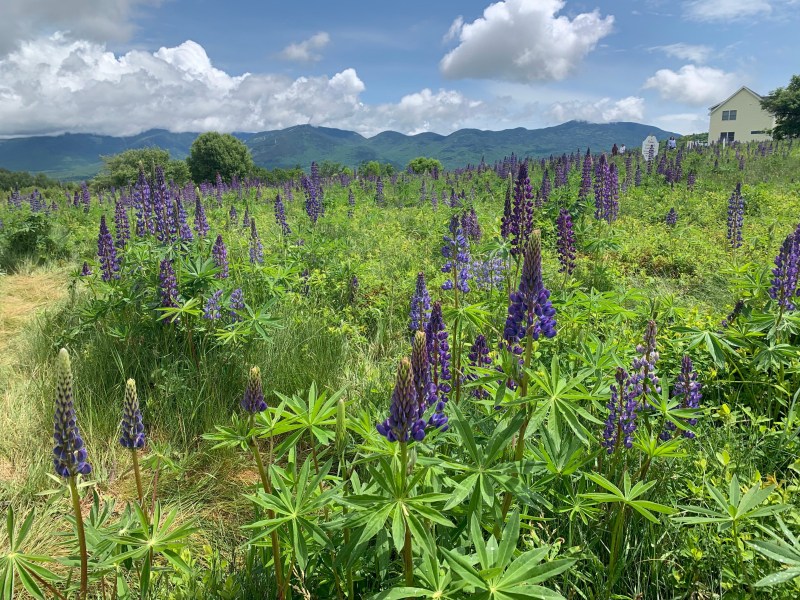
The White Mountains are known for their beautiful views year-round, but in June, the views in the fields become especially beautiful as the lupine burst into bloom.
Lupines are a tall spike of flowers, coming most commonly in purple, but also in pinks, whites and even yellow. A prolific self-seeder they’re known for their ability to fill a meadow with color during their blooming season.
While the timing of the peak bloom changes slightly every year due to weather conditions, it’s typically in early to mid June.
The flowers are often features in tourist brochures for places such as Iceland and New Zealand, but you don’t need to cross oceans to see them. While they aren’t quite as prolific in New Hampshire, if you know where to look you can see the wildflowers too.
Where can you see lupine fields in New Hampshire’s White Mountains?
If you’re looking to see the flowers, the town to head toward is Sugar Hill, the unofficial lupine capital of the New Hampshire. But it’s not the only spot, as you can also see them in Franconia, Easton and Bethlehem, according to Visit New Hampshire.
While some of the flowers are on private property or generally less accessible, there are several easily accessible spots.
Sunset Hill Road
Protected by the Ammonoosuc Conservation Trust, Sunset Hill Road in Sugar Hill offers one of the best spots to see the lupines in bloom. You’ll know you are in the right spot when you see cars pulled over on the side of the road. From the field, you’ll have a gorgeous view of the Presidential Ranges.
St. Matthew’s Chapel
Located at Route 117 at the corner of Birches Road in Sugar Hill, this is one of the most beautiful spots to immerse yourself in the lupines.
Polly’s Pancake Parlor
Polly’s Pancake Parlor, 672 Route 117, Sugar Hill, is best known for, you guessed it, their pancakes. But across the street from this is another lupine field, which makes a perfect spot to view some flowers and get a bite to eat. Just be warned, the restaurant is very popular, so either expect a long wait or come as close to opening as you can.
When do the lupines bloom?
The lupines typically bloom in early June, but the weather impacts exactly when the fields reach peak bloom every year.
For the most up-to-date information every season, Harman’s Cheese & Country Store, 1400 NH State Route 117, Sugar Hill, turns their Facebook account into a lupine tracker. They also post photos and a map daily at the bulletin board at their store to help people find the best lupine fields.
Are lupines native to New Hampshire?
While the lupines may be prolific in New Hampshire, not all the varieties you see are native.
The most common lupine species seen in the state isn’t native, but it has naturalized.
“Bigleaf lupine (lupinus polyphyllus) and the related ornamental Russell hybrid (Lupinus x regalis) were introduced to the northeast for both gardens and roadside stabilization in the early to mid-1900s,” according to University of New Hampshire horticulturalist Steph Sosinski in an article. “Through its intentional planting and as a garden escape, the bigleaf lupine rapidly spread throughout the landscape. It’s been admired by many, but closely monitored by others as a potentially invasive species.”
But, the sundial lupines seen in the state are native, and are the host plant New Hampshire’s state butterfly, the endangered Karner blue.
Both the size of the plant and the leaves can help tell the difference between the the different types of lupines.
“Bigleaf lupines are primarily taller and have larger leaves than the sundial lupine and grow up to five feet tall, whereas the sundial lupine typically only grows to around two feet,” Sosinski wrote. “Sundial lupines have 7-11 leaflets per leaf, while the bigleaf lupines have 11-17 leaflets.”
This article originally appeared on Portsmouth Herald. Reporting by Katie Landeck.