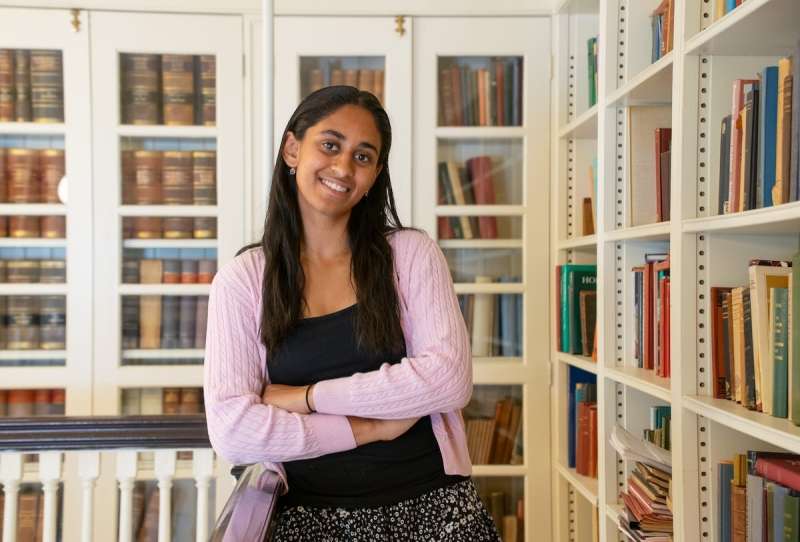
On the eve of her 17th birthday, Sami Koltur almost died.
Koltur, a student at Phillips Exeter Academy, went out for dinner at a restaurant with her parents, who were visiting her at school.
“I had a spoon of pasta, and I felt something itchy,” she recalled. “So, I took Benadryl, and I thought, you know, it was probably fine. I didn’t feel anything for a little bit.”
Once her symptoms didn’t seem to worsen, she told her parents she felt OK and headed back to her dorm. But soon after settling in, a sense of unease began to creep in.
“I go into the bathroom, and I’m like, really overstimulated, so I’m ripping my hoodie off and everything, and there’s just hives all over,” Koltur said.
The walk to the campus health center became a desperate sprint as it got harder for her to breathe, and she started banging on the door until a nurse opened it.
“I’m gonna die, like, you need to let me in. I literally can’t breathe,” she remembered saying.
Once inside, medical staff monitored her vitals, including oxygen, which had dropped to 60%. An ambulance eventually transported her to the hospital, where she spent the night.
Over the course of the evening, she had to use three EpiPens, which counter anaphylaxis. Koltur called this harrowing experience a “turning point.”
She said she wanted to make sure it never happened again — to her or anyone else. So she set out to create a solution.
Koltur notes that even when diners alert restaurants to allergies, cross‑contamination can still put them at risk. After researching existing detection methods, she designed a spoon called Allergense, which can test food for allergens and send results to a phone via Bluetooth in under 60 seconds.
A pocket-size allergen detector
The invention is mainly designed for restaurants to ensure food is safe before giving it out to customers, though Koltur says once it is more advanced, it may go out to consumers.
The tip of the spoon has 14 tiny electrodes, each coated with a different antibody. Each antibody only recognizes one specific allergen protein.
“When you stir your food, liquid flows across all 14 electrodes at once. If an allergen is in your food, its protein locks onto the matching antibody,” Koltur said.
Two electrical tests run simultaneously to detect what got caught and have to agree before the app connected to the spoon flags a detection. If they disagree, it prompts a retest.
“Sometimes there’s shortcomings of one or the other,” Koltur said, referring to the tests.
One of the tests, EIS — electrochemical impedance spectroscopy — sometimes confuses the current or impedes it with high-sodium foods, like soy sauce. Having both methods ensures that there are no false negatives.
The device is a pocket-size version of ELISA, or Enzyme Linked Immunosorbent Assay, which lab researchers use to determine if there’s an allergen in food. The issue with ELISA, Koltur said, is that it requires a $15,000 machine and takes four hours. Her proposed invention uses the same antibody chemistry but miniaturized onto a chip.
Currently, the spoon is undergoing clinical testing with 500 common foods and comparing results with ELISA to make sure it is working. With support from teachers at PEA, allergists and patent lawyers, Koltur applied for a patent for her invention, which is pending.
An app for those with food allergies
In the meantime, Koltur wanted to offer a tool to help those with allergies more immediately, as the spoon’s launch will take some time. Over the summer, she built the app Allergense, which is a crowdsourcing app available on the App Store that ranks restaurants and cafes based on allergen safety.
Upon opening the app, one can select their allergens from a list of 14, which includes peanuts, tree nuts, milk, eggs, wheat, soy, fish, shellfish, sesame, gluten, mustard, celery, lupin and sulphites. From there, users can see a map customized to their location that can be refreshed in real time to see locations marked with tags such as safe, caution or reaction.
Users can submit a report for a restaurant, select their allergens and select one of three options (ate safely, used caution, had reaction), write what they ate and add optional notes.
Over time, Koltur hopes people’s reviews can help others looking for a safe place to eat.
The drive behind Allergense
A high school senior, Koltur juggles being an inventor with extracurriculars, being a student-athlete and applying to colleges. She says her days are packed, and she sometimes feels burnt out, but inventing is something she is passionate about.
“To create change … you have to be disciplined in your intentions and goals,” Koltur said. “I set out my intentions for (Allergense), and that’s kind of how I was able to come to this stage.”
Koltur will be busy this fall with college applications, but she plans to continue this project in college and work on it more during the summer. In the next couple of years, she hopes to get the spoon out to restaurants, get the patent fully approved and make revenue.
So far, all her funding comes from entrepreneurial awards and in total, she has raised $250,000. The company is still pre-revenue as the spoon goes through testing and manufacturing stages, but she says their model projects about $15 million in year-one revenue across hardware sales, consumable tips and app subscriptions. This does not include restaurant licensing revenue, which she predicts will be another channel for revenue.
Staying consistent throughout it all is something she says she learned from sports.
“You’re not always going to find the motivation to just like, keep going, but it’s about consistency, and discipline, and just showing up even when you’re tired, because at some point, it is going to pay off,” Koltur said. “It’s going to help other people … people like me with allergies.”
This article originally appeared on Portsmouth Herald. Reporting by Grace Chai.