Looking to make a local impact with her climate-focused work, Stephanie Marshall, a member of Exeter’s Energy Committee, discovered northern New England-based nonprofit WindowDressers.
The organization, formed in Maine in 2010, helps community partners measure and manufacture reusable window insulation inserts, which, by covering drafty windows, can help households limit their energy usage during the frigid winter months.
“It’s this wonderful program that uses volunteers to build very low-cost but extremely effective insulating window inserts that go in from the interior of the house and completely seal a window, so you don’t have any drafts from it,” Marshall said.
Impressed with the window inserts, Marshall brought the idea with her to the Energy Committee. She said the program, which celebrated its inaugural year last winter, is different than the larger initiatives the committee typically takes up, which include reviews of Exeter’s recycling program, resource consumption and looking for grants to fund alternative energy sources.
“I went to a build that was happening in North Conway and was just really impressed with both the simplicity of it and the effectiveness of it and the affordability of it,” she said.
Program eyes expansion to surrounding communities
Last year, Marshall said community members built 189 window inserts. This year, her goal is 250.
In pursuit of the program’s expanded reach, window inserts are available to any household living within the SAU 16 district, which includes Brentwood, East Kingston, Kensington, Newfields and Stratham, in addition to Exeter.
The program has liaisons in each participating town, Marshall said.
“We want people from all the surrounding towns to have access to this really wonderful program,” Marshall said.
A small insert costs around $40, with prices rising to around $55 and $70 for larger windows. Costs for the window inserts are lower than other options because of the volunteer labor used to construct them, Marshall added.
Those who cannot afford the window inserts can purchase them at a discount. The WindowDressers organization aims to make around one-third of all inserts discounted or free, Marshall said.
Though other weatherization solutions cannot work in mobile homes, the WindowDressers inserts can, Marshall added.
Building window inserts — and community
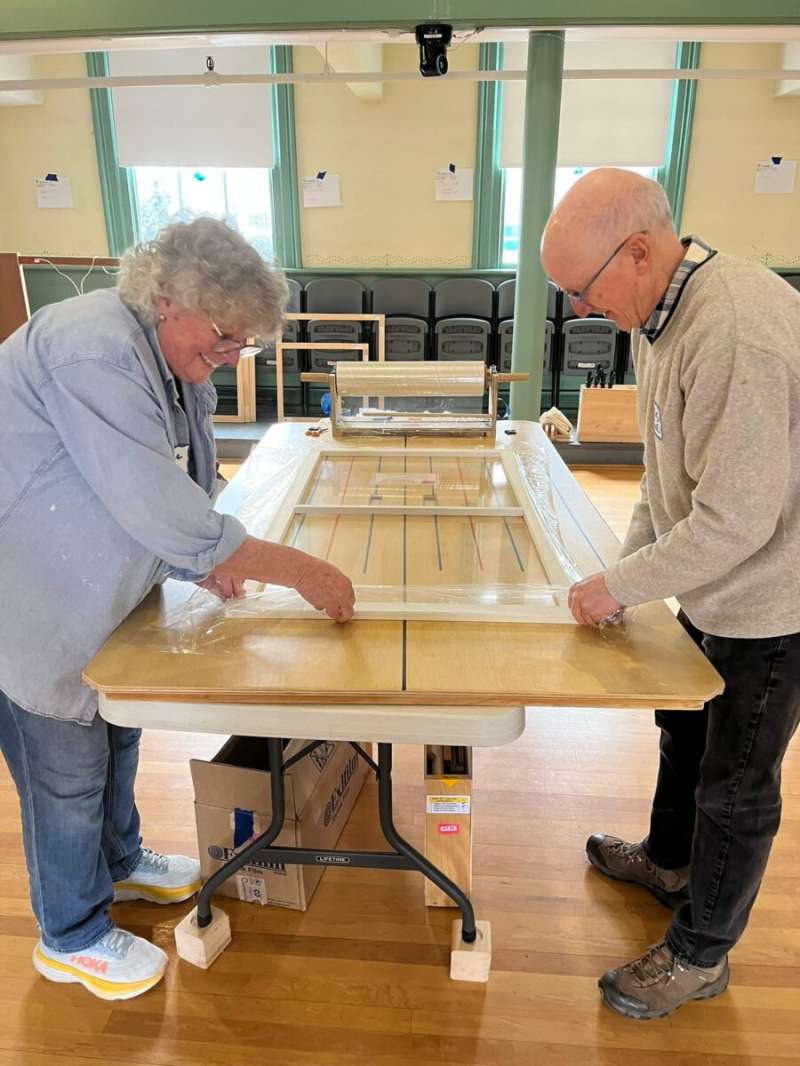
Once a household indicates interest, they are asked to participate in the building process, to be held between Jan. 15 and Jan. 22 at Exeter Town Hall, Marshall said.
“It’s really focused on individuals, residents and on building community,” Marshall added. “At the same time, you’re doing something to help people out.”
Last year, the WindowDressers organization coordinated 57 build events across New England, which Marshall called a “cumulative effect” of the program’s heightened awareness.
At Exeter’s build event, two four-hour shifts will be held each day, and no prior knowledge is required. Lunch, snacks and water will be provided.
“It’s like a community barn-raising combined with a pop-up manufacturing kind of thing.”
How can I purchase an insulating window insert?
Interested residents can purchase their window inserts on the WindowDressers website or by calling (207) 596-3073 by Nov. 30, after which a team of volunteers will measure each window for the custom build.
Typically, Marshall said, three to four inserts are sufficient to make a noticeable difference, though some elect to purchase one for every window.
Each insert usually lasts between five and 10 years. Though some leave them in year-round, Marshall said removing them once spring begins is as simple as popping the wooden frame out and storing it.
Though the program has a low profit margin, any proceeds are reinvested to ensure more discounted opportunities are available for those who need them.
Those with questions about the program are encouraged to contact Kristen Murphy, Exeter’s conservation and sustainability planner.
This article originally appeared on Portsmouth Herald. Reporting by Brandon Ng,