Sen. Dan Innis wrote the law that lets 20 voters force a districtwide vote on closing a school. The first petition filed under it targets Sutton Central School, in his own district, and his name is on it. Seven towns vote Dec. 5.
New Hampshire state Senator Dan Innis (R) wrote a law that allows 20 voters to force an entire school district to vote on closing a school, even if the petitioners don’t live in the town where the school is located.
Republican Gov. Kelly Ayotte then signed the bill into law.
When the first petition landed in Sen. Innis’ own district, he signed it. It was a petition to close an elementary school in a town he doesn’t live in.
The petition asked voters in the seven-town Kearsarge Regional School District to close Sutton Central School. It arrived at the district office Oct. 8, the first day Innis’ law took effect.
Innis, a Bradford Republican, has said openly that he wants schools closed.
He told the Concord Monitor last month that the cost of maintaining Simonds Elementary in Warner and Sutton Central had ballooned over the past few decades and that the district should stop spending money on small classrooms.
“I think the solution is going to be closing a couple elementary schools, and a lot of people don’t like that idea,” Innis said, adding that classes “with seven or eight kids in them” are “an awful lot of money to spend.”
In interviews with the Granite Post in recent weeks, people in Sutton and Warner, where the school board has also targeted Simonds, have kept for the same word.
“It felt like betrayal,” Nancy Glynn, vice chair of the Sutton Select Board and the town’s representative on the Kearsarge school board, told the Granite Post. “In this case, it felt very much like he was working against his communities.”
The Kearsarge fight comes after years of Republican moves at the State House to expand private school vouchers, cap school budgets and leave the state’s share of school costs the lowest in the country.
How did Dan Innis’ school closure law pass?
Innis was the prime sponsor of Senate Bill 588, which would have required every town in a school district to vote on closing any one school. In February, a Senate committee voted 5-0 to set the bill aside for further study, a move that usually kills a bill. Senators at the hearing agreed the 20-signature threshold was too low, according to Reaching Higher NH, a nonpartisan education policy group.
Then the language came back. The Senate Education Committee voted 3-2 to attach Innis’ closure process to House Bill 1374, a bill about how towns leave cooperative school districts. The 20-signature threshold stayed, and the closure language never got a public hearing in the House.
“There was never any debate. There was never any public hearing,” Glenn Pogust, chair of the Sutton Select Board, told the Granite Post.
Innis voted yes when HB 1374 passed the Senate 14-8 on May 7. Every Republican present voted for it, and every Democrat voted against it. Senate leaders then named Innis one of three senators to negotiate the final version with the House. Ayotte signed it July 10.
Jason Mutschler, a Warner parent, told the Granite Post, “there’s some dirty politics at hand here too.”
“He wrote the text, introduced it in the Senate bill and then snuck it into that House bill in an amendment,” Mutschler said of Innis. He said the senator “should frankly be ashamed.”
What does the law do?
Any 20 registered voters can petition the school board for a districtwide vote on closing a school. A simple majority across all seven towns who cast ballots decides the outcome, so voters elsewhere can outvote the town where the school sits. If they vote yes, the school must close before the next school year starts. The law sets no limit on how often a petition can be filed.
There is one exception. Under the law’s “municipal preservation option,” the town where the school sits can vote at a town meeting to keep it running anyway. But the town then has 60 days to strike a deal with the district on who pays for teachers, the building and busing, and who ends up owning the school. If they can’t agree, the State Board of Education decides.
That upends the deal the seven towns made more than 60 years ago. Pogust said the district’s Articles of Agreement let a neighborhood elementary school close only if voters in its own town said so. “They knew they needed a bigger high school, but they wanted to keep their neighborhood elementary schools,” he said.
Abigail Strass, a Warner parent whose child is due to start kindergarten at Simonds next year, said the law is so loosely written that “20 high school seniors could petition to close the high school.”
Who signed the petition to close Sutton Central?
Innis did. Mutschler said that didn’t surprise him. “Not even a little bit,” he said.
Pogust said most of the other signers live in a town that “doesn’t have their own elementary school,” which he described as “one of the wealthiest towns in the district,” with many homes on Lake Sunapee. He did not name the town.
A statewide group called the School District Governance Association of New Hampshire posted a petition form titled “Discontinuance of Sutton Central School” on its website.
Its board includes Rep. Claudine Burnham (R-Milton), who also voted for HB 1374. Its 2026 legislator scorecard gave awards to 201 lawmakers, all Republicans, and awarded Innis a perfect score.
Superintendent Michael Bessette told the school board on Oct. 8 that the petition had about 67 signatures and that the district would post it online once every name was checked.
What do parents in Warner and Sutton say?
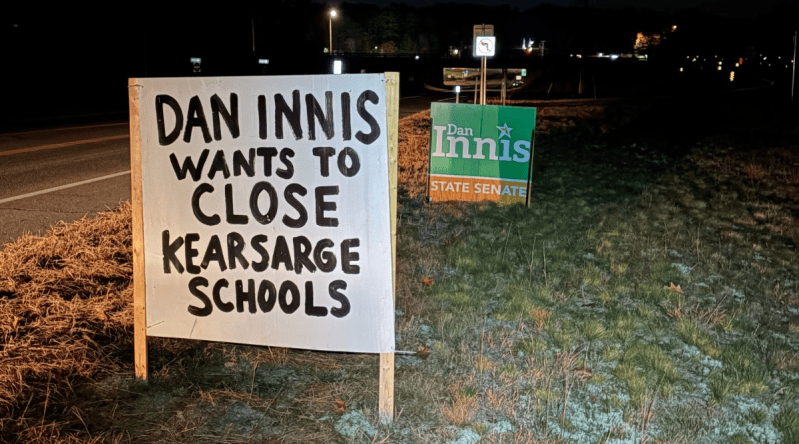
The Granite Post interviewed nearly a dozen parents and local officials in Warner and Sutton in recent weeks. Residents have organized under the name Save Kearsarge Schools, and their signs now line roads in both towns.
Molly Sanders of Warner used to run the before- and after-school programs at Simonds. Her daughter is due to start kindergarten there next year.
“I’m mad,” Sanders said. “He has done multiple things to undermine and underfund public education. And I’m tired of it.”
“He lives the next town over and he never shows his face around,” she said. “It was just the Warner Fall Foliage Festival. He did not show up.”
Her message to voters: “Don’t vote for Dan Innis.”
Glynn said the board has invited Innis and he has never come. “He hasn’t even come to a school board meeting,” she said. “And instead, he writes legislation to go against what we’re doing, and it’s just not right.”
Strass was more measured, but no less critical of the signature. “Was I disappointed? Absolutely. Surprised? No,” she said. “If he wrote the legislation, he should stick by it. But he also needs to stick by the consequences of that.”
Pogust said a closure would gut the village. “The effect on our community would be devastating,” he said. “We’re in a small village where the school is. A lot of kids walk to school.”
The district’s own study found Kearsarge needs about $60 million in repairs across its seven schools. Sutton Central accounts for about $2 million of that. Sarah Hansen, a Warner parent, put it this way: “Shutting Sutton or Simonds won’t put a roof on the high school.”
Which local Republicans backed the law?
Innis represents five of the district’s seven towns: Bradford, Newbury, Sutton, Warner and Wilmot. He lost his Seacoast Senate seat in 2018 and moved into District 7 before winning it in 2022.
“Dan Innis has never been an independent thinker,” Glynn said. “He has always been someone to fold and go in line with whatever his party is asking him to do.”
The only Republican state representatives for any Kearsarge town are Reps. George Grant and Michael Aron of Springfield. Both voted for the final version of HB 1374, which passed the House 179-161 with every yes vote coming from a Republican. Every other House member for a Kearsarge town, from Sutton and Wilmot to Warner, Bradford, New London and Newbury, is a Democrat.
Innis, Grant and Aron also voted for House Bill 1300, which Innis cosponsored. It puts a school tax cap question on the ballot Nov. 3. Kearsarge’s board voted Oct. 8 to tell voters it does not recommend the cap.
Is this part of a bigger push against public schools?
Glynn pointed to open enrollment, Education Freedom Accounts, HB 1374 and the state’s share of school funding. “It’s almost like a war against public education,” she said.
New Hampshire pays a smaller share of its public school costs than any other state. Property taxpayers cover about 72% of what districts spend, and the state’s share has fallen from 34.9% in the 2007-08 school year to 25.6%, according to the New Hampshire Fiscal Policy Institute. A judge ruled in 2025 that the state’s funding system is unconstitutional. Pogust said that leaves districts “under tremendous pressure to be able to try to cut costs.”
While the state’s share shrank, Republicans expanded private school vouchers. Innis cosponsored the 2025 law that opened Education Freedom Accounts to every family, no matter how much they earn. The program now pays for 10,510 students at a cost of $51.6 million, $12.3 million over budget, and about 80% of them were not in public school when they signed up. Senate Republicans protected that money in the 2025 budget while cutting housing aid.
Republicans also tried to require every public school in the state to participate in open enrollment, with the students’ home districts paying for students who leave. That bill failed in the House in April. Its champion, House Education Committee Chair Kristin Noble (R-Bedford), cosponsored Innis’ original closure bill and helped write the final version of HB 1374.
Where budget caps already exist, schools went first. Rochester’s superintendent proposed closing a school and cutting 40 jobs to meet that city’s cap, and Claremont closed Bluff Elementary during its 2025 budget crisis.
Rebecca Harned, Innis’ Democratic challenger, opposes all three: the closure law, the tax cap and the voucher expansion. Innis supported all three.
When is the vote?
Voters from all seven Kearsarge towns can cast ballots on Saturday, Dec. 5, starting at 9 a.m. at Kearsarge Regional Middle School. A majority of voters decides whether Sutton Central School closes.
Bessette said running the vote will cost the district more than $15,000, and the law lets the question come back. “There’s an unlimited number of times these petitions can be filed,” he told the board.
Innis faces voters Nov. 3. Harned, a research scientist, lives in Sutton and serves on the district’s budget committee. She has said the law oversteps the state’s role and takes away local control.