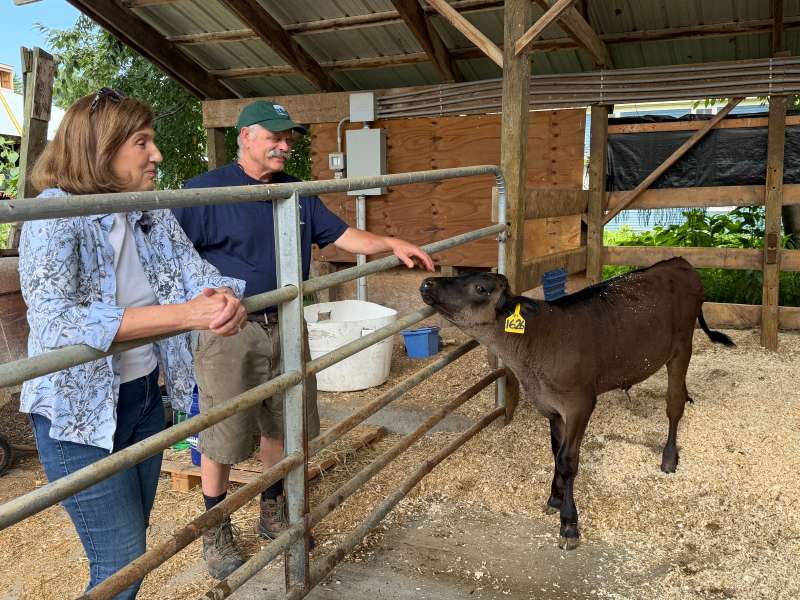
Touring Bohanan Farm on Friday, Democratic gubernatorial candidate Cinde Warmington heard what Trump’s tariffs are costing a fifth-generation Hopkinton dairy operation and pitched a state gas tax suspension for immediate relief at the pump.
Jamie Robertson can trace most of what it costs to run Bohanan Farm back to Canada: the fertilizer spread on his cornfields, the diesel in his tractors and delivery trucks, even the glass bottles that carry Contoocook Creamery milk to stores around the Capital Region.
“These 50% tariffs are really scary,” Robertson said during a tour of the farm with Democratic gubernatorial candidate Cinde Warmington during her visit to the fifth-generation Hopkinton dairy farm on the last Friday in July.
“Really scary.”
Robertson was talking about the Trump administration’s newest round of duties on Canadian goods.
Robertson runs Bohanan Farm with his wife, Heather, and their sons, the fifth generation of Heather’s family to work the land along the Contoocook River. The operation milks about 110 of its 125 mature dairy cows, raises another 100 calves plus about 50 beef animals, and bottles roughly 16,000 eight-ounce servings of milk a day, alongside beef sold at the farm, at area farm stands, and to the Tucker’s restaurant chain.
On July 20, President Donald Trump imposed an additional 50% tariff on roughly $20 billion in Canadian imports starting Aug. 19, covering products the White House said ranged “from wine to hockey sticks to cement.”
Warmington told Robertson she would take that fight on.
“We need to stand up and make sure that Washington hears what the impact is on the tariffs on local people like this,” she said. “I want to tell you, listening to Jamie and a lot of others across the state, the cost of fuel is through the roof. And I think it’s time that we took a look at a gas tax suspension here in the state and give them some immediate relief on these costs that they’re facing.”
New Hampshire’s gas tax adds 23.7 cents to every gallon sold in the state, and the same rate applies to diesel. Gov. Kelly Ayotte (R) has declined to suspend it.
In early May, with regular gasoline averaging $4.53 a gallon in New Hampshire, up from about $2.90 in 2022, the Republican governor said she was watching prices at the pump but was not willing to offer a tax holiday.
American farm exports to China have fallen by roughly half since Beijing responded to the Trump administration’s tariffs with double-digit duties on US farm goods. During Trump’s first term, retaliatory tariffs cost American agriculture an estimated $27 billion from mid-2018 through 2019, including $391 million a year in lost dairy sales, according to a Congressional Research Service review of federal trade data.
Asked what he wants from a governor on tariffs, Robertson said having the governor “fight against the tariffs […] would certainly be a big plus.”
New Hampshire’s current governor has been almost entirely absent in that fight.
As most of New England’s governors banded together last year to blunt the damage from Trump’s tariffs to their economies, Ayotte kept what the Boston Globe charitably called a “strategic distance” from their efforts, declining to coordinate with the group.
Robertson’s also said adequately funding the state
“Where we need support from the governor in the state is the university system, and extension, which is a part of the university system, and a strong Department of Agriculture”” Robertson said.
Bohanan Farm leans on the University of New Hampshire agriculture extrension program for its crops, for dairy nutrition and for herd health, Robertson said, and the program’s reach extends well past operations his size.
“Extension is there for the backyard person too, [who] isn’t big enough to get anybody interested in coming to help them,” he said.
The university system Robertson wants the governor to defend is absorbing deep state funding cuts.
Under the two-year budget Ayotte signed in June 2025, state support for the University System of New Hampshire fell from $95 million a year to $87 million in the first year and $77 million in the fiscal year that began July 1. Ayotte had proposed a 4% trim, House Republicans passed a 30% cut, and the final deal landed roughly 15% below the previous budget. Chancellor Catherine Provencher has said the system is “still reeling” from what she estimates is a $35 million reduction over two years.
Days after the budget took effect, UNH announced $17.5 million in new spending cuts, on top of $12.5 million in reductions and more than 30 eliminated jobs the month before. Tuition rose across the state’s public campuses for the first time in six years. Last week, UNH’s faculty union declared a bargaining impasse after 490 days of contract talks.
Polling last August found 53% of Granite Staters opposed the university cuts.
At Bohanan Farm, the squeeze arrives on a schedule. About every 28 days, when the grass needs cutting and the fields need another round of fertilizer, Robertson said, his phone rings while he is out delivering milk: his son, asking whether “we got enough money in the checkbook to get fertilizer.”
His answer: “I don’t know, ask your mother.”