New Hampshire Republicans have pushed a raft of legislation in the past decade that has given New Hampshire the ranking of one of the hardest states to vote in the United States, and caused over 100 voters to be turned away from the polls in 2025.
Now, a top Republican group is warning that 1 in 8 voters could be turned away from the polls in 2026 as a result.
What does the ad say?
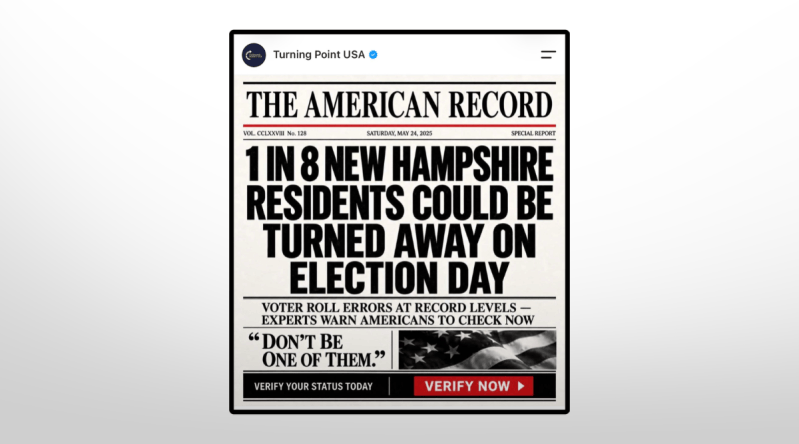
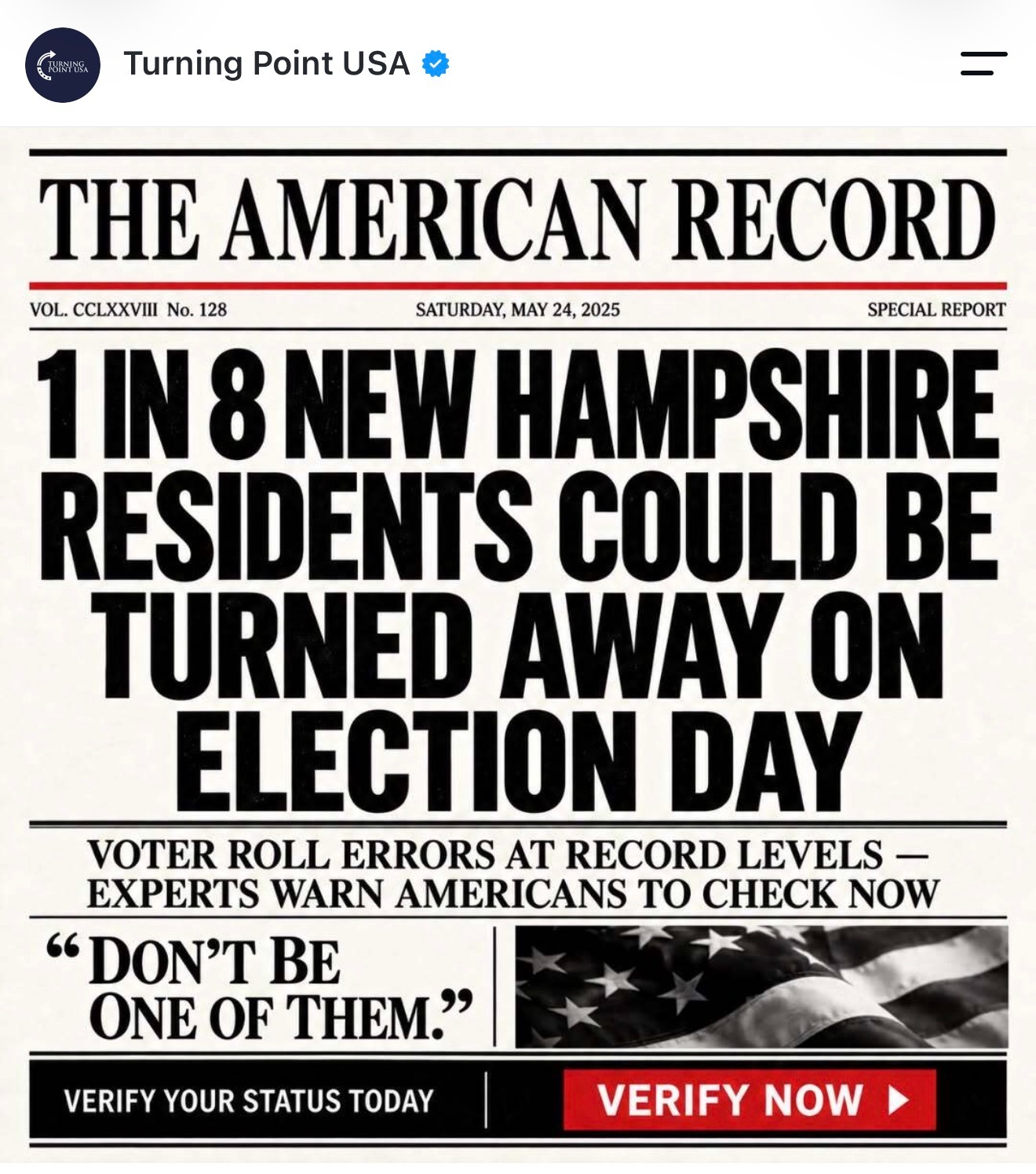
Turning Point USA, the conservative group founded by the late Charlie Kirk, ran an ad designed to look like the front page of a newspaper, under the banner headline “1 in 8 New Hampshire residents could be turned away on Election Day.” with a warning.
“Don’t Be One Of Them.”
The ads do not say where the 1-in-8 figure comes from, and the state has no number of its own. Secretary of State Dave Scanlan testified in federal court in February that his office has not tracked how many people have been turned away since new voting rules took effect.
The ads appear to have since been taken down, and Turning Point USA did not respond to a request for comment.
How did New Hampshire get here?
The rules that turn voters away were written by Republicans in Concord. In 2024, Republican lawmakers passed House Bill 1569, which eliminated the sworn affidavit that voters without a passport or birth certificate had used for decades to register. Then-Gov. Chris Sununu, also a Republican, signed it that September over the objections of local election officials. Voting rights experts called the law “the most restrictive in the country.”
The state was already near the bottom of the pack. The Cost of Voting Index, an academic study that scores every state on its voting rules, ranked New Hampshire second-hardest in the country in 2024, behind only Mississippi, and dead last in 2022.
In the new law’s first year, which included only low-turnout town meetings and city elections, the New Hampshire Campaign for Voting Rights counted at least 244 people who were turned away because they did not have the right documents.
Scanlan told the court he expected that number to rise in a bigger election.
What is still on the books?
A federal judge struck down the citizenship requirement in May, ruling that the sworn statement “is the only method of proof available to a significant number of New Hampshire voters.” The state appealed and asked to keep the law in place for this fall, and both the judge and the federal appeals court in Boston said no, most recently on Sept. 4.
Most of the law is still in effect. Anyone registering for the first time has to show documents proving their identity, age, and address, and no sworn statement counts for those, so voters who arrive without them can still be turned away. Gov. Kelly Ayotte has since signed a Republican bill requiring proof of citizenship, age, address, and identity to request an absentee ballot.
What about college students?
Ayotte also signed House Bill 323 in April, ending the use of student IDs as voter identification. Secretary of State David Scanlan then went further, telling local election officials they could no longer accept a student ID for any purpose, including as backup evidence, under a provision of the law that lets a voter without a qualifying photo ID prove who they are by other means.
The Coalition for Open Democracy sued in August. On Oct. 2, a federal judge upheld the law but blocked Scanlan’s directive, writing that “the State has not identified any security or integrity concern specific to student ID cards.” Scanlan said the ruling “defies common sense,” and the state has asked the federal appeals court in Boston to put the ruling on hold before Nov. 3.
Who is Turning Point backing in New Hampshire?
Turning Point Action, the group’s political arm, released its New Hampshire endorsements in September: Ayotte for governor, John E. Sununu for U.S. Senate, and Lily Tang Williams for the 2nd Congressional District. John Sununu’s brother Chris is the governor who signed HB 1569.
What do you need to vote on Nov. 3?
Voters who are already registered need a photo ID at the polls
Student IDs no longer count as standard ID, though after the Oct. 2 ruling, local officials may consider one as backup evidence of who you are unless the appeals court steps in. First-time registrants should bring documents proving their identity, age, and address, along with a birth certificate or passport if they have one. Those who don’t can sign a sworn statement that they are a citizen.
Voting groups and Republican lawmakers alike recommend registering ahead of time at a town or city clerk’s office. You can check your registration here, and Granite Post’s voter guide has the full list of accepted documents.
New Hampshire does not allow no-excuse absentee voting, and it is one of only three states with no early in-person voting. You can get an absentee ballot if you will be out of town on Election Day, have a disability or illness, have a religious observance, work or care for a child or adult the whole time the polls are open, or are covered by a domestic violence protective order, among other reasons.
The Republican law Ayotte signed last year applies here too. Since Sept. 30, 2025, an absentee ballot application has to include a copy of your photo ID or be notarized, and anyone registering by absentee has to send proof of citizenship, age, identity, and address. Request your ballot from your town or city clerk as early as you can. A mailed ballot has to reach the clerk by 5 p.m. on Election Day, and a hand-delivered one by 5 p.m. the day before.Granite Post’s absentee guide walks through each step.