| New Hampshire is the worst state in the country to be a teacher |
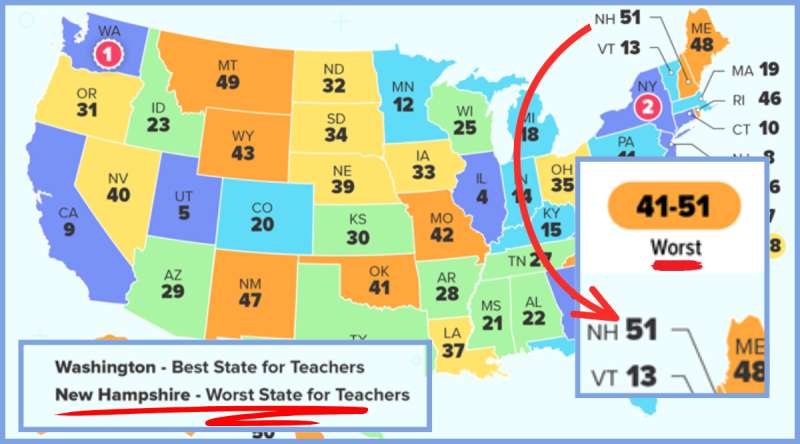
New Hampshire is the worst state in the country to work as a teacher, according to a ranking released Monday by the personal finance site WalletHub.
Why did New Hampshire rank last?
The state finished 51st out of 51, behind every other state and Washington, DC. It came in dead last on “Opportunity & Competition”, the category worth 70 of the ranking’s 100 points, covering starting salary measured against local cost of living, pensions, and tenure protections.
New Hampshire placed 7th on “Academic & Work Environment,” the category measuring school quality and working conditions. The ranking weighed compensation, tenure protections, state spending per student, school system quality, and turnover rates across 24 measures, using data collected as of August 17, 2026.
The findings land on a school system the state itself barely pays for. In 2024-25 New Hampshire covered 28.2% of its public school costs, last among the 50 states, leaving the rest to local taxpayers. The state lost 6.74% of its teachers in a single year.
Where is the state’s education money going?
The school voucher program Gov. Kelly Ayotte (R) expanded to families at any income level in 2025 has grown fast. Education Freedom Accounts cost an estimated $51.6 million in 2025-26, nearly double the previous year’s cost and $12.3 million more than the state budgeted. They are projected to reach $61.4 million this school year.
“WalletHub’s dead-last ranking is a damning reflection of Kelly Ayotte’s priorities,” said Rep. Patricia Cornell, a Manchester Democrat and former middle school guidance counselor, in a statement released by the New Hampshire Democratic Party.
“At a time when teachers are struggling to make ends meet, and our public schools are facing budget shortfalls, Kelly Ayotte and Republicans are choosing to spend millions on their voucher scheme.”
What else have lawmakers done to cause this?
Republican lawmakers have spent five years trying to put teachers at legal risk over what they say in class. A 2021 law limiting how teachers discuss racism and discrimination allowed parents to bring lawsuits and potentially put teachers’ licenses at risk before a federal judge struck it down in 2024, a ruling now on appeal.
The House passed a bill this year that would have allowed suits of up to $10,000 per violation of the law before it died in May.