Republicans’ biggest attack on New Hampshire Democrats keeps getting blunted by huge checks from opioid industry leaders.
Republican US Senate nominee John E. Sununu’s campaign took $5,000 in June from John Hammergren, the former chief executive of McKesson Corporation. From 2006 to 2019, McKesson shipped more prescription opioid pills into New Hampshire than any other drug distributor, according to federal data compiled by The Washington Post.
Hammergren ran McKesson for about 18 years. In the company’s 2017 fiscal year, he took home $98 million, at “the same time federal and state officials went after McKesson for its role in the nation’s opioid epidemic,” Axios reported.
The check arrived while Sununu’s fellow Republicans were months into their biggest attack on Democrats this year: calling governor nominee Cinde Warmington an “opioid lobbyist” over her 2002 work for Purdue Pharma.
It’s also not the first McKesson money Sununu has taken.
The company’s employee political action committee (PAC) gave his Senate campaign $5,000 in September 2008, the same year McKesson agreed to a $13.25 million federal civil penalty over suspicious drug orders. Hammergren himself put more than $73,000 into that PAC while he ran the company, Federal Election Commission (FEC) records show.
The Sununu campaign did not respond to a request for comment.
Who is Sununu’s donor?
Hammergren led McKesson, one of the nation’s largest drug distributors, until he retired in 2019. Distributors like McKesson buy medicine from drugmakers and ship it to pharmacies and hospitals.
He left with what Bloomberg called “corporate America’s largest pension,” which he had cut to $114 million in 2014 after shareholders complained about executive pay.
Sununu’s campaign received Hammergren’s $5,000 on June 23 through WinRed, the Republican online fundraising site, according to the report the campaign filed in July with the FEC. The campaign put $3,500 toward the primary and $1,500 toward the November election.
The donation lists Hammergren as retired and living in Wolfeboro. Hammergren’s past donations listing a Wolfeboro residence list McKesson as his employer and chief executive as his job.
What did McKesson do in New Hampshire?
McKesson sent 149.9 million oxycodone and hydrocodone pills to New Hampshire from 2006 to 2019, according to The Washington Post’s database.
That was about 29% of the roughly 515 million of those pills shipped into the state.
Federal officials have twice accused McKesson of failing to report suspicious orders for tightly controlled drugs like opioid painkillers in other states. Those are orders from pharmacies that are unusually large or frequent.
The company agreed to pay the $13.25 million civil penalty in 2008 and a record $150 million civil penalty in 2017, according to the US Department of Justice.
In 2022, McKesson and two other big distributors, Cardinal Health and AmerisourceBergen, agreed to pay a combined $21 billion to settle lawsuits claiming they helped fuel the opioid crisis. McKesson’s share was $7.4 billion.
New Hampshire expects to get $115 million from the deal, paid out over 18 years, for addiction treatment, recovery services, and other tools to fight the opioid crisis.
How does the donation fit in with other donations Sununu received and votes he made while in office?
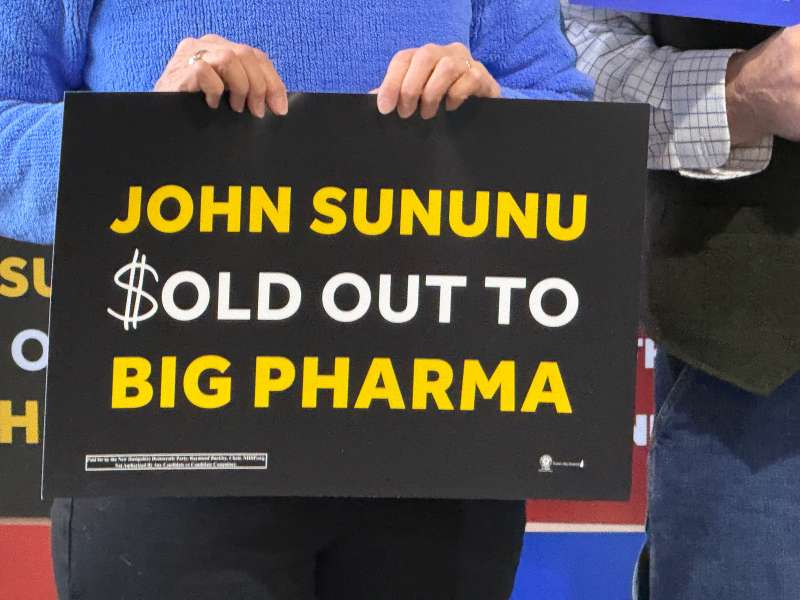
A deep dive by the Granite Post into Sununu’s records on the campaign trail and in office found that Sununu frequently accepts donations from opioid companies while then casting votes in office to shield them from greater scrutiny.
Throughout his first five campaigns for Congress and the US Senate, Sununu received over $110,000 from corporate PACs of opioid manufacturers, distributors, and retailers. That includes the PACs of six opioid companies that collectively agreed to pay more than $26.2 billion in criminal penalties and civil settlements over claims their businesses fueled the opioid crisis. Among those firms are Walgreen Co, Johnson & Johnson, and McKesson.
As a member of Congress, John Sununu voted against two amendments that were intended to crack down on misleading advertisements from drug companies. The amendments would have increased penalties for violating advertising rules and required drug companies to release advertisements with balanced visual and audio information. Sununu also voted in favor of the Pain Relief Promotion Act, a bill that would have expanded protections for doctors who prescribed larger quantities of pain killers.
The Granite Post previously reported Sununu has also voted four times against allowing Medicare to negotiate lower prescription drug prices for seniors.
How does this align with Sununu’s post-Senate career?
After leaving the Senate in 2009, John Sununu held multiple corporate board seats and worked with a range of firms in healthcare, telecommunications, and lobbying, including a venture capital firm that invested in the opioid industry.
In a 2014 video, Sununu touted his experience working with Vatera Healthcare Partners, saying, “I work with a small venture capital firm that’s making investments in pharmaceuticals and biotechnology and have a few consulting clients on the technology side.” At the time, Sununu served on the board of directors of a pharmaceutical company under the majority ownership and control of Vatera.
In 2015, Vatera acquired a $2 billion controlling stake in Alvogen, a New Jersey-based pharmaceutical company that would later be part of a nationwide settlement over its alleged role in the opioid crisis. In the settlement, Alvogen and seven other defendant companies were expected to pay $720 million for their alleged role in the opioid crisis, of which New Hampshire is set to receive $4.5 million.
Additionally, the settlement banned Alvogen from manufacturing oxycodone in doses over 40 mg, and from marketing or offering discounts on opioid products.
Another post-Senate position held by Sununu was at TAP Advisors, a mergers and acquisitions firm in New York that specializes in healthcare. While Sununu was there, TAP Advisors became the exclusive financial advisor to Mallinckrodt Pharmaceuticals in its sale of its nuclear imaging business to another company.
Between 2004 and 2016, amidst New Hampshire’s opioid crisis and during part of Sununu’s Senate term, Mallinckrodt was allegedly the largest supplier of opioids in New Hampshire, and accounted for more than a quarter of all of the opioids in the market.
In 2020, John Sununu’s brother, then-Governor Chris Sununu, entered into a $1.6 billion settlement agreement with Mallinckrodt for its alleged role in New Hampshire’s opioid crisis. In a press release, Gov. Sununu stated that the “major settlement with Mallinckrodt is another important step toward ending the irresponsible business practices that have devastated countless lives.”
The former governor also noted that Mallinckrodt distributed enough opioids between 2006 and 2014 “to provide each man, woman, and child in the state with 114 pills.” By 2023, Mallinckrodt reportedly declared bankruptcy that slashed its obligation to opioid victims and put the $6.3 million it owed to New Hampshire at risk.
How does Sununu’s donation fit the GOP’s attacks in the governor’s race?
The issue of opioid money has loomed large over the 2026 midterm election cycle as Sununu’s party has made former New Hampshire Executive Councilor Cinde Warmington’s past opioid lobbying work the center of her campaign for governor.
“Cinde chose to make money off big pharmaceutical companies who hurt Granite Staters, and she is absolutely disqualified from serving as our governor,” Ayotte campaign spokesperson John Corbett said, according to the New Hampshire Bulletin.
The Republican campaign against Warmington rests almost entirely on the idea she profited from the companies behind the opioid crisis.
Sununu’s donor ran one of those companies.
It’s the second time this year that Republicans’ own fundraising has blunted the attacks against Warmington.
In March, Granite Post reported that Gov. Kelly Ayotte, whose campaign has pushed the attacks on Warmington, accepted at least $83,049 from opioid makers, distributors, their PACs and employees, and members of the Sackler family. The Sacklers owned Purdue, a major pharmaceutical company responsible for making and marketing OxyContin, the painkiller widely blamed for setting off the opioid crisis. Purdue has since admitted it misled doctors, patients and the public about the drug.
McKesson’s PAC gave Ayotte’s Senate campaign $19,000 between 2010 and 2016, FEC records show.
Warmington’s campaign has said the attacks “reek of Kelly’s hypocrisy.” It pointed out that Ayotte didn’t join the 26 states that sued Purdue while she was New Hampshire’s attorney general from 2004 to 2009. New Hampshire sued Purdue in 2017 under a later attorney general.
In May, Granite Post reported that lobbyists for drug companies, big tech, oil and insurance are helping fund Sununu’s comeback, and that he owns stock in nearly all of those industries. The race’s first attack ad accused him of helping drug and oil companies make billions.
Sununu faces Democratic US Rep. Chris Pappas in the race for New Hampshire’s open Senate seat. Ayotte faces Warmington in the race for governor.
In 2017, 424 people in New Hampshire died of opioid overdoses, a rate more than twice the national average, according to federal data cited by the New Hampshire Bulletin.
Opioid deaths fell 44% from 2022 to 2025, according to the New Hampshire Drug Monitoring Initiative. State health officials’ early estimate for 2025 is 187 deaths.